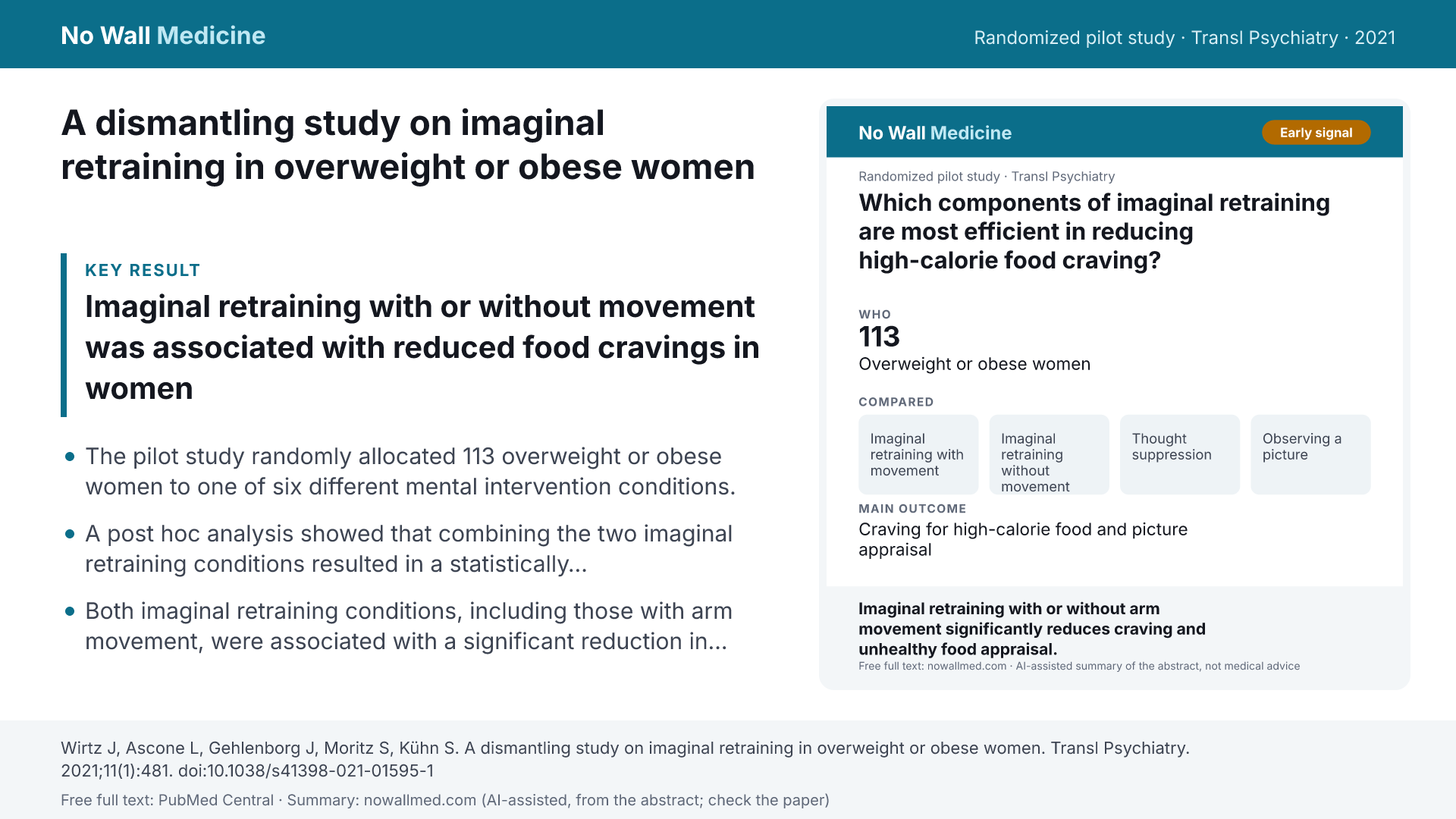
Imaginal retraining with or without movement was associated with reduced food cravings in women
A dismantling study on imaginal retraining in overweight or obese women
Randomized pilot studyEarly signal
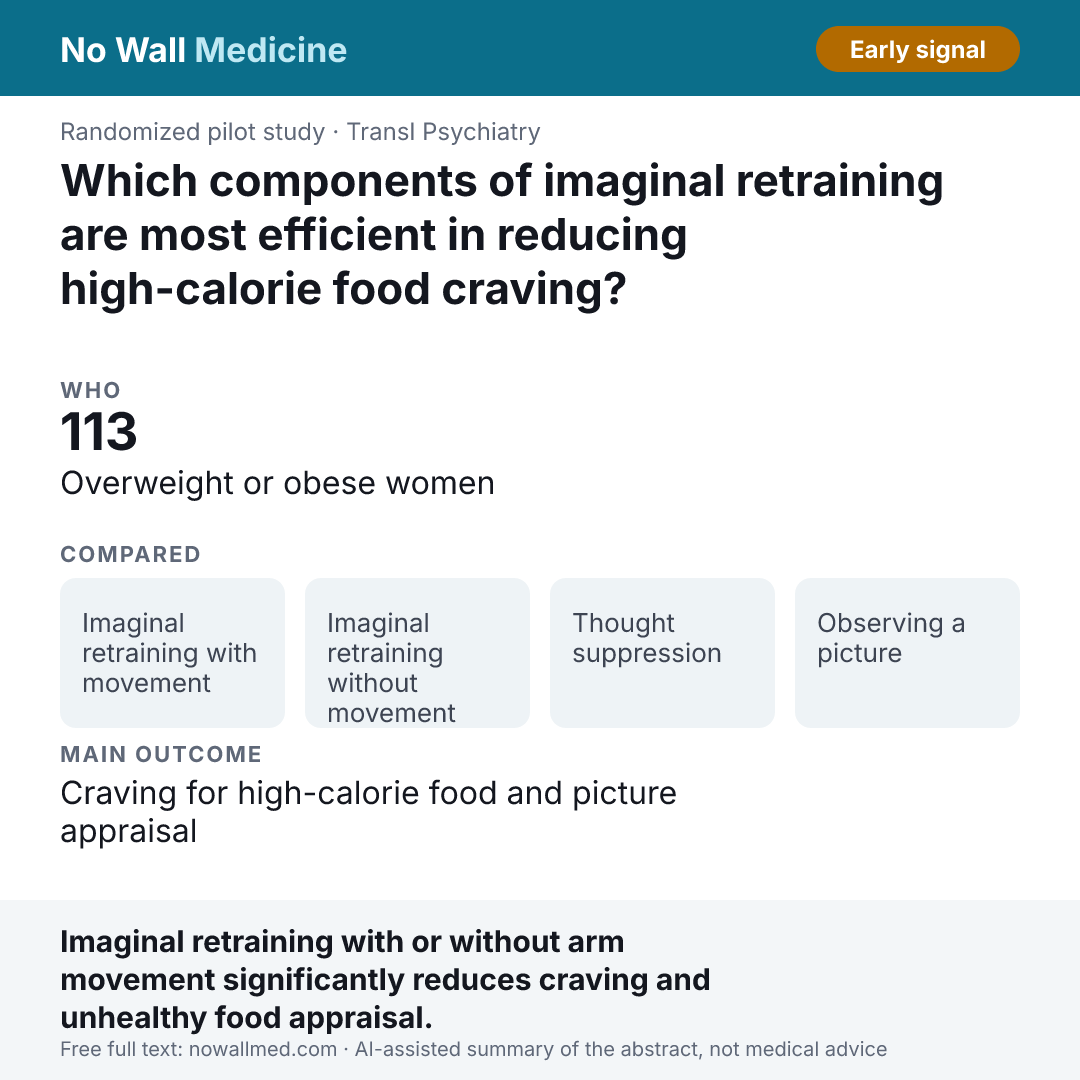
Which components of imaginal retraining are most efficient in reducing high-calorie food craving?
Who
113
Overweight or obese women
Compared
Imaginal retraining with movement
Imaginal retraining without movement
Thought suppression
Observing a picture
Main outcome
Craving for high-calorie food and picture appraisal
Bottom line: Imaginal retraining with or without arm movement significantly reduces craving and unhealthy food appraisal.
Limitation: Future studies should repeat the experiment in situations of high craving.
Transl Psychiatry · 2021-09-17 · Save PNG
Clinical question: Which components of imaginal retraining are most efficient in reducing high-calorie food craving?
Key points
- The pilot study randomly allocated 113 overweight or obese women to one of six different mental intervention conditions.
- A post hoc analysis showed that combining the two imaginal retraining conditions resulted in a statistically significant reduction in craving for high-calorie food.
- Both imaginal retraining conditions, including those with arm movement, were associated with a significant reduction in how pleasant unhealthy food pictures were rated.
Limitation the authors note: The authors noted that future studies should repeat the experiment in situations of high craving and allow for a personalized selection of stimuli.
Headline and key points written with AI from the paper’s abstract, with every number checked against it. Read the paper before relying on them.
Was this summary helpful?
Subject terms
Headline, design, result, key points, caveat and citation as plain text.
Cite this article
Wirtz J, Ascone L, Gehlenborg J, Moritz S, Kühn S. A dismantling study on imaginal retraining in overweight or obese women. Transl Psychiatry. 2021. doi:10.1038/s41398-021-01595-1
Spotted a mistake? Suggest a correction