A dismantling study on imaginal retraining in overweight or obese women
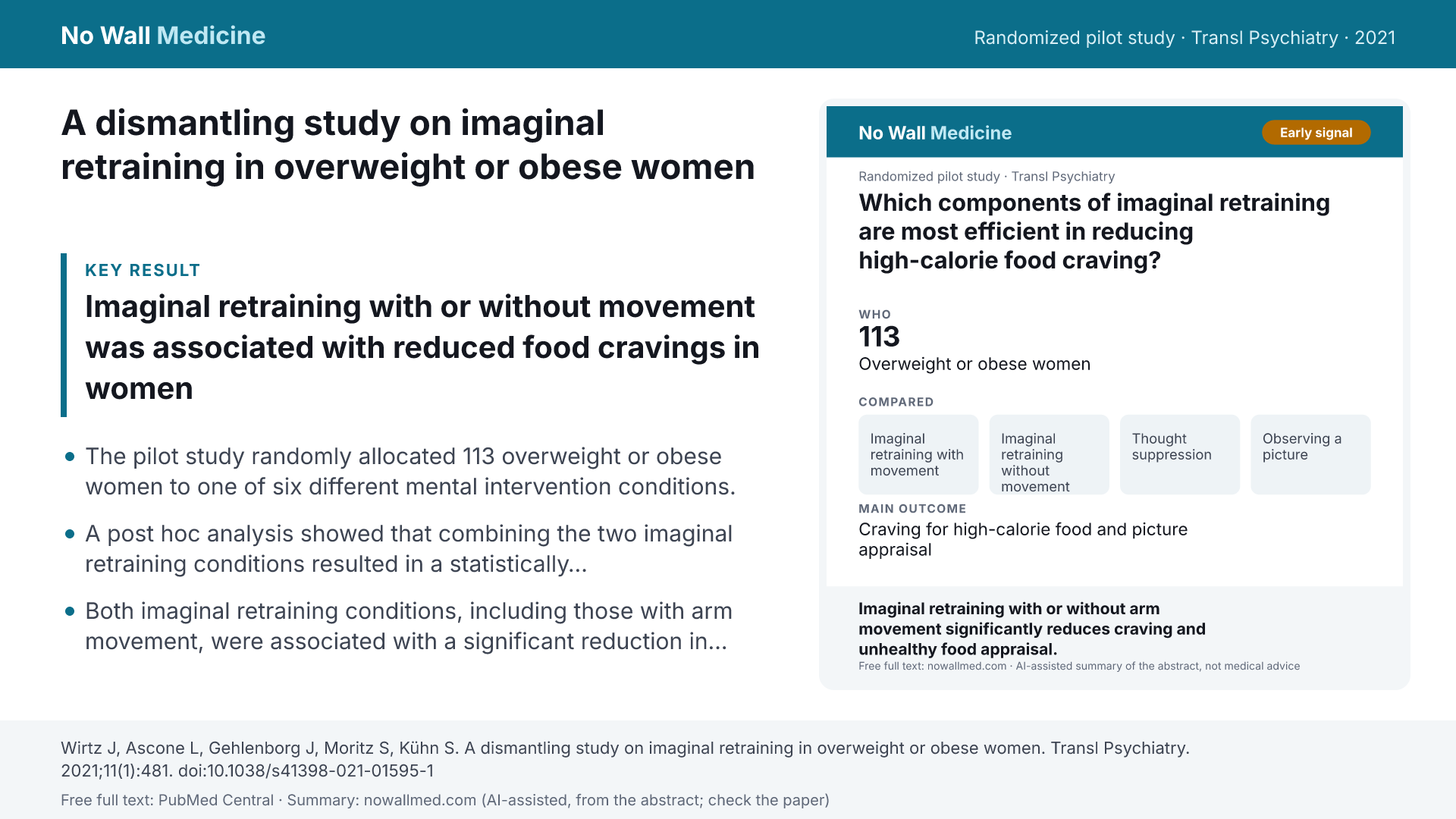
Key result: Imaginal retraining with or without movement was associated with reduced food cravings in women
Randomized pilot studyEarly signal
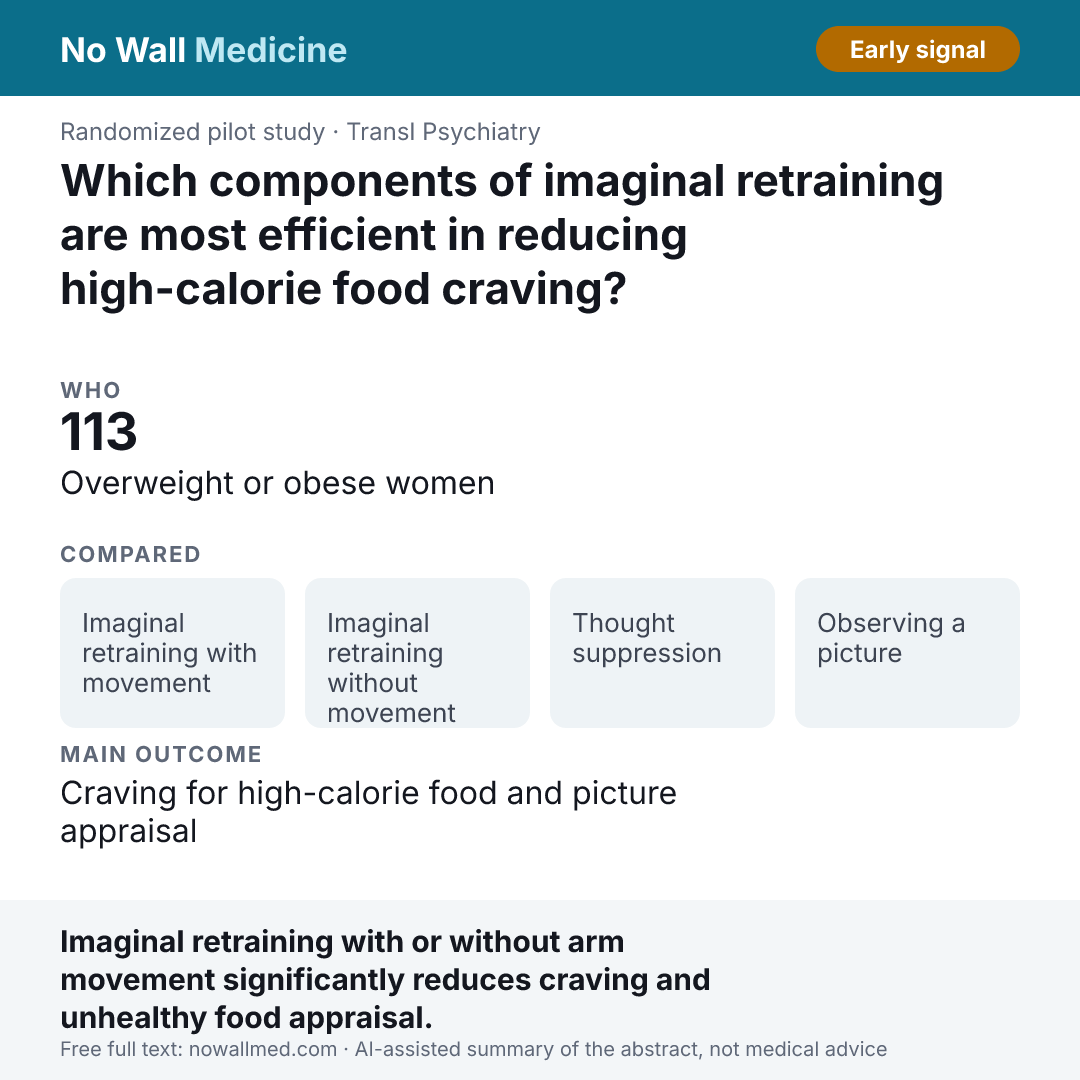
Which components of imaginal retraining are most efficient in reducing high-calorie food craving?
Who
113
Overweight or obese women
Compared
Imaginal retraining with movement
Imaginal retraining without movement
Thought suppression
Observing a picture
Main outcome
Craving for high-calorie food and picture appraisal
Bottom line: Imaginal retraining with or without arm movement significantly reduces craving and unhealthy food appraisal.
Limitation: Future studies should repeat the experiment in situations of high craving.
Transl Psychiatry · 2021-09-17 · Save PNG
Key points
- The pilot study randomly allocated 113 overweight or obese women to one of six different mental intervention conditions.
- A post hoc analysis showed that combining the two imaginal retraining conditions resulted in a statistically significant reduction in craving for high-calorie food.
- Both imaginal retraining conditions, including those with arm movement, were associated with a significant reduction in how pleasant unhealthy food pictures were rated.
Limitation the authors note: The authors noted that future studies should repeat the experiment in situations of high craving and allow for a personalized selection of stimuli.
Discussion prompts
- Would these patients look like yours? Who was left out?
- Is the main outcome one that matters to patients?
- Is the difference large enough to change what you do?
Cite: Wirtz J, Ascone L, Gehlenborg J, Moritz S, Kühn S. A dismantling study on imaginal retraining in overweight or obese women. Transl Psychiatry. 2021. doi:10.1038/s41398-021-01595-1
Free full text: PubMed Central · Summary and visual abstract: nowallmed.com/a/a-dismantling-study-on-imaginal-retraining-in-overweight-or-obese-1qhdtfk/ (AI-assisted from the abstract; check the paper before relying on it).