Fasting-mimicking diet reduces liver fat and inflammation in people with type 2 diabetes
A fasting-mimicking diet programme reduces liver fat and liver inflammation/fibrosis measured by magnetic resonance imaging in patients with type 2 diabetes
Randomised, controlled, assessor-blinded trialBenefit found
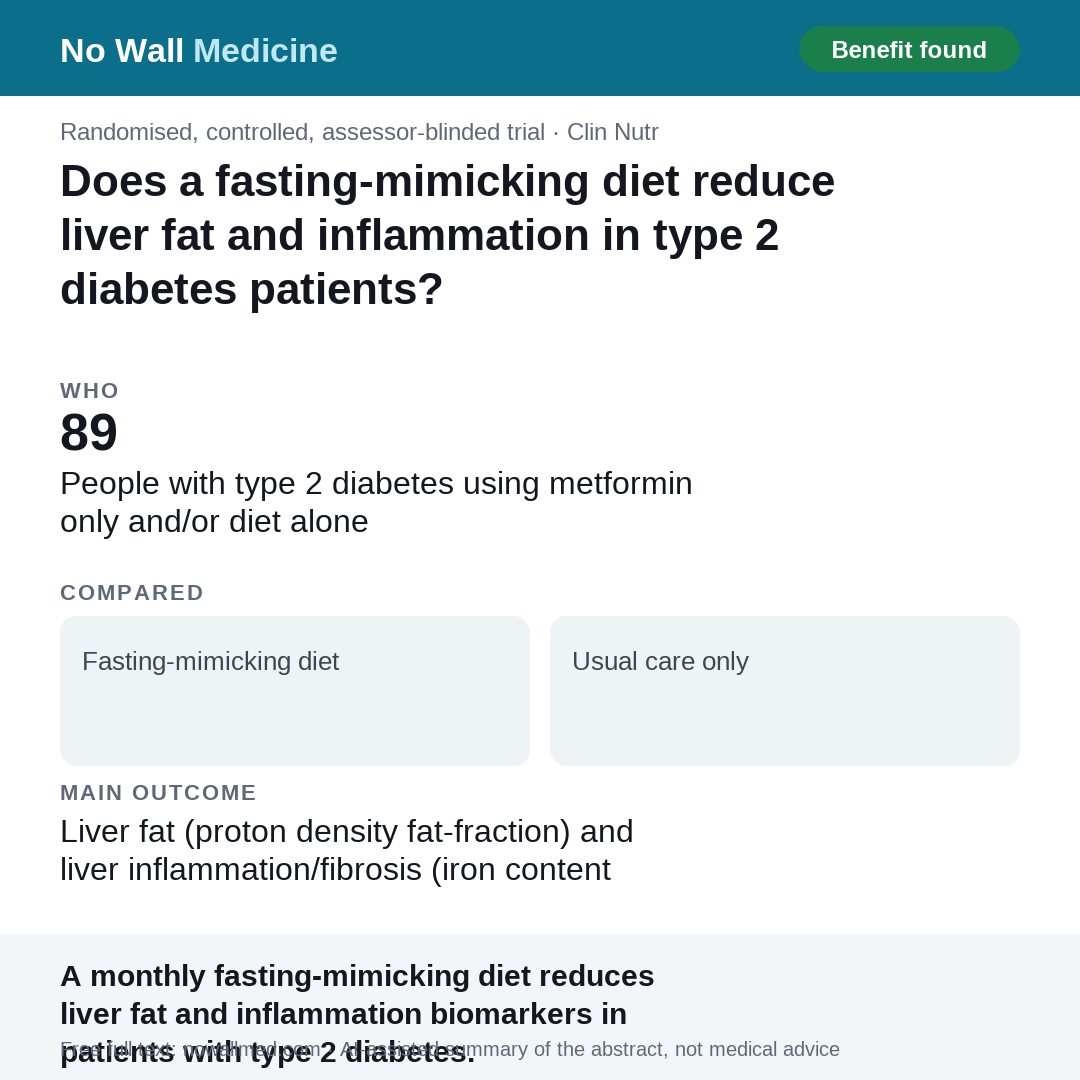
Does a fasting-mimicking diet reduce liver fat and inflammation in type 2 diabetes patients?
Who
89
People with type 2 diabetes using metformin only and/or diet alone
Compared
Fasting-mimicking diet
Usual care only
Main outcome
Liver fat (proton density fat-fraction) and liver inflammation/fibrosis (iron content corrected T1)
Result: -2.8 %, 95 % CI -4.7 to -0.8 for PDFF; -29.9 ms, 95 % CI -51.8 to -8.0 for cT1
Bottom line: A monthly fasting-mimicking diet reduces liver fat and inflammation biomarkers in patients with type 2 diabetes.
Clin Nutr · 2025-02-18Download image
Clinical question: Does a fasting-mimicking diet reduce liver fat and inflammation in type 2 diabetes patients?
Why it matters: It was unknown if adding a fasting-mimicking diet to usual care could reduce liver fat and inflammation or fibrosis in patients with type 2 diabetes.
Key points
- The study followed 89 participants with type 2 diabetes who were randomized to receive either a fasting-mimicking diet for five consecutive days monthly or usual care for 12 months.
- At 12 months, the fasting-mimicking diet group showed a -2.8% change in proton density fat-fraction, a measure of liver fat, and a -29.9 ms change in iron content corrected T1, a measure of liver inflammation or fibrosis.
- In combined analysis, every 1% decrease in liver fat was associated with a 0.75 mmol/mol decrease in HbA1c and a 0.52 kg decrease in weight.
Headline and key points written with AI from the paper’s abstract, with every number checked against it. Read the paper before relying on them.
Was this summary helpful?
Subject terms
Cite this article
van den Burg EL, Schoonakker MP, van Peet PG, le Cessie S, Numans ME, Pijl H. A fasting-mimicking diet programme reduces liver fat and liver inflammation/fibrosis measured by magnetic resonance imaging in patients with type 2 diabetes. Clin Nutr. 2025. doi:10.1016/j.clnu.2025.02.017
Spotted a mistake? Suggest a correction
Top studies every Monday
The week’s key trials and guidelines in your specialties, plus any topics you follow. By email, free.
Get the weekly digest