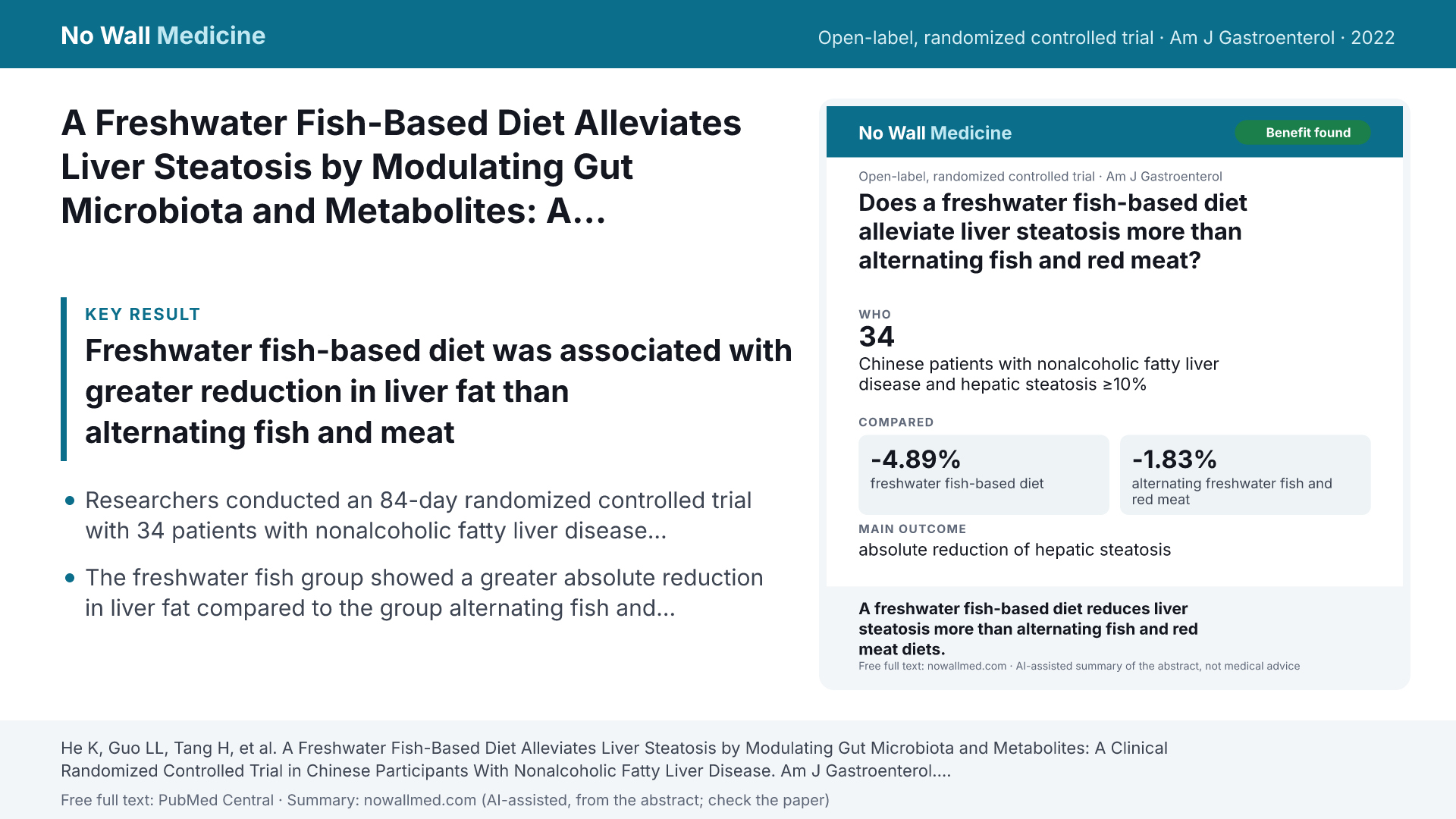
Freshwater fish-based diet was associated with greater reduction in liver fat than alternating fish and meat
A Freshwater Fish-Based Diet Alleviates Liver Steatosis by Modulating Gut Microbiota and Metabolites: A Clinical Randomized Controlled Trial in Chinese Participants With Nonalcoholic Fatty Liver Disease
Open-label, randomized controlled trialBenefit found
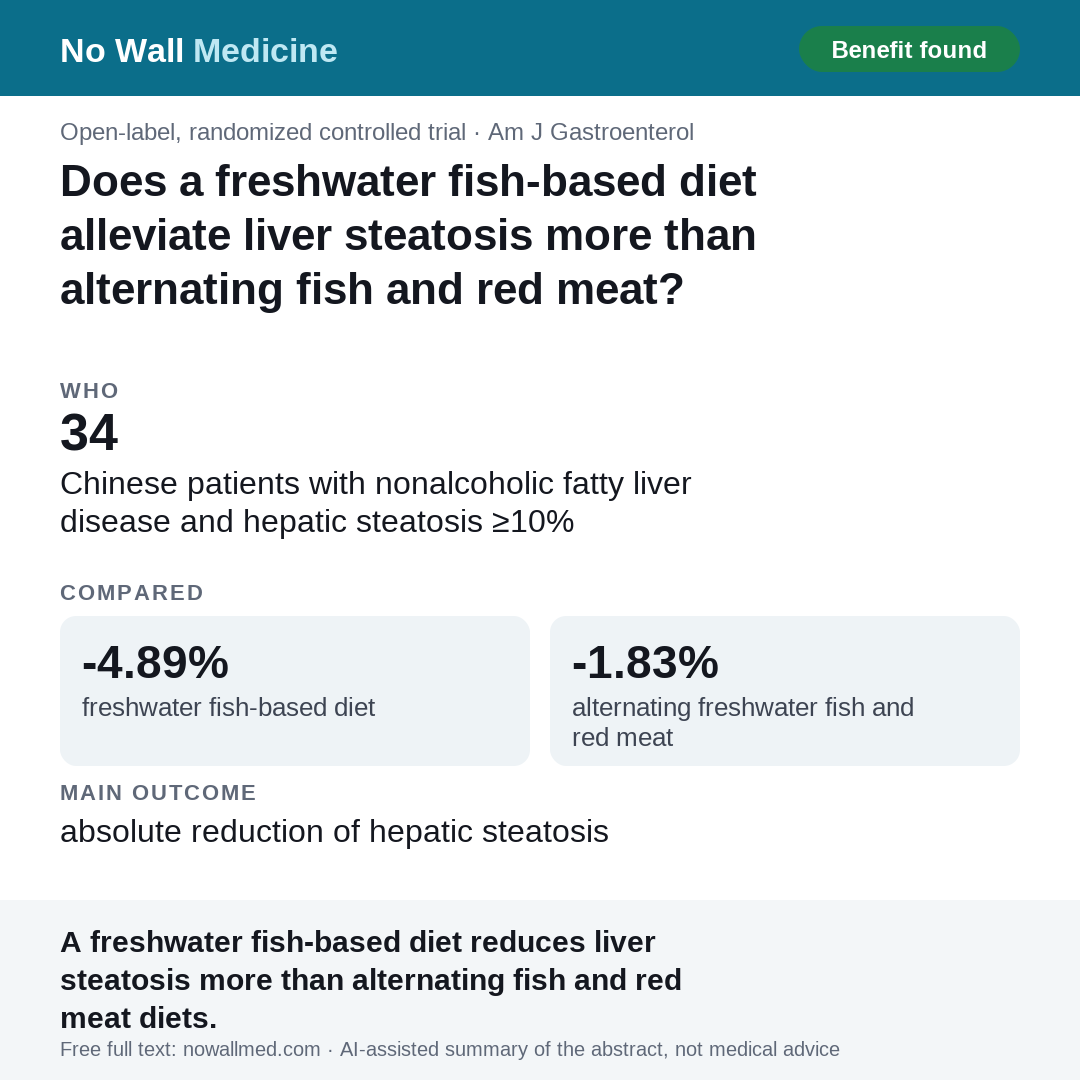
Does a freshwater fish-based diet alleviate liver steatosis more than alternating fish and red meat?
Who
34
Chinese patients with nonalcoholic fatty liver disease and hepatic steatosis ≥10%
Compared
-4.89%freshwater fish-based diet
-1.83%alternating freshwater fish and red meat
Main outcome
absolute reduction of hepatic steatosis
Bottom line: A freshwater fish-based diet reduces liver steatosis more than alternating fish and red meat diets.
Am J Gastroenterol · 2022-06-17Download image
Clinical question: Does a freshwater fish-based diet alleviate liver steatosis more than alternating fish and red meat?
Why it matters: It is unknown how a diet based on freshwater fish compares to a diet alternating fish and red meat for managing liver fat in patients with nonalcoholic fatty liver disease.
Key points
- Researchers conducted an 84-day randomized controlled trial with 34 patients with nonalcoholic fatty liver disease (fatty liver) having hepatic steatosis of at least 10%.
- The freshwater fish group showed a greater absolute reduction in liver fat compared to the group alternating fish and red meat (-4.89% vs -1.83%, P = 0.032).
- The fish-only group showed greater changes in gut bacteria, short-chain fatty acids, and unconjugated bile acids compared to the alternating diet group.
Headline and key points written with AI from the paper’s abstract, with every number checked against it. Read the paper before relying on them.
Was this summary helpful?
Subject terms
Cite this article
He K, Guo LL, Tang H, et al. A Freshwater Fish-Based Diet Alleviates Liver Steatosis by Modulating Gut Microbiota and Metabolites: A Clinical Randomized Controlled Trial in Chinese Participants With Nonalcoholic Fatty Liver Disease. Am J Gastroenterol. 2022. doi:10.14309/ajg.0000000000001885
Spotted a mistake? Suggest a correction