High-resolution microendoscopy improves efficiency in screening and surveillance for esophageal squamous cell neoplasia
A High-Resolution Microendoscope Improves Esophageal Cancer Screening and Surveillance: Implications for Underserved Global Settings Based on an International Randomized Controlled Trial
International randomized controlled trialBenefit found
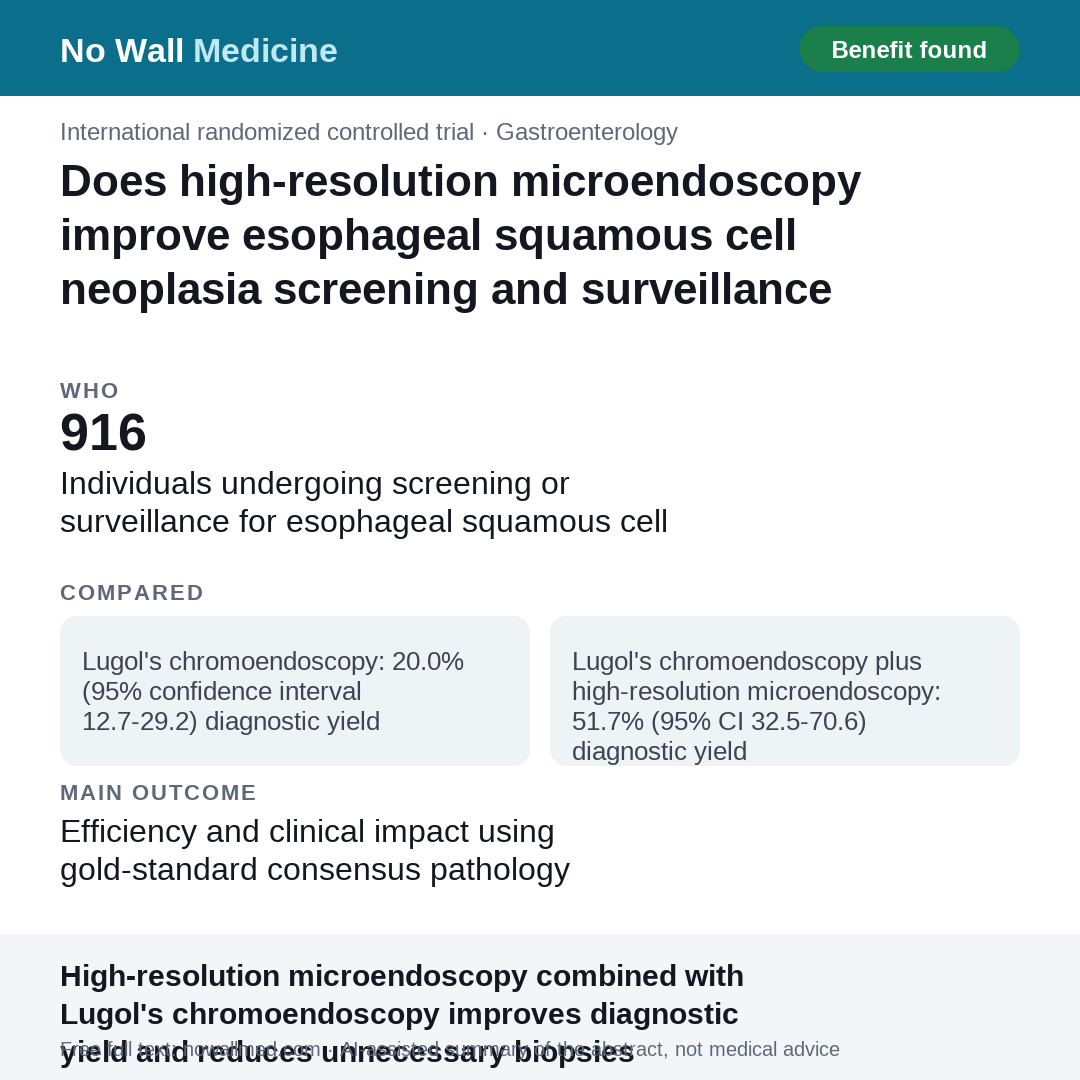
Does high-resolution microendoscopy improve esophageal squamous cell neoplasia screening and surveillance efficiency?
Who
916
Individuals undergoing screening or surveillance for esophageal squamous cell neoplasia · China and the United States
Compared
Lugol's chromoendoscopy: 20.0% (95% confidence interval 12.7-29.2) diagnostic yield
Lugol's chromoendoscopy plus high-resolution microendoscopy: 51.7% (95% CI 32.5-70.6) diagnostic yield
Main outcome
Efficiency and clinical impact using gold-standard consensus pathology
Bottom line: High-resolution microendoscopy combined with Lugol's chromoendoscopy improves diagnostic yield and reduces unnecessary biopsies during screening.
Limitation: Six participants had neoplasia missed by the endoscopist on high-resolution microendoscopy.
Gastroenterology · 2024-10-29Download image
Clinical question: Does high-resolution microendoscopy improve esophageal squamous cell neoplasia screening and surveillance efficiency?
Why it matters: Lugol's chromoendoscopy, a standard method for detecting esophageal squamous cell neoplasia, is limited by low specificity, which can lead to unnecessary biopsies.
Key points
- The study randomized 859 participants in China and 36 in the United States to receive either Lugol's chromoendoscopy or Lugol's chromoendoscopy plus high-resolution microendoscopy.
- In the screening group, the diagnostic yield of biopsies increased from 20.0% to 51.7% when high-resolution microendoscopy was added to the standard care.
- The use of high-resolution microendoscopy was associated with 65.2% of biopsies potentially saved and 59.7% of participants potentially spared from any biopsy.
Headline and key points written with AI from the paper’s abstract, with every number checked against it. Read the paper before relying on them.
Was this summary helpful?
Subject terms
Cite this article
Tan MC, Li Z, Patel KK, Zhang F, Yu X, Wang X. A High-Resolution Microendoscope Improves Esophageal Cancer Screening and Surveillance: Implications for Underserved Global Settings Based on an International Randomized Controlled Trial. Gastroenterology. 2024. doi:10.1053/j.gastro.2024.10.025
Spotted a mistake? Suggest a correction
Top studies every Monday
The week’s key trials and guidelines in your specialties, plus any topics you follow. By email, free.
Get the weekly digest