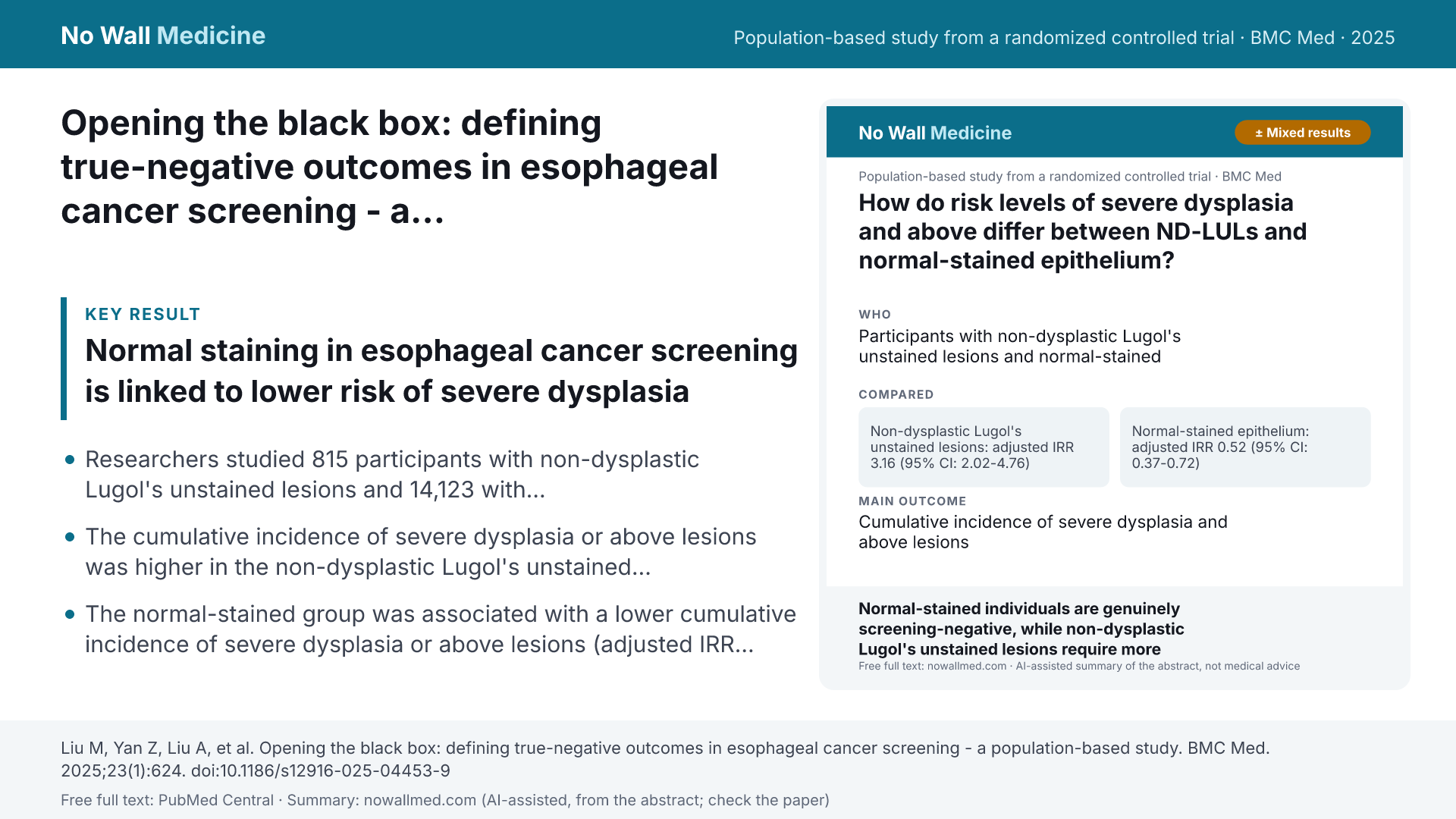
Normal staining in esophageal cancer screening is linked to lower risk of severe dysplasia
Opening the black box: defining true-negative outcomes in esophageal cancer screening - a population-based study
Population-based study from a randomized controlled trialMixed results
How do risk levels of severe dysplasia and above differ between ND-LULs and normal-stained epithelium?
Who
Participants with non-dysplastic Lugol's unstained lesions and normal-stained epithelium · Community-based
Compared
Non-dysplastic Lugol's unstained lesions: adjusted IRR 3.16 (95% CI: 2.02-4.76)
Normal-stained epithelium: adjusted IRR 0.52 (95% CI: 0.37-0.72)
Main outcome
Cumulative incidence of severe dysplasia and above lesions
Result: adjusted IRR 3.16 (95% CI: 2.02-4.76) for ND-LULs; adjusted IRR 0.52 (95% CI: 0.37-0.72) for normal-stained
Bottom line: Normal-stained individuals are genuinely screening-negative, while non-dysplastic Lugol's unstained lesions require more frequent re-screening.
BMC Med · 2025-11-07Download image
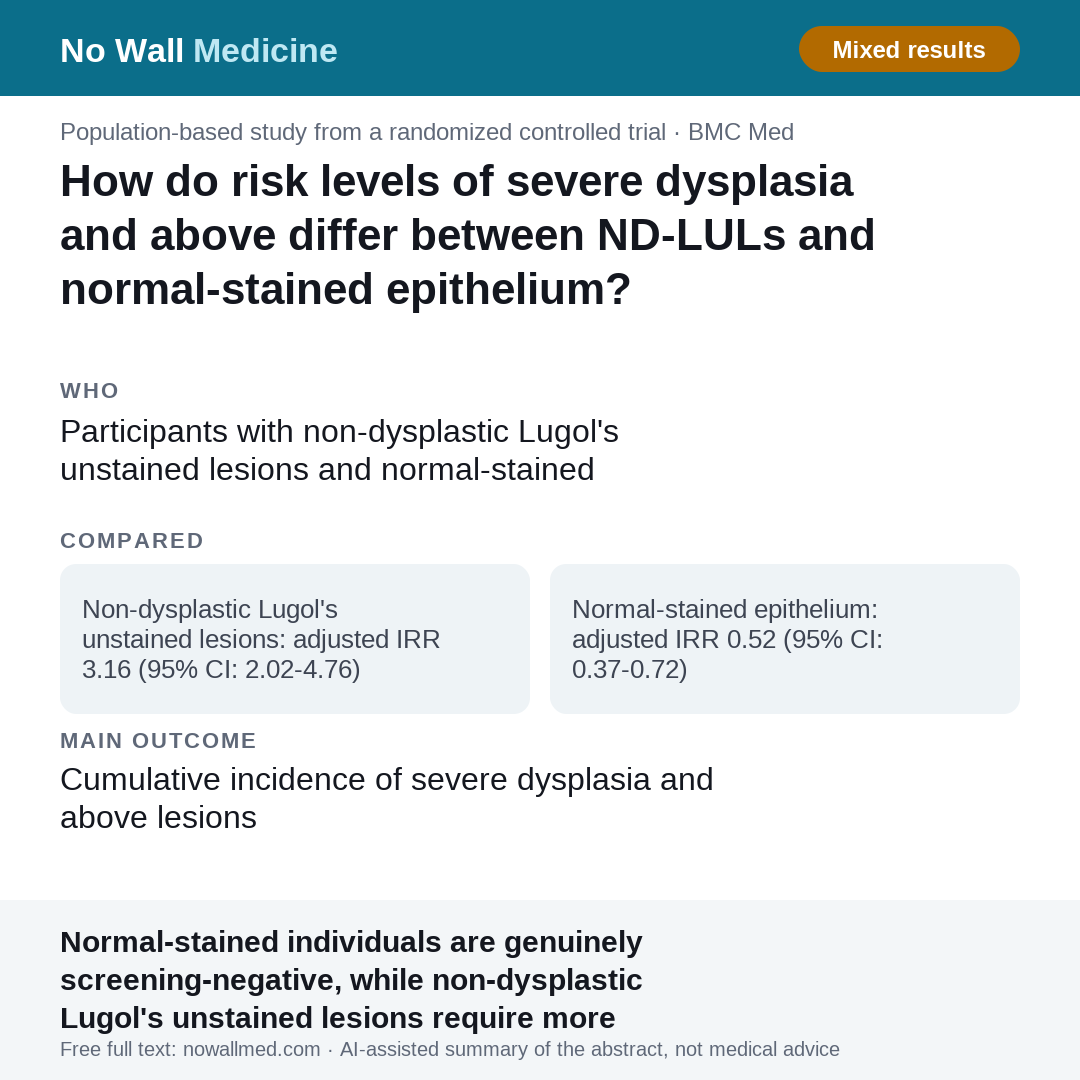
Clinical question: How do risk levels of severe dysplasia and above differ between ND-LULs and normal-stained epithelium?
Why it matters: Current definitions of negative results in esophageal cancer screening may overlook different risk levels between individuals with non-dysplastic Lugol's unstained lesions and those with normal-stained epithelium.
Key points
- Researchers studied 815 participants with non-dysplastic Lugol's unstained lesions and 14,123 with normal-stained epithelium over 10 years.
- The cumulative incidence of severe dysplasia or above lesions was higher in the non-dysplastic Lugol's unstained lesions group (adjusted IRR = 3.16, 95% CI: 2.02-4.76) compared to controls.
- The normal-stained group was associated with a lower cumulative incidence of severe dysplasia or above lesions (adjusted IRR = 0.52, 95% CI: 0.37-0.72) compared to controls.
Headline and key points written with AI from the paper’s abstract, with every number checked against it. Read the paper before relying on them.
Was this summary helpful?
Subject terms
Cite this article
Liu M, Yan Z, Liu A, et al. Opening the black box: defining true-negative outcomes in esophageal cancer screening - a population-based study. BMC Med. 2025. doi:10.1186/s12916-025-04453-9
Spotted a mistake? Suggest a correction