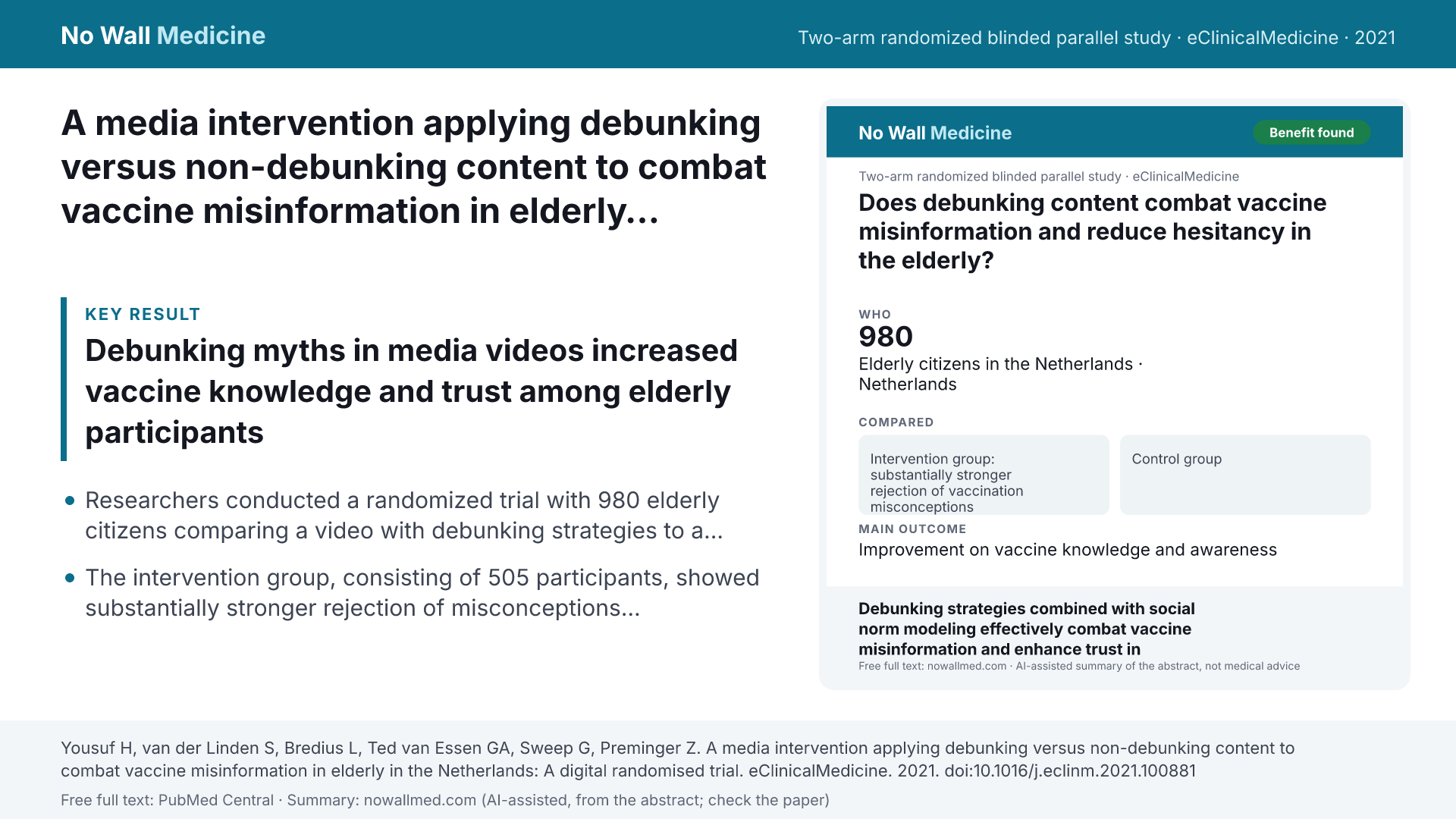
Debunking myths in media videos increased vaccine knowledge and trust among elderly participants
A media intervention applying debunking versus non-debunking content to combat vaccine misinformation in elderly in the Netherlands: A digital randomised trial
Two-arm randomized blinded parallel studyBenefit found
Does debunking content combat vaccine misinformation and reduce hesitancy in the elderly?
Who
980
Elderly citizens in the Netherlands · Netherlands
Compared
Intervention group: substantially stronger rejection of vaccination misconceptions
Control group
Main outcome
Improvement on vaccine knowledge and awareness
Bottom line: Debunking strategies combined with social norm modeling effectively combat vaccine misinformation and enhance trust in government among the elderly.
Funded by: Dutch Influenza Foundation
eClinicalMedicine · 2021-05-15Download image
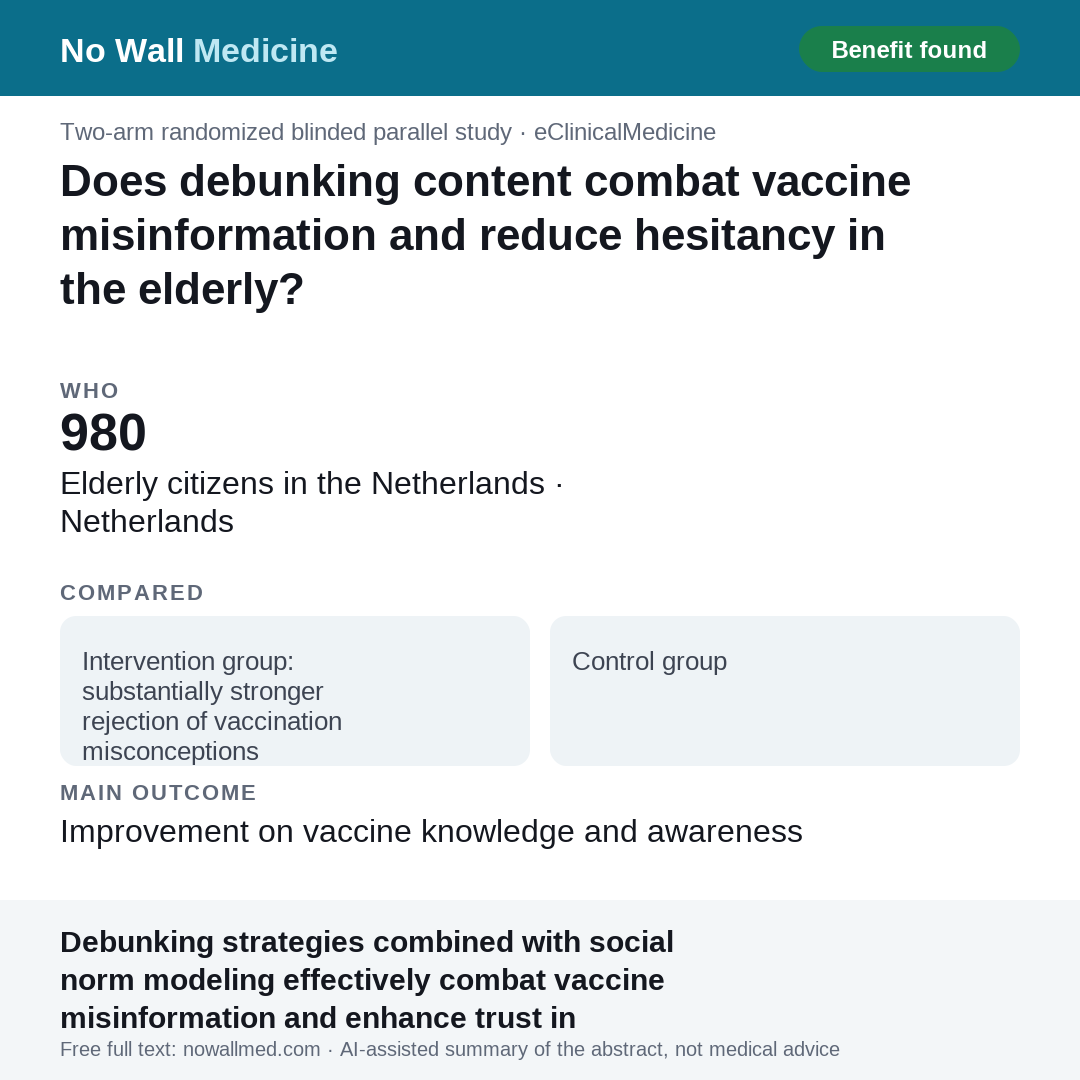
Clinical question: Does debunking content combat vaccine misinformation and reduce hesitancy in the elderly?
Why it matters: It was unknown if applying debunking strategies to media content could effectively combat vaccine misinformation and reduce hesitancy in elderly populations.
Key points
- Researchers conducted a randomized trial with 980 elderly citizens comparing a video with debunking strategies to a video containing only vaccine information and social norms.
- The intervention group, consisting of 505 participants, showed substantially stronger rejection of misconceptions regarding autism, immune system weakening, and influenza vaccine efficacy.
- Exposure to the debunking intervention was also associated with enhanced trust in the government.
Headline and key points written with AI from the paper’s abstract, with every number checked against it. Read the paper before relying on them.
Was this summary helpful?
Cite this article
Yousuf H, van der Linden S, Bredius L, Ted van Essen GA, Sweep G, Preminger Z. A media intervention applying debunking versus non-debunking content to combat vaccine misinformation in elderly in the Netherlands: A digital randomised trial. eClinicalMedicine. 2021. doi:10.1016/j.eclinm.2021.100881
Spotted a mistake? Suggest a correction