Machine learning on MRI shows variable accuracy for predicting breast cancer spread to lymph nodes
A meta-analysis of the diagnostic performance of machine learning-based MRI in the prediction of axillary lymph node metastasis in breast cancer patients
Why it matters: The diagnostic values of machine learning-based MRI for classifying axillary lymph node metastasis in breast cancer patients have been variable.
Key points
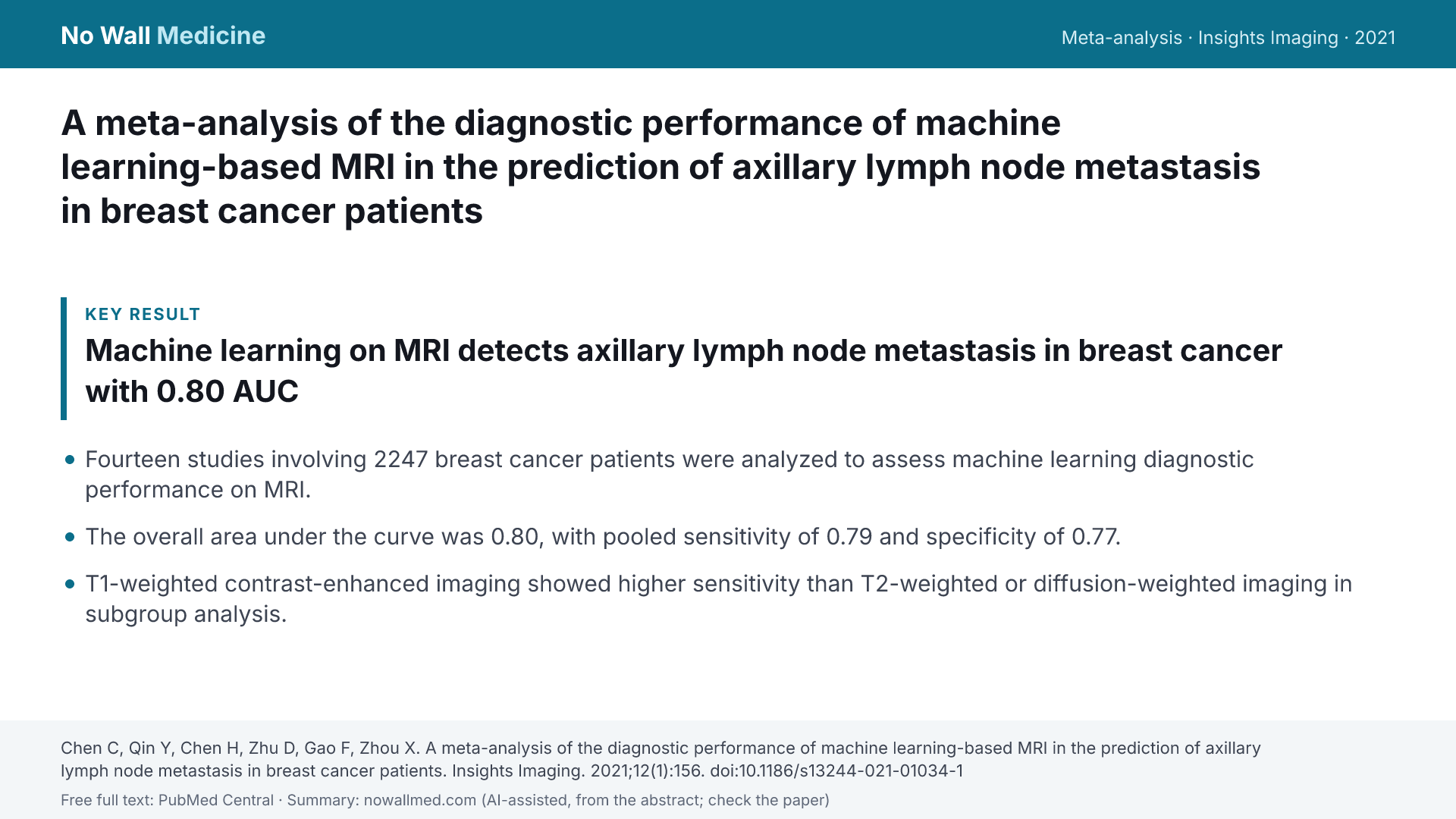
- Researchers analyzed 14 studies involving 2247 breast cancer patients to evaluate machine learning on magnetic resonance imaging (MRI) for detecting axillary lymph node metastasis.
- The pooled sensitivity was 0.79 and specificity was 0.77, with an overall area under the curve of 0.80 and a negative predictive value of 0.83.
- T1-weighted contrast-enhanced imaging yielded a higher sensitivity of 0.80 compared to 0.67 for T2-weighted fat-suppressed imaging and 0.76 for diffusion-weighted imaging.
Headline and key points written with AI from the paper’s abstract, with every number checked against it. Read the paper before relying on them.
Was this summary helpful?
Cite this article
Chen C, Qin Y, Chen H, Zhu D, Gao F, Zhou X. A meta-analysis of the diagnostic performance of machine learning-based MRI in the prediction of axillary lymph node metastasis in breast cancer patients. Insights Imaging. 2021. doi:10.1186/s13244-021-01034-1
Spotted a mistake? Suggest a correction