Viewing educational materials in a mobile app was linked to better perinatal well-being
A Mobile App-Based Intervention (Parentbot-a Digital Healthcare Assistant) for Parents: Secondary Analysis of a Randomized Controlled Trial
Secondary analysis of a randomized controlled trialBenefit found
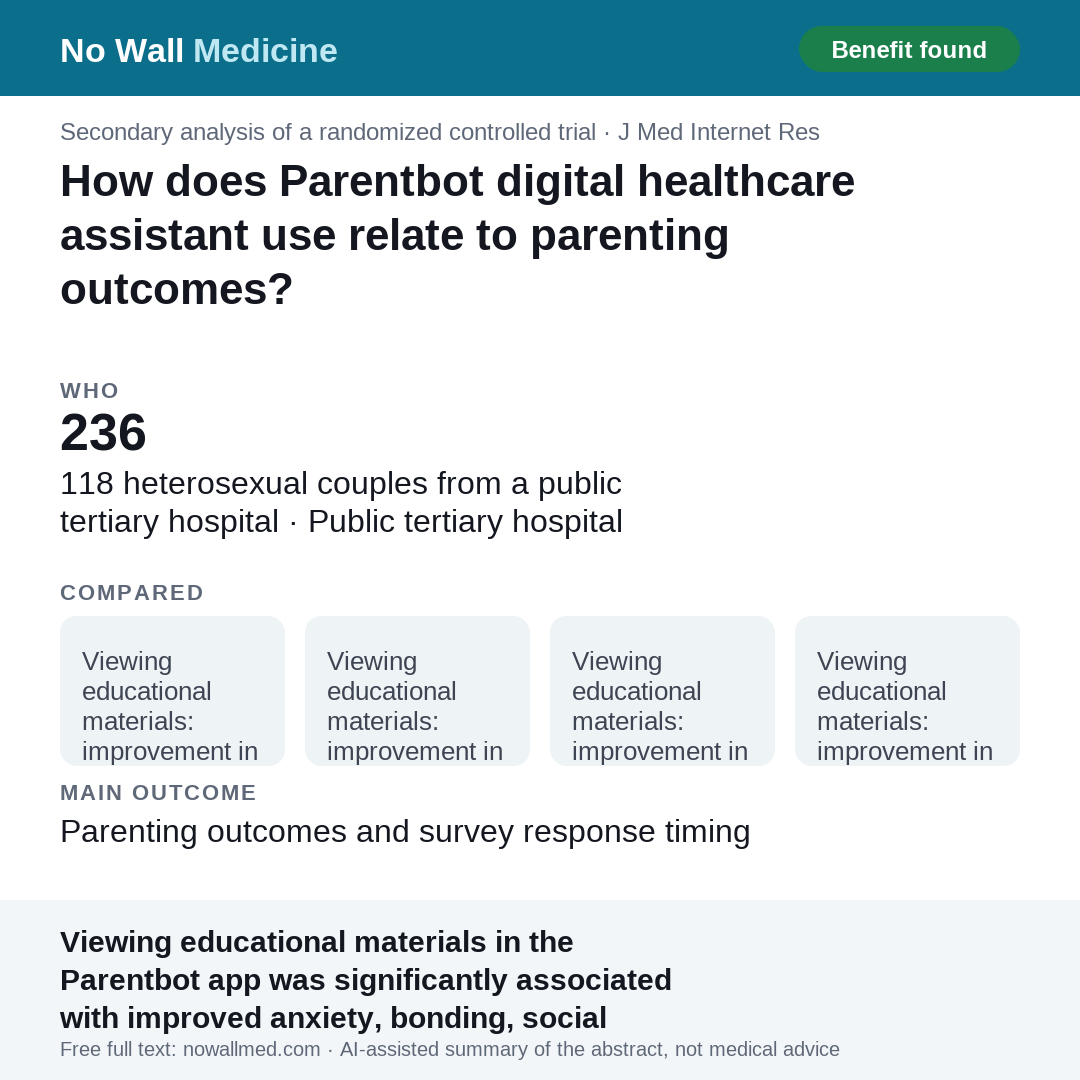
How does Parentbot digital healthcare assistant use relate to parenting outcomes?
Who
236
118 heterosexual couples from a public tertiary hospital · Public tertiary hospital in Singapore
Compared
Viewing educational materials: improvement in anxiety β=-0.48 (95% CI -0.94 to -0.009)
Viewing educational materials: improvement in parent-child bonding β=-0.10 (95% CI -0.19 to -0.01)
Viewing educational materials: improvement in social support β=0.31 (95% CI 0.08-0.54)
Viewing educational materials: improvement in parenting satisfaction β=0.57 (95% CI 0.07-1.07)
Main outcome
Parenting outcomes and survey response timing
Bottom line: Viewing educational materials in the Parentbot app was significantly associated with improved anxiety, bonding, social support, and parenting satisfaction.
Limitation: Other app features like poster activities and forum posts had limited effect on well-being.
J Med Internet Res · 2025-04-17Download image
Clinical question: How does Parentbot digital healthcare assistant use relate to parenting outcomes?
Why it matters: Developing mobile app interventions is resource intensive, so it is important to evaluate which specific components parents use and appreciate.
Key points
- Researchers analyzed 236 participants, consisting of 118 mothers and 118 fathers, from a randomized controlled trial in Singapore.
- Viewing educational materials in the Parentbot digital healthcare assistant was associated with improvements in anxiety, parent-child bonding, social support, and parenting satisfaction at 1 month postpartum.
- Other app features, including forum posts and reflection exercises, were found to have a limited effect on improving parental well-being.
Headline and key points written with AI from the paper’s abstract, with every number checked against it. Read the paper before relying on them.
Was this summary helpful?
Subject terms
Cite this article
Chua JYX, Choolani M, Chee CYI, Yi H, Lalor JG, Chong YS. A Mobile App-Based Intervention (Parentbot-a Digital Healthcare Assistant) for Parents: Secondary Analysis of a Randomized Controlled Trial. J Med Internet Res. 2025. doi:10.2196/64882
Spotted a mistake? Suggest a correction
Top studies every Monday
The week’s key trials and guidelines in your specialties, plus any topics you follow. By email, free.
Get the weekly digest