Evaluating the Effectiveness of the Supportive Parenting App on Parental Outcomes: Randomized Controlled Trial
Randomized controlled trialMixed results
Is the Supportive Parenting App effective on parental outcomes during the perinatal period?
Who
400
200 couples (400 mothers and fathers) · 2 public health care institutions in Singapore
Compared
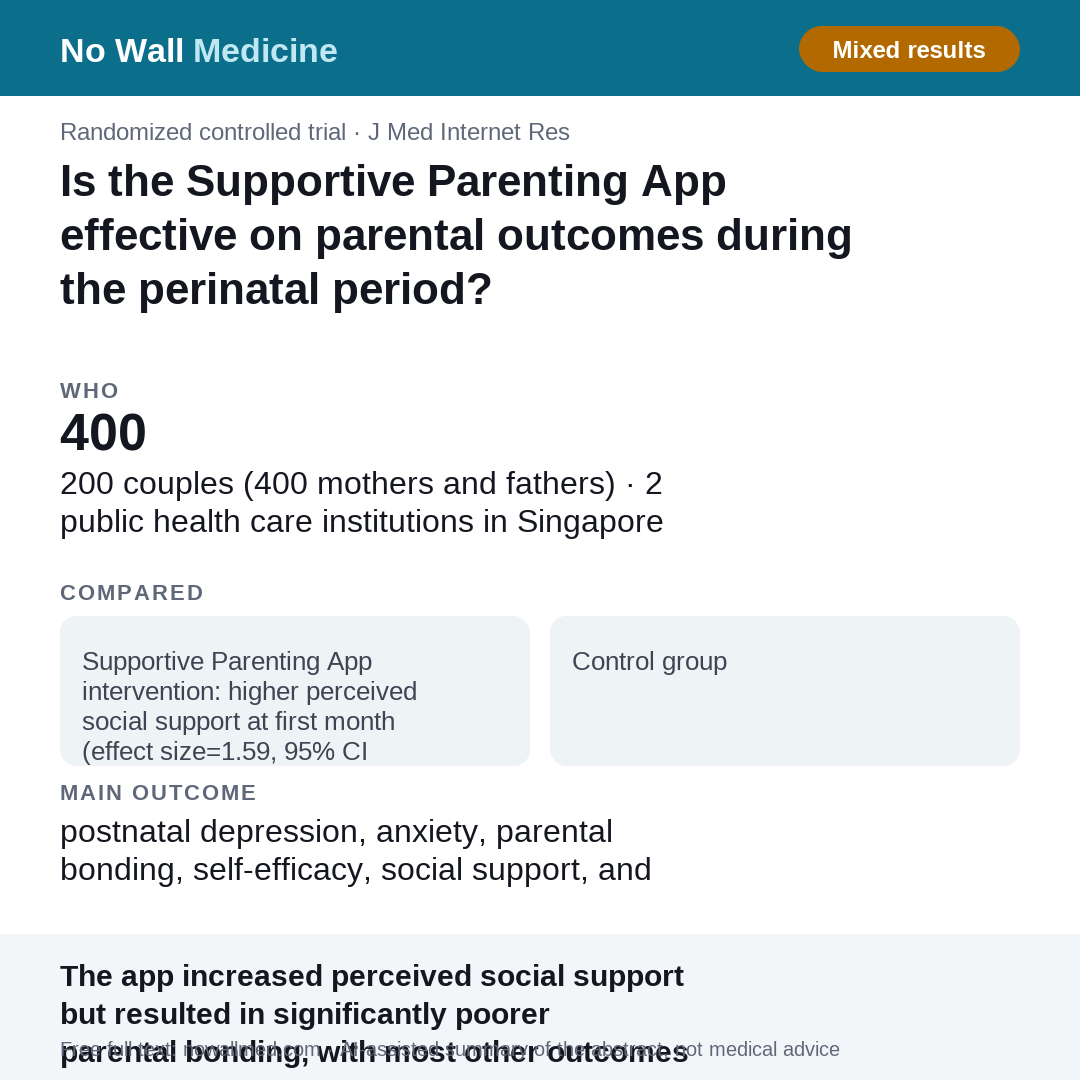
Supportive Parenting App intervention: higher perceived social support at first month (effect size=1.59, 95% CI 0.38-2.80)
Control group
Main outcome
postnatal depression, anxiety, parental bonding, self-efficacy, social support, and satisfaction
Bottom line: The app increased perceived social support but resulted in significantly poorer parental bonding, with most other outcomes showing no significant difference.
Limitation: The limited effectiveness may be because of the COVID-19 pandemic.
J Med Internet Res · 2023-01-16Download image
Clinical question: Is the Supportive Parenting App effective on parental outcomes during the perinatal period?
Abstract
Background
Adjusting to new or additional parenting responsibilities increases stress and affects parental well-being. Existing research has highlighted both parents' desire to receive more support. It has also been found that receiving sufficient social support enhances parenting outcomes. With the increasing popularity of mobile health apps, a Supportive Parenting App (SPA) intervention was developed to fulfill the support needs of parents during the perinatal period. Objective
This study aimed to examine the effectiveness of the SPA on parental outcomes during the perinatal period. Methods
A 2-group pretest and repeated posttest randomized controlled trial was conducted wherein 200 couples (N=400 mothers and fathers) were recruited from 2 public health care institutions in Singapore. Parents were randomly assigned to intervention (100/200, 50%) or control (100/200, 50%) groups. The SPA intervention consisted of a mobile app-based psychoeducation and peer support program to support parents from pregnancy to 6 months post partum. The outcome measures included postnatal depression, anxiety, parental bonding, parental self-efficacy, perceived social support, and parenting satisfaction. Data were collected at baseline (at >24 weeks of gestation-age of viability in Singapore) and at the first, second, fourth, sixth, ninth, and 12th month post partum. Linear mixed models were used to compare parental outcomes between the groups, and a linear mixed model for repeated measures was used to examine within-group changes. Results
Parents in the intervention group mostly showed better outcomes compared with those in the control group. Parents in the intervention group had higher perceived social support than those in the control group at the first (effect size=1.59, 95% CI 0.38-2.80; Cohen standardized effect size=1.31; P=.01), second (effect size=1.98, 95% CI 1.09-2.88; Cohen standardized effect size=2.21; P=.003), and fourth (effect size=2.57, 95% CI 1.62-3.51; Cohen standardized effect size=2.72; P=.048) months post partum. However, parents in the intervention group showed significantly poorer parental bonding (effect size=1.67, 95% CI 0.24-3.11; Cohen standardized effect size=1.16; P=.02). The other parental outcomes did not differ significantly between groups. The scores of mothers and fathers also differed significantly for all outcomes except parental self-efficacy. Conclusions
Parents in the intervention group generally fared better, especially regarding perceived social support. However, the lack of statistical significance in most outcomes showed the limited effectiveness of the SPA intervention, which may be because of the COVID-19 pandemic. Parental differences in outcome scores suggest that mothers and fathers have different support needs; therefore, interventions should be tailored accordingly. Further improvements and evaluations are needed to examine the effectiveness of the SPA intervention in enhancing parental outcomes. Despite statistically insignificant results, limitations should be considered to further improve mobile health app-based interventions such as SPA, as they could serve as reliable and convenient sources of support for parents. Trial registration
Clinicaltrails.gov NCT4706442; https://clinicaltrials.gov/ct2/show/NCT04706442.
Subject terms
Cite this article
Shorey S, Law E, Thilagamangai, Mathews J, Lim SH, Shi L. Evaluating the Effectiveness of the Supportive Parenting App on Parental Outcomes: Randomized Controlled Trial. J Med Internet Res. 2023. doi:10.2196/41859
Spotted a mistake? Suggest a correction
Top studies every Monday
The week’s key trials and guidelines in your specialties, plus any topics you follow. By email, free.
Get the weekly digest