A Multicentered Randomized Controlled Trial Comparing the Effectiveness of Pain Treatment Communication Tools in Emergency Department Patients With Back or Kidney Stone Pain
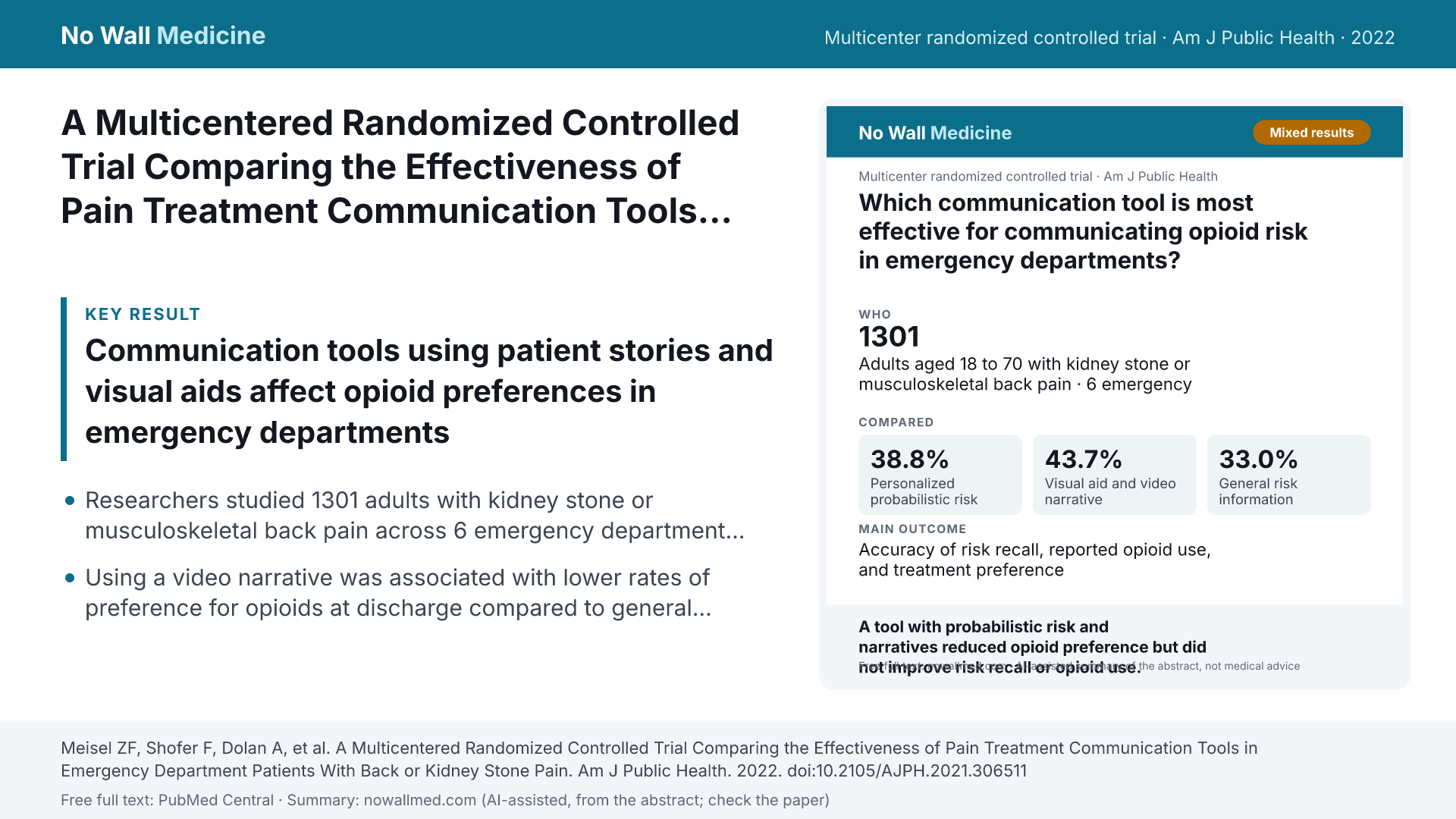
Key result: Communication tools using patient stories and visual aids affect opioid preferences in emergency departments
Multicenter randomized controlled trialMixed results
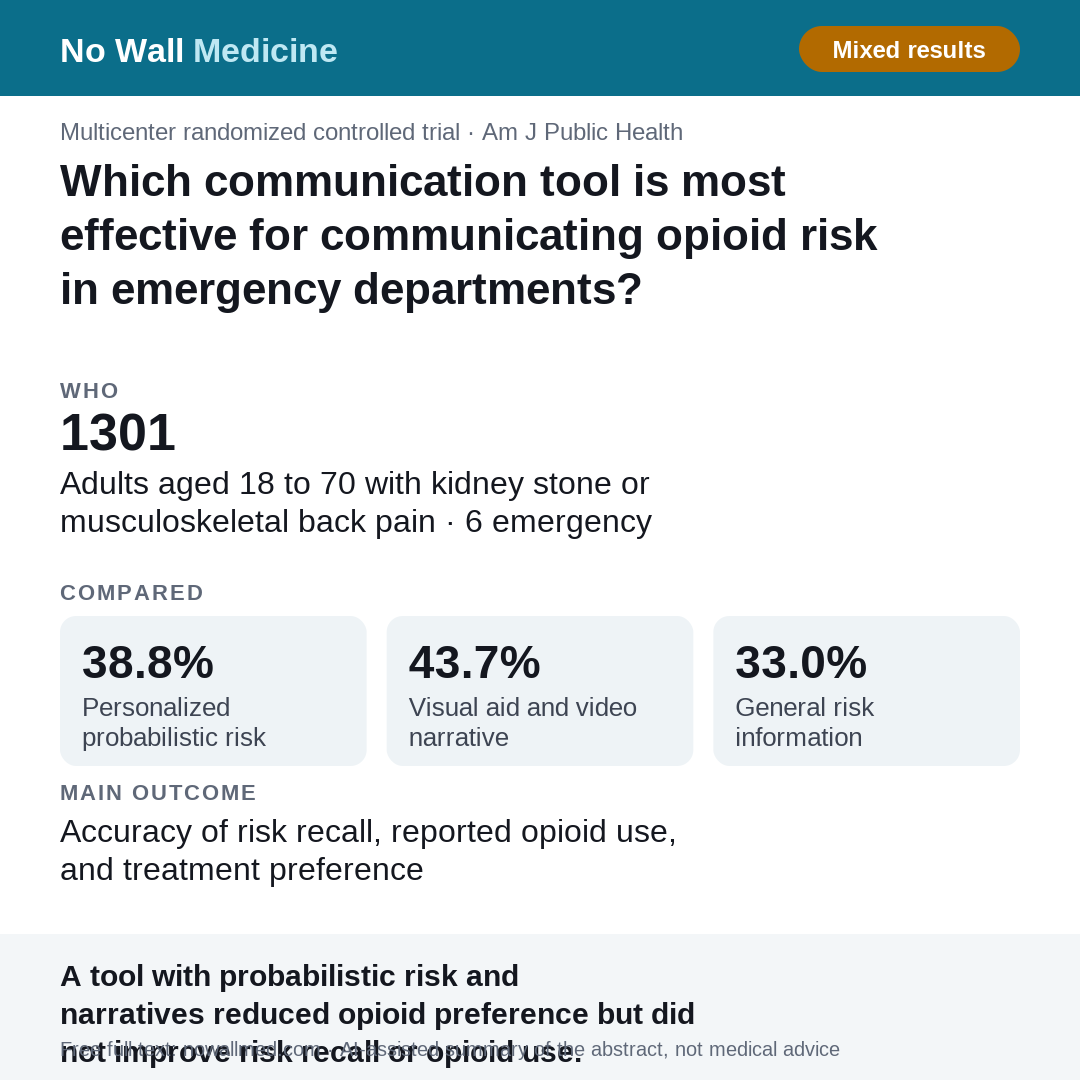
Which communication tool is most effective for communicating opioid risk in emergency departments?
Who
1301
Adults aged 18 to 70 with kidney stone or musculoskeletal back pain · 6 emergency department sites in the United States
Compared
38.8%Personalized probabilistic risk visual aid
43.7%Visual aid and video narrative
33.0%General risk information
Main outcome
Accuracy of risk recall, reported opioid use, and treatment preference
Result: difference 7.1%; 95% CI 0.64, 0.97
Bottom line: A tool with probabilistic risk and narratives reduced opioid preference but did not improve risk recall or opioid use.
Am J Public Health · 2022-02-10Download image
Key points
- Researchers studied 1301 adults with kidney stone or musculoskeletal back pain across 6 emergency department sites in the United States.
- Using a video narrative was associated with lower rates of preference for opioids at discharge compared to general risk information (25.9% vs 33.0%).
- There were no differences in risk recall at 14 days or reported opioid use at 14 days between the three communication groups.
Discussion prompts
- Would these patients look like yours? Who was left out?
- Is the main outcome one that matters to patients?
- Is the difference large enough to change what you do?
Cite: Meisel ZF, Shofer F, Dolan A, et al. A Multicentered Randomized Controlled Trial Comparing the Effectiveness of Pain Treatment Communication Tools in Emergency Department Patients With Back or Kidney Stone Pain. Am J Public Health. 2022. doi:10.2105/AJPH.2021.306511
Free full text: PubMed Central · Summary and visual abstract: nowallmed.com/a/a-multicentered-randomized-controlled-trial-comparing-the-l4lo53/ (AI-assisted from the abstract; check the paper before relying on it).