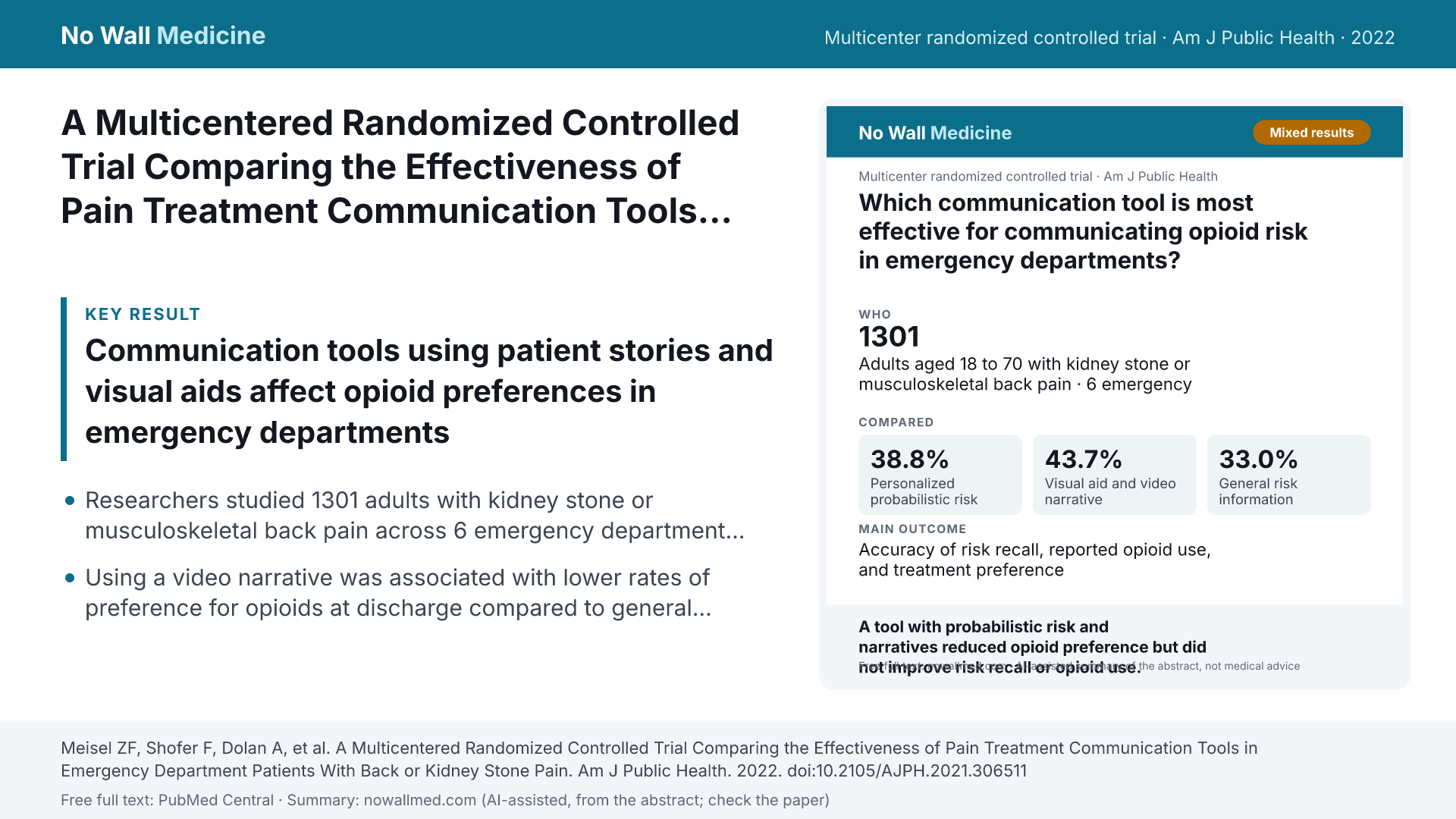
Communication tools using patient stories and visual aids affect opioid preferences in emergency departments
A Multicentered Randomized Controlled Trial Comparing the Effectiveness of Pain Treatment Communication Tools in Emergency Department Patients With Back or Kidney Stone Pain
Multicenter randomized controlled trialMixed results
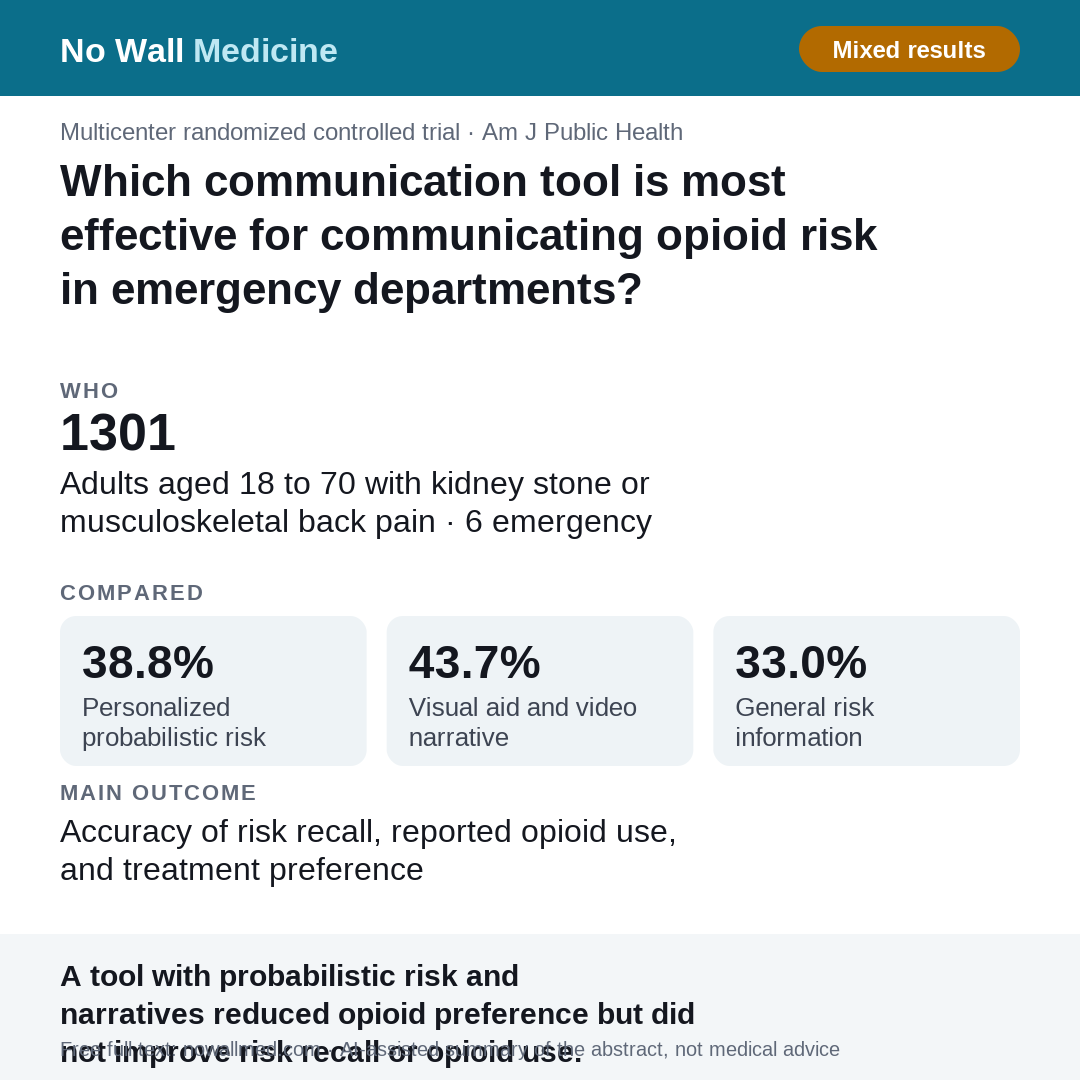
Which communication tool is most effective for communicating opioid risk in emergency departments?
Who
1301
Adults aged 18 to 70 with kidney stone or musculoskeletal back pain · 6 emergency department sites in the United States
Compared
38.8%Personalized probabilistic risk visual aid
43.7%Visual aid and video narrative
33.0%General risk information
Main outcome
Accuracy of risk recall, reported opioid use, and treatment preference
Result: difference 7.1%; 95% CI 0.64, 0.97
Bottom line: A tool with probabilistic risk and narratives reduced opioid preference but did not improve risk recall or opioid use.
Am J Public Health · 2022-02-10Download image
Same trial (NCT03134092)
Papers we list that report this registered trial, oldest first. Read a secondary analysis alongside the main results.
- Secondary analysis Harm found
Black patients had lower odds of receiving opioid prescriptions despite their stated treatment preferences JAMA Netw Open 2021-07 - Main results Mixed results
This paper Am J Public Health 2022-02
Clinical question: Which communication tool is most effective for communicating opioid risk in emergency departments?
Key points
- Researchers studied 1301 adults with kidney stone or musculoskeletal back pain across 6 emergency department sites in the United States.
- Using a video narrative was associated with lower rates of preference for opioids at discharge compared to general risk information (25.9% vs 33.0%).
- There were no differences in risk recall at 14 days or reported opioid use at 14 days between the three communication groups.
Headline and key points written with AI from the paper’s abstract, with every number checked against it. Read the paper before relying on them.
Was this summary helpful?
Subject terms
Headline, design, result, key points, caveat and citation as plain text.
Cite this article
Meisel ZF, Shofer F, Dolan A, et al. A Multicentered Randomized Controlled Trial Comparing the Effectiveness of Pain Treatment Communication Tools in Emergency Department Patients With Back or Kidney Stone Pain. Am J Public Health. 2022. doi:10.2105/AJPH.2021.306511
Spotted a mistake? Suggest a correction