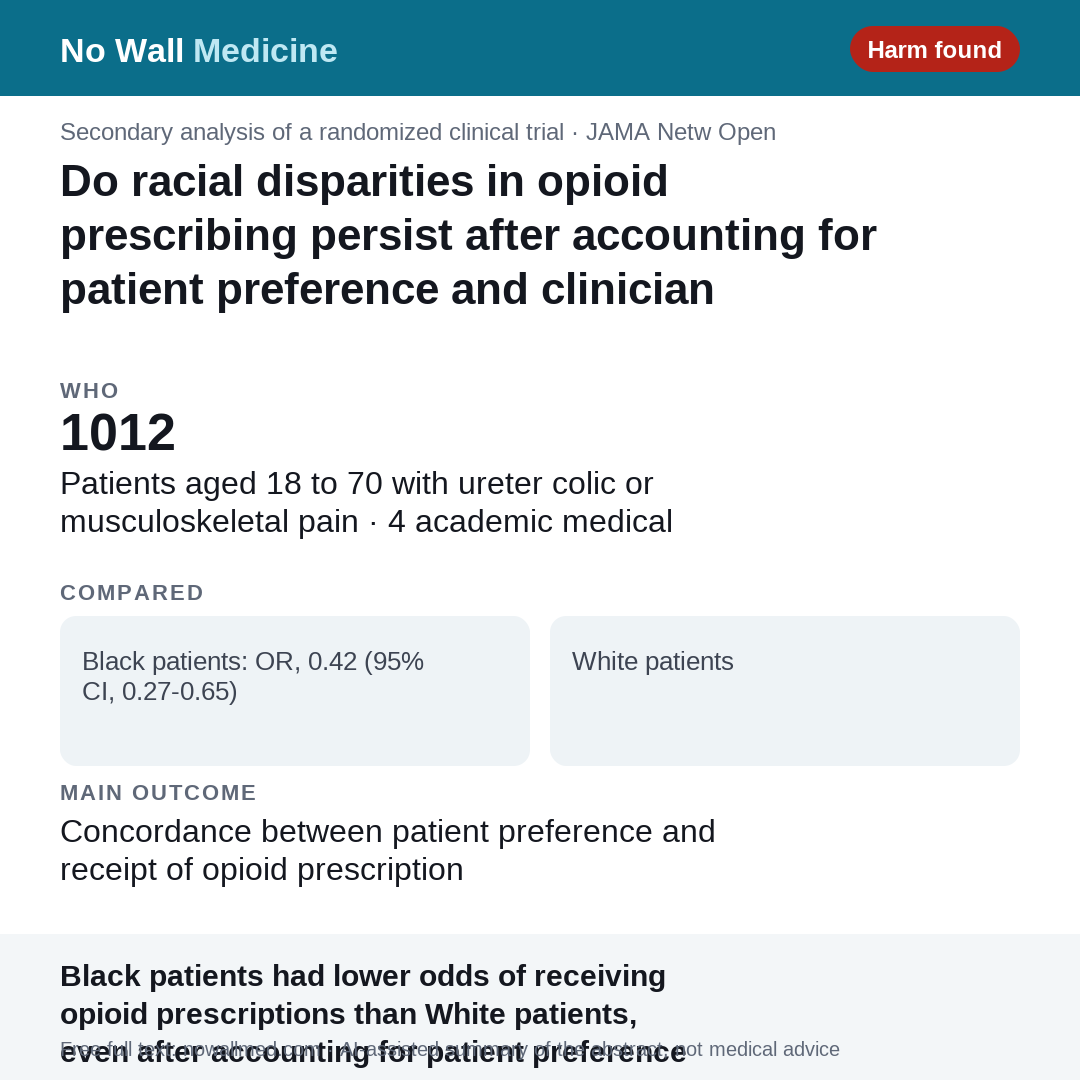
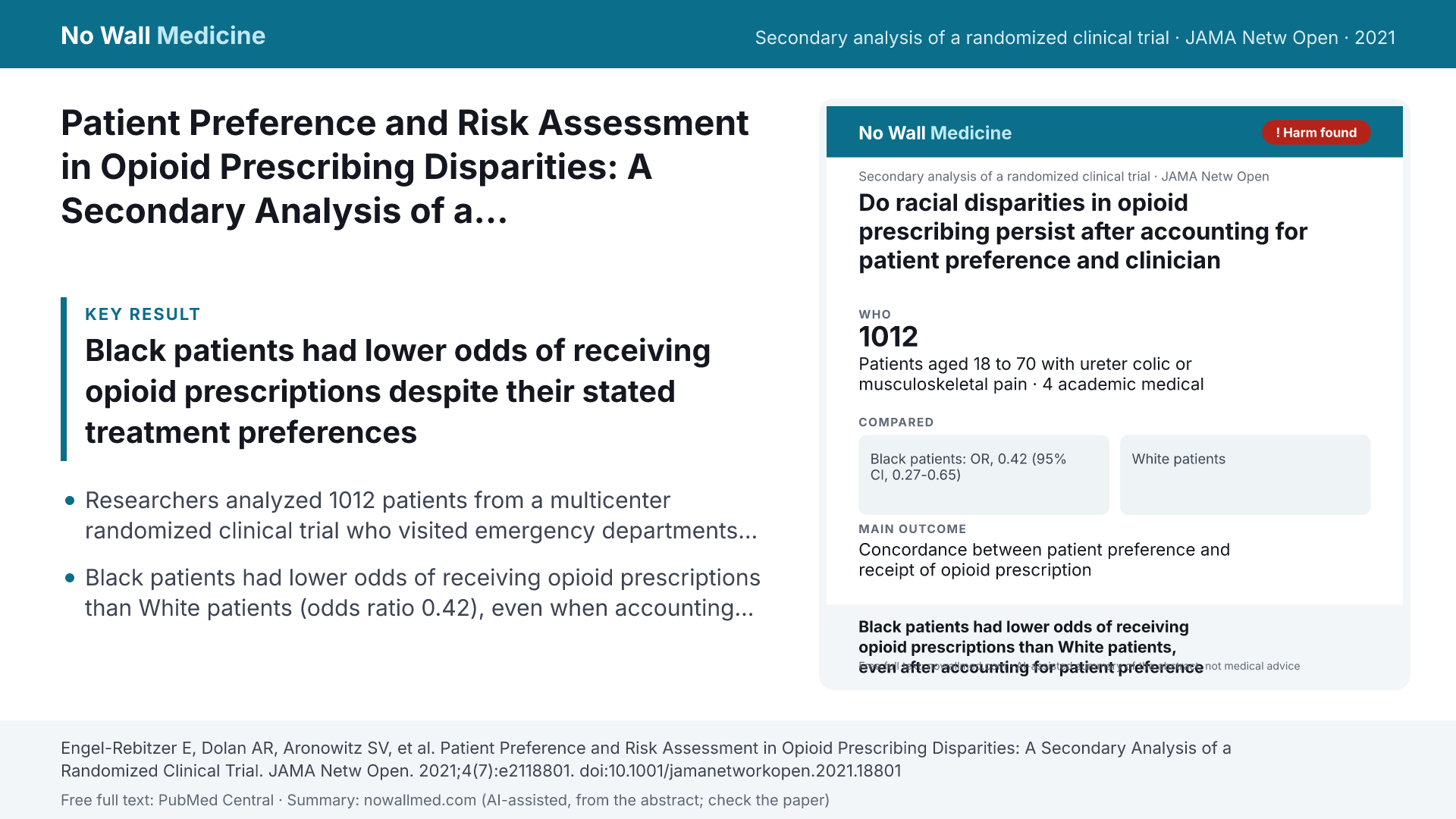
Black patients had lower odds of receiving opioid prescriptions despite their stated treatment preferences
Patient Preference and Risk Assessment in Opioid Prescribing Disparities: A Secondary Analysis of a Randomized Clinical Trial
Secondary analysis of a randomized clinical trialHarm found
Do racial disparities in opioid prescribing persist after accounting for patient preference and clinician information?
Who
1012
Patients aged 18 to 70 with ureter colic or musculoskeletal pain · 4 academic medical center emergency departments
Compared
Black patients: OR, 0.42 (95% CI, 0.27-0.65)
White patients
Main outcome
Concordance between patient preference and receipt of opioid prescription
Result: odds ratio 0.42 (95% CI 0.27-0.65)
Bottom line: Black patients had lower odds of receiving opioid prescriptions than White patients, even after accounting for patient preference and clinician information.
JAMA Netw Open · 2021-07-01Download image
Same trial (NCT03134092)
Papers we list that report this registered trial, oldest first. Read a secondary analysis alongside the main results.
- Secondary analysis Harm found
This paper JAMA Netw Open 2021-07 - Main results Mixed results
Communication tools using patient stories and visual aids affect opioid preferences in emergency departments Am J Public Health 2022-02
Clinical question: Do racial disparities in opioid prescribing persist after accounting for patient preference and clinician information?
Key points
- Researchers analyzed 1012 patients from a multicenter randomized clinical trial who visited emergency departments for acute pain.
- Black patients had lower odds of receiving opioid prescriptions than White patients (odds ratio 0.42), even when accounting for patient preferences.
- Providing clinicians with additional information about patient preferences and misuse risk did not eliminate these prescribing disparities.
Headline and key points written with AI from the paper’s abstract, with every number checked against it. Read the paper before relying on them.
Was this summary helpful?
Subject terms
Headline, design, result, key points, caveat and citation as plain text.
Cite this article
Engel-Rebitzer E, Dolan AR, Aronowitz SV, et al. Patient Preference and Risk Assessment in Opioid Prescribing Disparities: A Secondary Analysis of a Randomized Clinical Trial. JAMA Netw Open. 2021. doi:10.1001/jamanetworkopen.2021.18801
Spotted a mistake? Suggest a correction