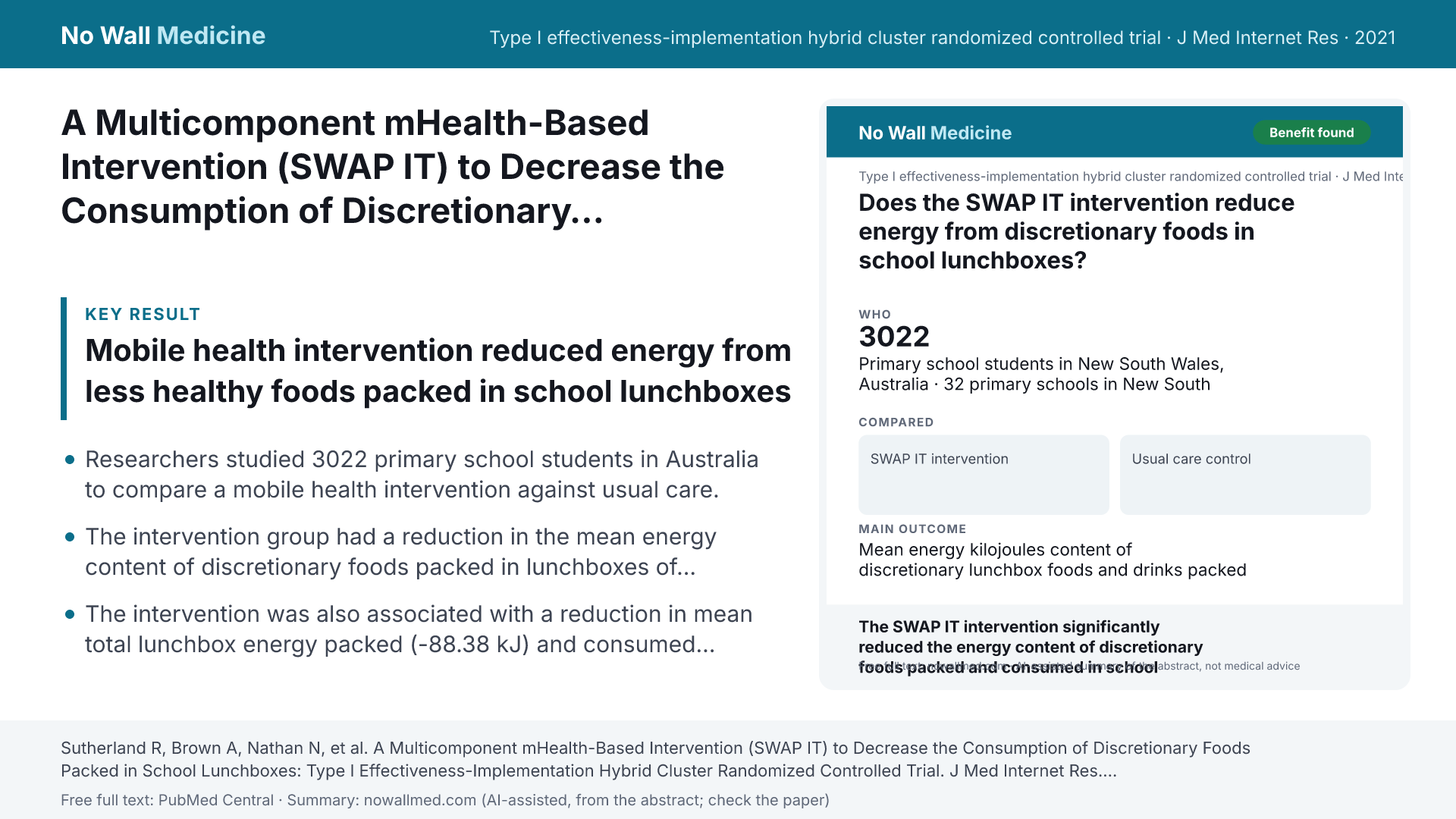
Mobile health intervention reduced energy from less healthy foods packed in school lunchboxes
A Multicomponent mHealth-Based Intervention (SWAP IT) to Decrease the Consumption of Discretionary Foods Packed in School Lunchboxes: Type I Effectiveness-Implementation Hybrid Cluster Randomized Controlled Trial
Type I effectiveness-implementation hybrid cluster randomized controlled trialBenefit found
Does the SWAP IT intervention reduce energy from discretionary foods in school lunchboxes?
Who
3022
Primary school students in New South Wales, Australia · 32 primary schools in New South Wales, Australia
Compared
SWAP IT intervention
Usual care control
Main outcome
Mean energy kilojoules content of discretionary lunchbox foods and drinks packed
Result: -117.26 kJ; 95% CI -195.59 to -39.83
Bottom line: The SWAP IT intervention significantly reduced the energy content of discretionary foods packed and consumed in school lunchboxes.
J Med Internet Res · 2021-06-24Download image
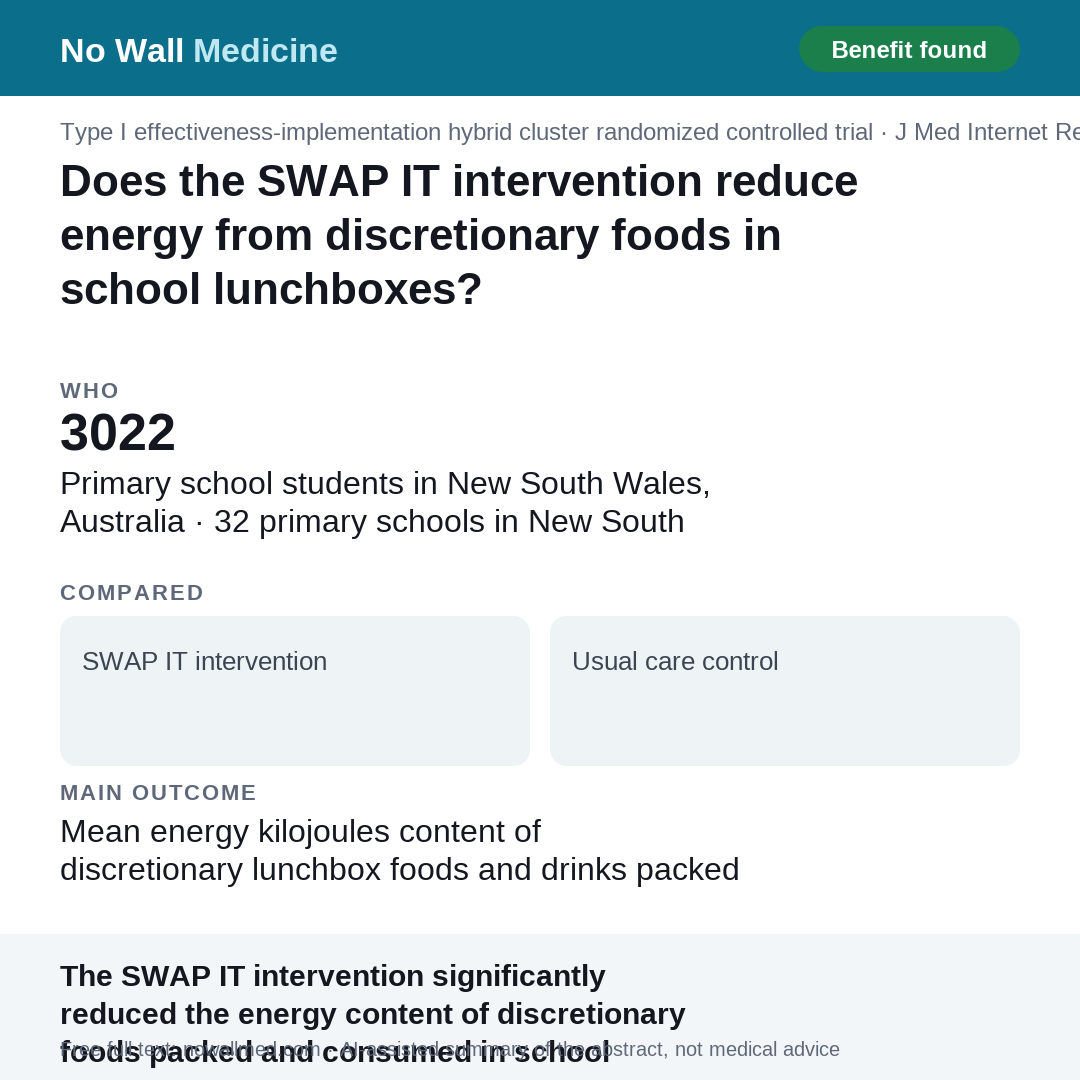
Clinical question: Does the SWAP IT intervention reduce energy from discretionary foods in school lunchboxes?
Why it matters: It is unknown if multicomponent mobile health interventions can effectively reduce the energy contribution of less healthy foods and drinks packed for children to eat at school.
Key points
- Researchers studied 3022 primary school students in Australia to compare a mobile health intervention against usual care.
- The intervention group had a reduction in the mean energy content of discretionary foods packed in lunchboxes of -117.26 kJ compared to the control group.
- The intervention was also associated with a reduction in mean total lunchbox energy packed (-88.38 kJ) and consumed (-117.17 kJ) relative to the control.
Headline and key points written with AI from the paper’s abstract, with every number checked against it. Read the paper before relying on them.
Was this summary helpful?
Subject terms
Cite this article
Sutherland R, Brown A, Nathan N, et al. A Multicomponent mHealth-Based Intervention (SWAP IT) to Decrease the Consumption of Discretionary Foods Packed in School Lunchboxes: Type I Effectiveness-Implementation Hybrid Cluster Randomized Controlled Trial. J Med Internet Res. 2021. doi:10.2196/25256
Spotted a mistake? Suggest a correction