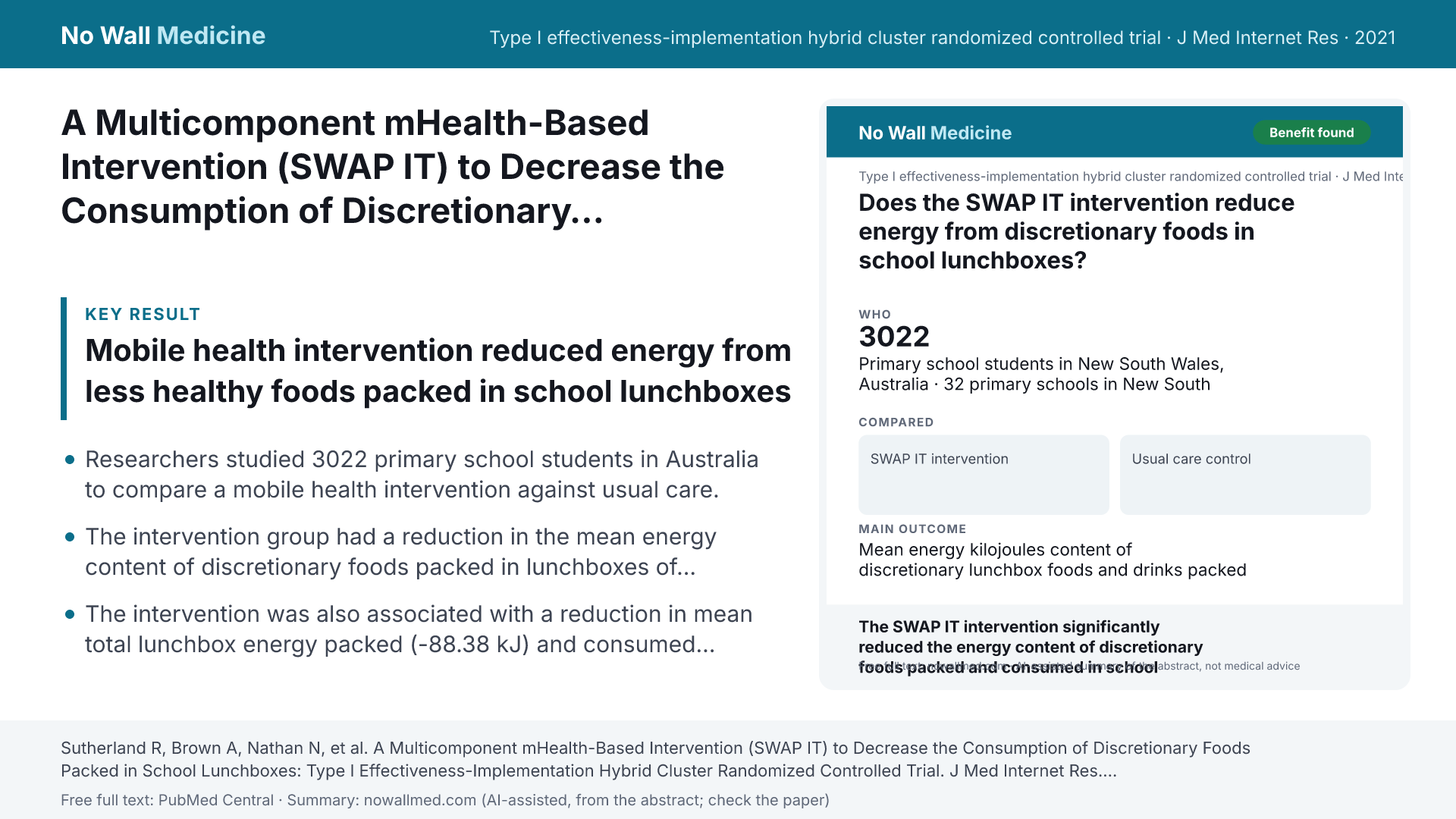
A Multicomponent mHealth-Based Intervention (SWAP IT) to Decrease the Consumption of Discretionary Foods Packed in School Lunchboxes: Type I Effectiveness-Implementation Hybrid Cluster Randomized Controlled Trial
Key result: Mobile health intervention reduced energy from less healthy foods packed in school lunchboxes
Key points
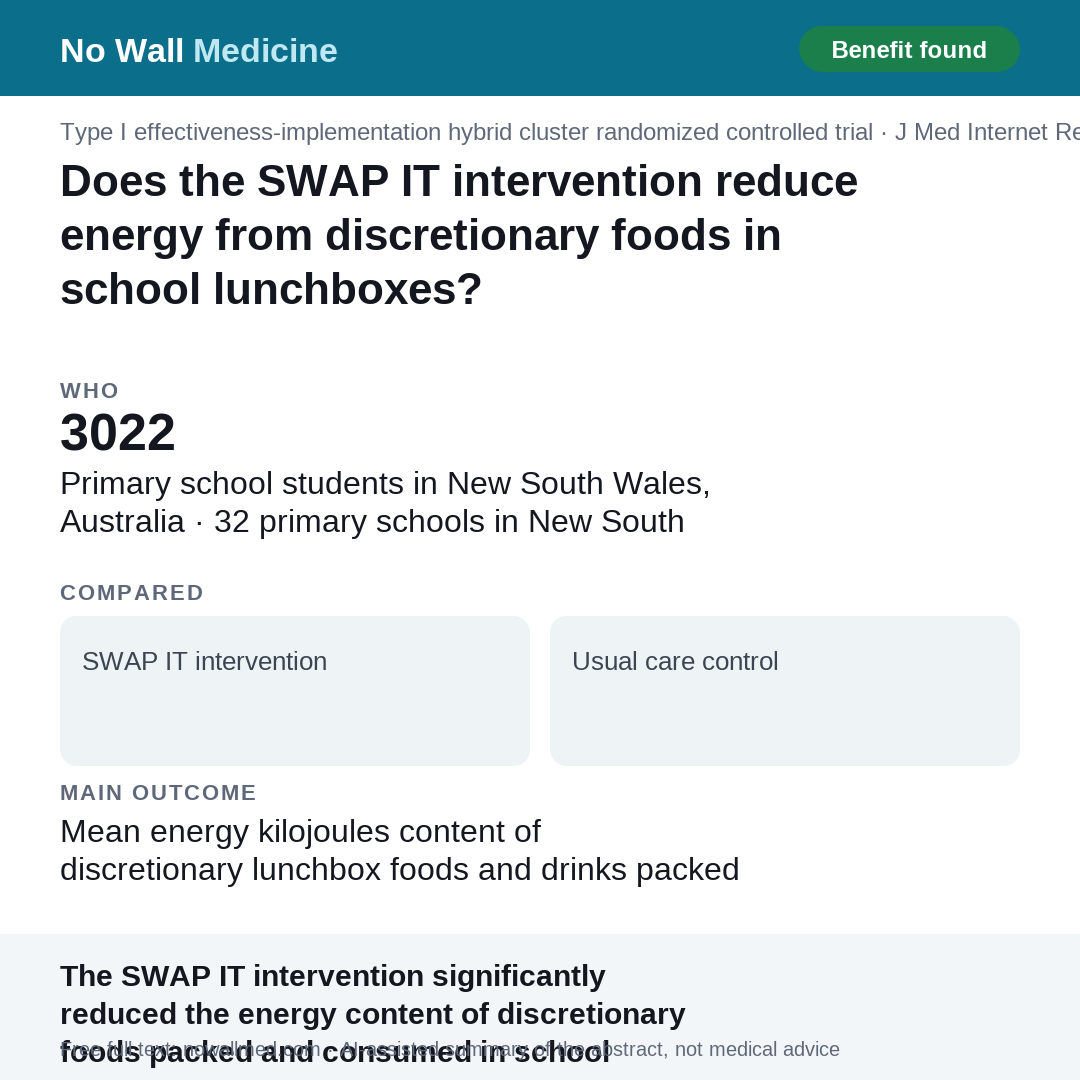
- Researchers studied 3022 primary school students in Australia to compare a mobile health intervention against usual care.
- The intervention group had a reduction in the mean energy content of discretionary foods packed in lunchboxes of -117.26 kJ compared to the control group.
- The intervention was also associated with a reduction in mean total lunchbox energy packed (-88.38 kJ) and consumed (-117.17 kJ) relative to the control.
Why it matters: It is unknown if multicomponent mobile health interventions can effectively reduce the energy contribution of less healthy foods and drinks packed for children to eat at school.
Discussion prompts
- Would these patients look like yours? Who was left out?
- Is the main outcome one that matters to patients?
- Is the difference large enough to change what you do?
Cite: Sutherland R, Brown A, Nathan N, et al. A Multicomponent mHealth-Based Intervention (SWAP IT) to Decrease the Consumption of Discretionary Foods Packed in School Lunchboxes: Type I Effectiveness-Implementation Hybrid Cluster Randomized Controlled Trial. J Med Internet Res. 2021. doi:10.2196/25256
Free full text: PubMed Central · Summary and visual abstract: nowallmed.com/a/a-multicomponent-mhealth-based-intervention-swap-it-to-decrease-the-n1shy9/ (AI-assisted from the abstract; check the paper before relying on it).