Gene assay predicts recurrence in tamoxifen-treated breast cancer patients
A multigene assay to predict recurrence of tamoxifen-treated, node-negative breast cancer
Why it matters: A 21-gene tumour test predicted distant recurrence in node-negative, hormone-receptor-positive breast cancer, introducing genomic testing into routine pathology.
Related landmark trials: TAILORx
Context written by the No Wall Medicine team.
Randomized trialBenefit found
Can gene assay predict recurrence
Who
668
Node-negative breast cancer patients
Compared
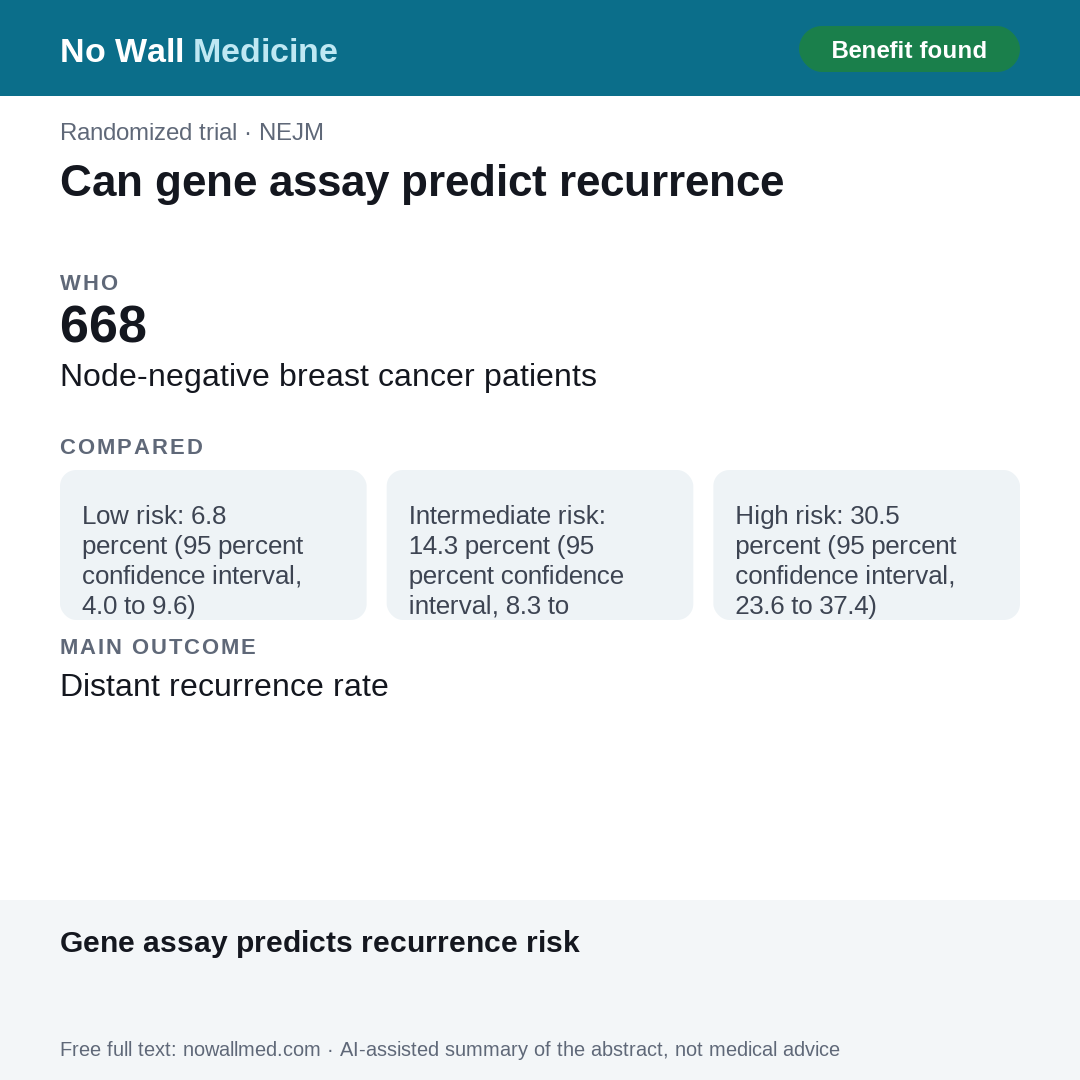
Low risk: 6.8 percent (95 percent confidence interval, 4.0 to 9.6)
Intermediate risk: 14.3 percent (95 percent confidence interval, 8.3 to 20.3)
High risk: 30.5 percent (95 percent confidence interval, 23.6 to 37.4)
Main outcome
Distant recurrence rate
Bottom line: Gene assay predicts recurrence risk
NEJM · 2004-12-10Download image
Trial at a glance
Bottom line: The recurrence score predicted distant recurrence in tamoxifen-treated patients with node-negative breast cancer
Clinical question
Can a multigene assay predict recurrence of tamoxifen-treated breast cancer
Design
Multicentre, clinical trial
Who was studied
675 patients with node-negative breast cancer
Key inclusion criteria
- node-negative
- estrogen-receptor-positive
- tamoxifen-treated
- breast cancer
Interventions
- patients: RT-PCR assay of 21 genes
Primary outcome
distant recurrence. 6.8 percent, 14.3 percent, 30.5 percent at 10 years
Secondary outcomes
- overall survival: recurrence score was predictive (P<0.001)
Written with AI from the abstract; every number was checked against it. Details such as eligibility criteria may be missing because the abstract does not give them. Read the paper before relying on it.
Key points
- 668 patients with node-negative breast cancer were studied.
- 10-year distant recurrence rates were 6.8%, 14.3%, and 30.5% for low, intermediate, and high-risk groups.
- Recurrence score predicted overall survival independently of age and tumor size.
Headline and key points written with AI from the paper’s abstract, with every number checked against it. Read the paper before relying on them.
Was this summary helpful?
Subject terms
Cite this article
Paik S, Shak S, Tang G, Kim C, Baker J, Cronin M. A multigene assay to predict recurrence of tamoxifen-treated, node-negative breast cancer. NEJM. 2004. doi:10.1056/NEJMoa041588
Spotted a mistake? Suggest a correction
Top studies every Monday
The week’s key trials and guidelines in your specialties, plus any topics you follow. By email, free.
Get the weekly digest