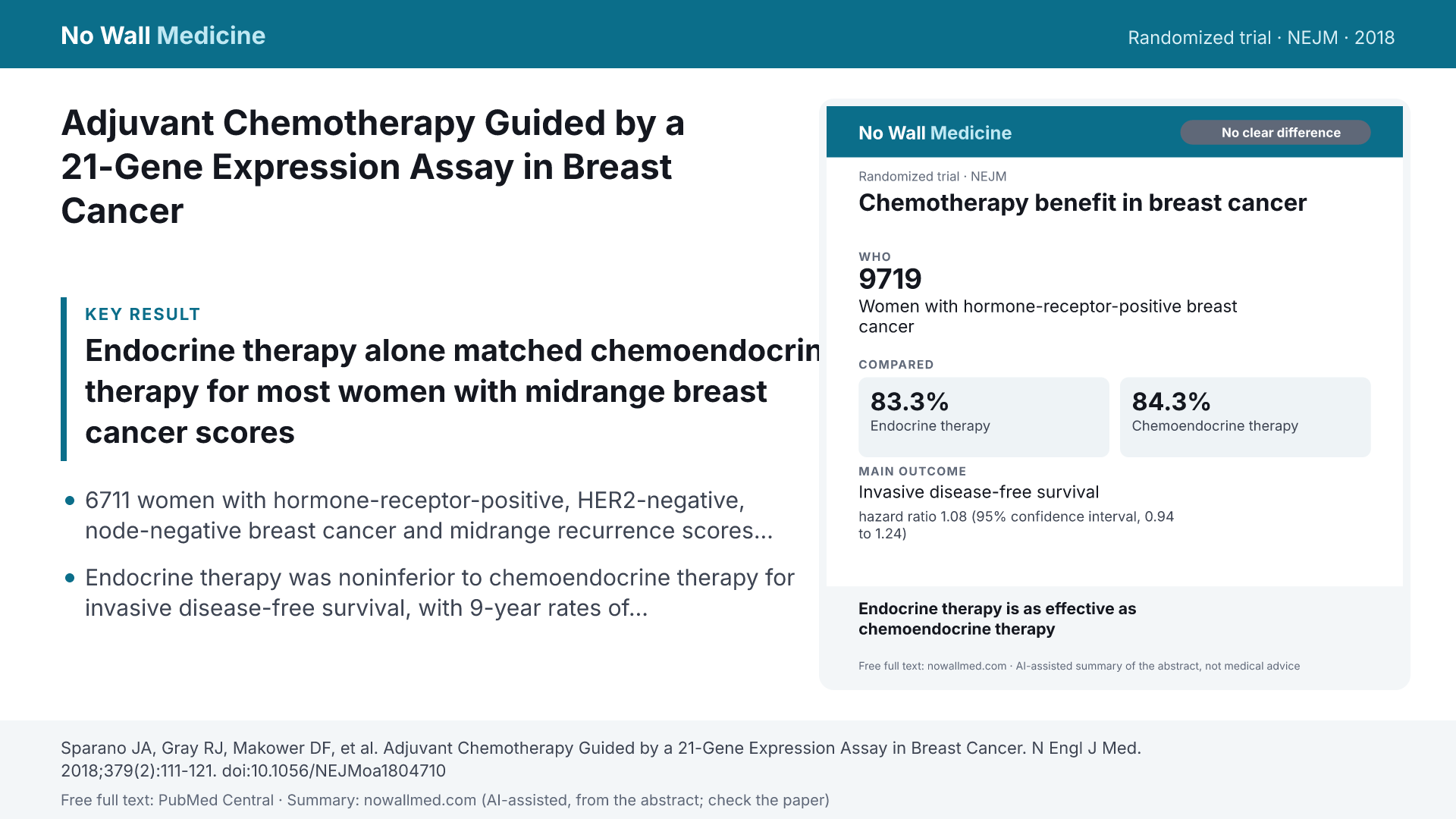
Endocrine therapy alone matched chemoendocrine therapy for most women with midrange breast cancer scores
Adjuvant Chemotherapy Guided by a 21-Gene Expression Assay in Breast Cancer
Why it matters: For women with an intermediate 21-gene score, endocrine therapy alone was noninferior to chemotherapy plus endocrine therapy, sparing many from chemotherapy.
Related landmark trials: 21-gene recurrence score (Oncotype DX) · MINDACT
Context written by the No Wall Medicine team.
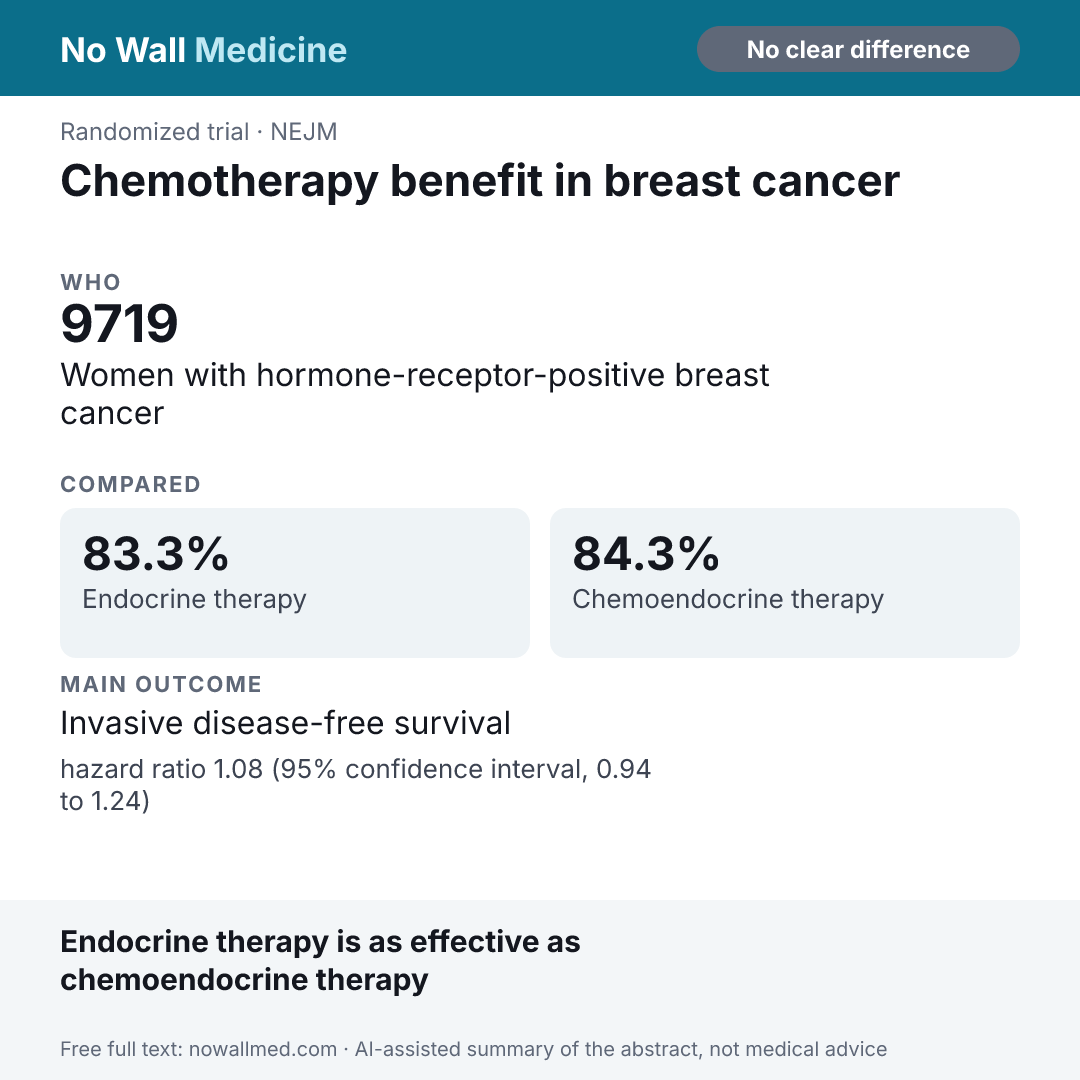
Randomized trialNo clear difference
Chemotherapy benefit in breast cancer
Who
9719
Women with hormone-receptor-positive breast cancer
Compared
83.3%Endocrine therapy
84.3%Chemoendocrine therapy
Main outcome
Invasive disease-free survival
Result: hazard ratio 1.08 (95% confidence interval, 0.94 to 1.24)
Bottom line: Endocrine therapy is as effective as chemoendocrine therapy
Funded by: National Cancer Institute and others
NEJM · 2018-06-03 · Save PNG
Trial at a glance
Bottom line: Endocrine therapy was noninferior to chemoendocrine therapy for invasive disease-free survival
Clinical question
Does adjuvant chemotherapy benefit women with midrange 21-gene recurrence scores?
Design
Prospective, randomized trial. 10,273 women, 2006-2010
Who was studied
10,273 women with hormone-receptor-positive breast cancer
Key inclusion criteria
- 18 to 75 years of age
- hormone-receptor-positive
- human epidermal growth factor receptor 2 (Human Epidermal Growth Factor Receptor 2) -negative
- axillary node-negative breast cancer
Interventions
- endocrine therapy: endocrine therapy alone
- chemoendocrine therapy: chemotherapy plus endocrine therapy
Primary outcome
invasive disease-free survival. hazard ratio 1.08, 95% confidence interval 0.94 to 1.24, P = 0.26
Secondary outcomes
- freedom from disease recurrence at a distant site: 94.5% and 95.0%
- freedom from recurrence at a distant or local-regional site: 92.2% and 92.9%
- overall survival: 93.9% and 93.8%
Limitations reported by the authors
- nonadherence to assigned treatment
Funding
National Cancer Institute and others
Written with AI from the full paper; every number was checked against it. Read the paper before relying on it.
Same trial (NCT00310180)
Papers we list that report this registered trial, oldest first. Read a secondary analysis alongside the main results.
- Main results No clear difference
This paper NEJM 2018-06 - Secondary analysis Mixed results
Depression and lower quality of life were associated with early stopping of breast cancer hormone therapy JAMA Oncol 2021-06 - Secondary analysis Harm found
Black race was associated with shorter survival and relapse-free intervals in early breast cancer JAMA Oncol 2022-02 - Secondary analysis Harm found
Asian and Black patients had higher rates of breast cancer recurrence in clinical trial analysis JAMA Surg 2023-04
Key points
- 6711 women with hormone-receptor-positive, HER2-negative, node-negative breast cancer and midrange recurrence scores were randomly assigned to two treatment groups.
- Endocrine therapy was noninferior to chemoendocrine therapy for invasive disease-free survival, with 9-year rates of 83.3% versus 84.3%.
- Chemotherapy showed some benefit for invasive disease-free survival in women 50 years or younger with recurrence scores of 16 to 25.
Headline and key points written with AI from the paper’s abstract, with every number checked against it. Read the paper before relying on them.
Was this summary helpful?
Subject terms
Headline, design, result, key points, caveat and citation as plain text.
Cite this article
Sparano JA, Gray RJ, Makower DF, et al. Adjuvant Chemotherapy Guided by a 21-Gene Expression Assay in Breast Cancer. N Engl J Med. 2018;379(2):111-121. doi:10.1056/NEJMoa1804710
Spotted a mistake? Suggest a correction