Cognitive remediation networks show increased connectivity and links between symptoms and learning after treatment
A network approach exploring the effects of cognitive remediation on cognition, symptoms, and functioning in early psychosis
Secondary analysis of randomized controlled trial dataBenefit found
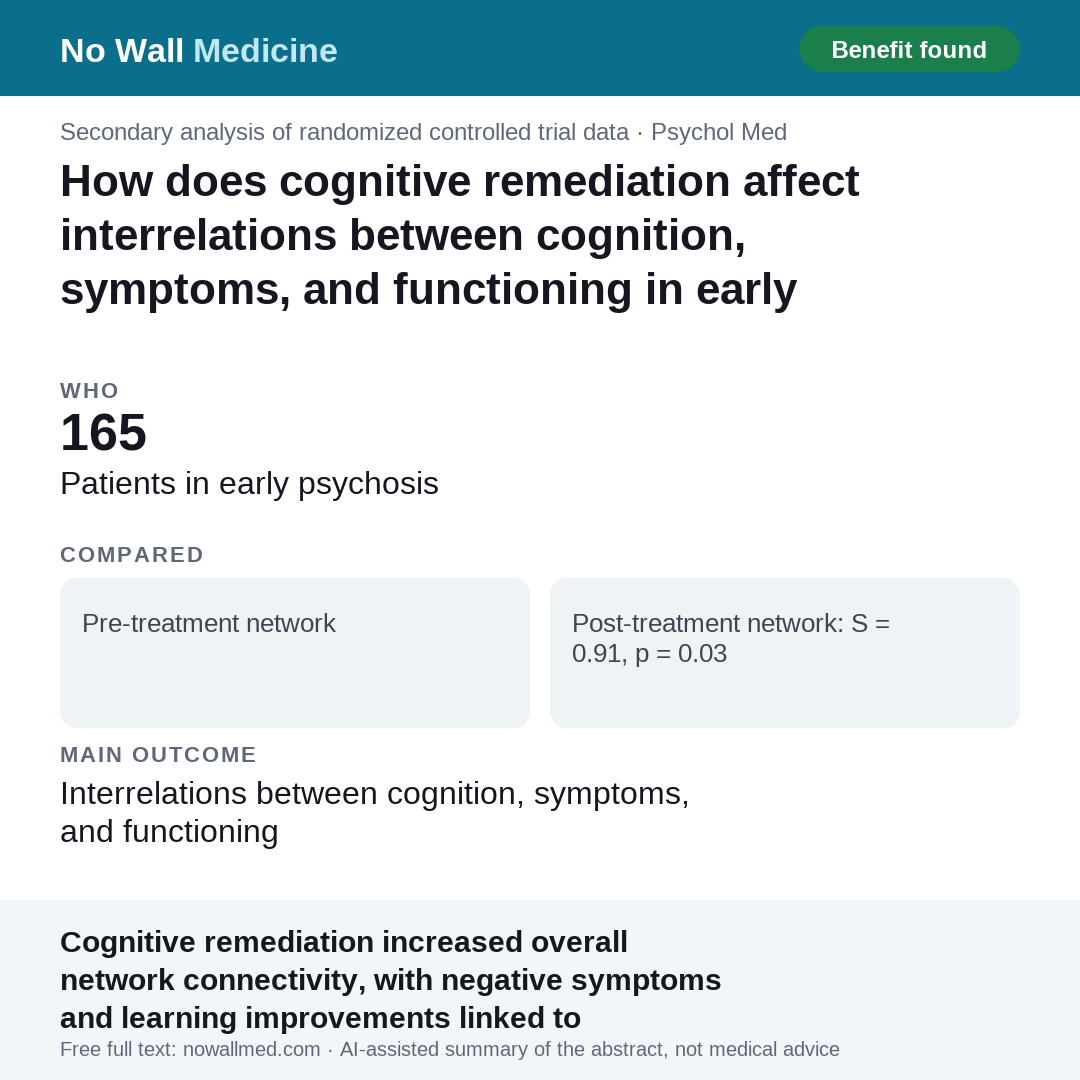
How does cognitive remediation affect interrelations between cognition, symptoms, and functioning in early psychosis?
Who
165
Patients in early psychosis
Compared
Pre-treatment network
Post-treatment network: S = 0.91, p = 0.03
Main outcome
Interrelations between cognition, symptoms, and functioning
Bottom line: Cognitive remediation increased overall network connectivity, with negative symptoms and learning improvements linked to functioning changes.
Psychol Med · 2025-03-03Download image
Clinical question: How does cognitive remediation affect interrelations between cognition, symptoms, and functioning in early psychosis?
Why it matters: It is unknown which specific features or relationships between cognition, symptoms, and functioning promote or inhibit the effectiveness of cognitive remediation.
Key points
- Researchers analyzed data from 165 people in a randomized controlled trial to see how cognitive remediation, a brain training therapy, affects symptoms, cognition, and functioning.
- The post-treatment network showed greater overall connectivity (S = 0.91, p = 0.03) compared to the pre-treatment network, though the network structure did not differ (M = 0.20, p = 0.45).
- Negative symptoms were central to the networks and were most strongly associated with changes in functioning, while visual learning improvement was positively associated with personal goal achievement.
Headline and key points written with AI from the paper’s abstract, with every number checked against it. Read the paper before relying on them.
Was this summary helpful?
Subject terms
Cite this article
Watson AJ, Stringer D, Pickles A, McCrone P, Reeder C, Birchwood M. A network approach exploring the effects of cognitive remediation on cognition, symptoms, and functioning in early psychosis. Psychol Med. 2025. doi:10.1017/S0033291725000212
Spotted a mistake? Suggest a correction
Top studies every Monday
The week’s key trials and guidelines in your specialties, plus any topics you follow. By email, free.
Get the weekly digest