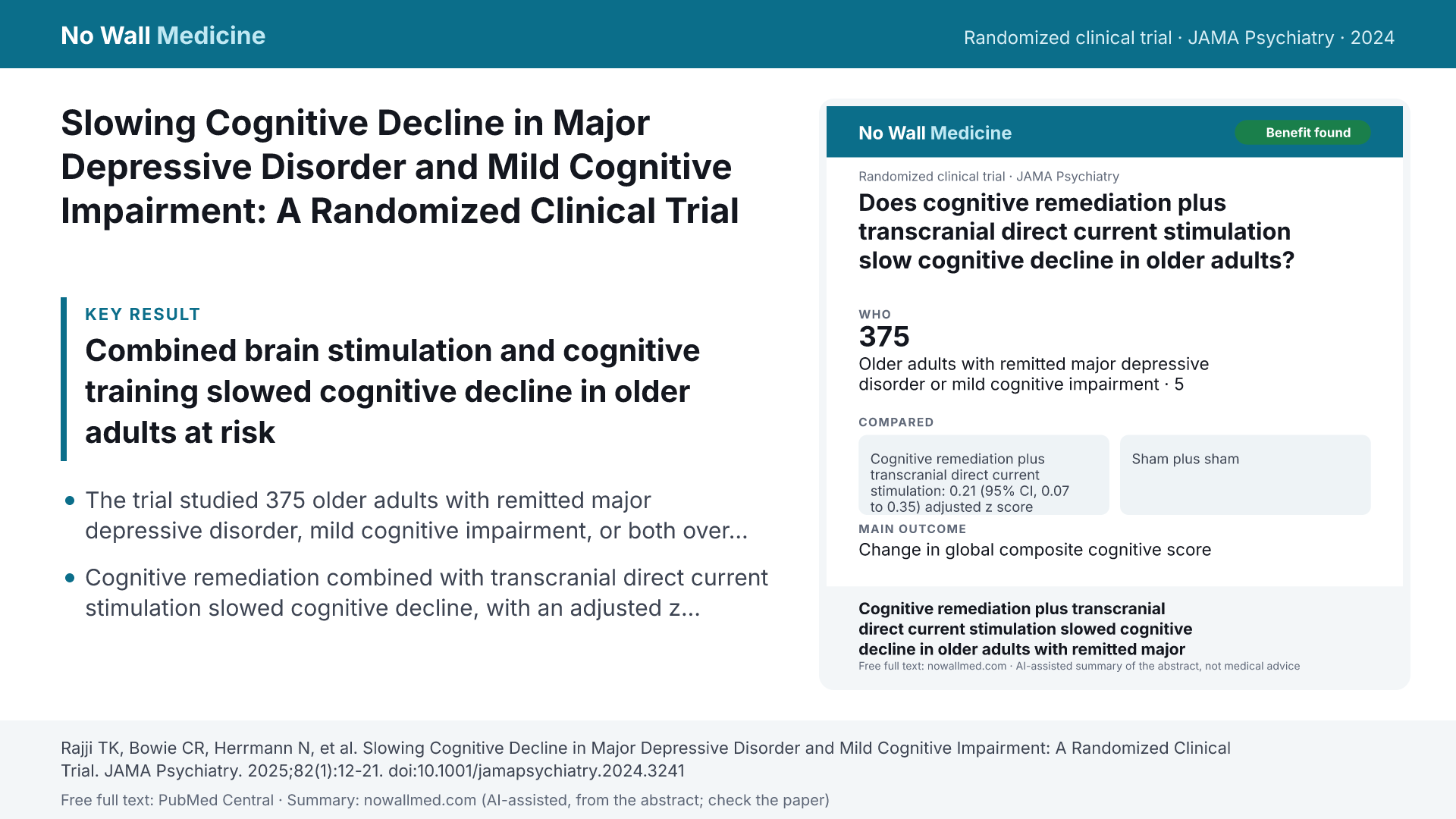
Combined brain stimulation and cognitive training slowed cognitive decline in older adults at risk
Slowing Cognitive Decline in Major Depressive Disorder and Mild Cognitive Impairment: A Randomized Clinical Trial
Randomized clinical trialBenefit found
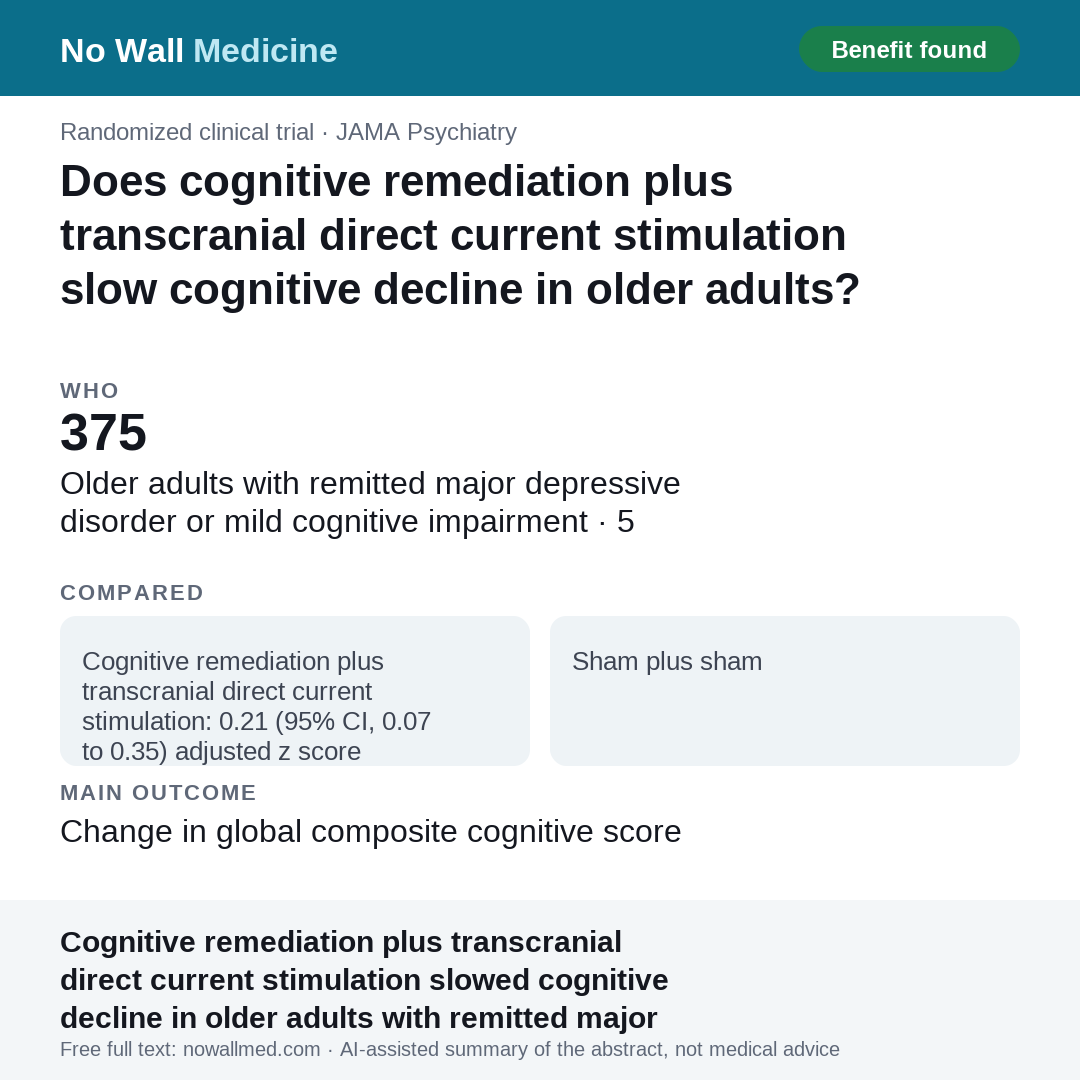
Does cognitive remediation plus transcranial direct current stimulation slow cognitive decline in older adults?
Who
375
Older adults with remitted major depressive disorder or mild cognitive impairment · 5 academic hospitals in Toronto, Ontario, Canada
Compared
Cognitive remediation plus transcranial direct current stimulation: 0.21 (95% CI, 0.07 to 0.35) adjusted z score difference
Sham plus sham
Main outcome
Change in global composite cognitive score
Result: adjusted z score difference 0.21 (95% CI, 0.07 to 0.35)
Bottom line: Cognitive remediation plus transcranial direct current stimulation slowed cognitive decline in older adults with remitted major depressive disorder or mild cognitive impairment.
JAMA Psychiatry · 2024-10-30Download image
Clinical question: Does cognitive remediation plus transcranial direct current stimulation slow cognitive decline in older adults?
Why it matters: It is unknown if combining cognitive remediation and transcranial direct current stimulation can slow cognitive decline or prevent progression to dementia in older adults with depression or mild cognitive impairment.
Key points
- The trial studied 375 older adults with remitted major depressive disorder, mild cognitive impairment, or both over a median follow-up of 48.3 months.
- Cognitive remediation combined with transcranial direct current stimulation slowed cognitive decline, with an adjusted z score difference of 0.21 at month 60.
- The treatment did not show acute improvement in cognition at month 2 or a significant effect on delaying progression to dementia.
Headline and key points written with AI from the paper’s abstract, with every number checked against it. Read the paper before relying on them.
Was this summary helpful?
Subject terms
Cite this article
Rajji TK, Bowie CR, Herrmann N, Pollock BG, Lanctôt KL, Kumar S. Slowing Cognitive Decline in Major Depressive Disorder and Mild Cognitive Impairment: A Randomized Clinical Trial. JAMA Psychiatry. 2024. doi:10.1001/jamapsychiatry.2024.3241
Spotted a mistake? Suggest a correction
Top studies every Monday
The week’s key trials and guidelines in your specialties, plus any topics you follow. By email, free.
Get the weekly digest