Slowing Cognitive Decline in Major Depressive Disorder and Mild Cognitive Impairment: A Randomized Clinical Trial
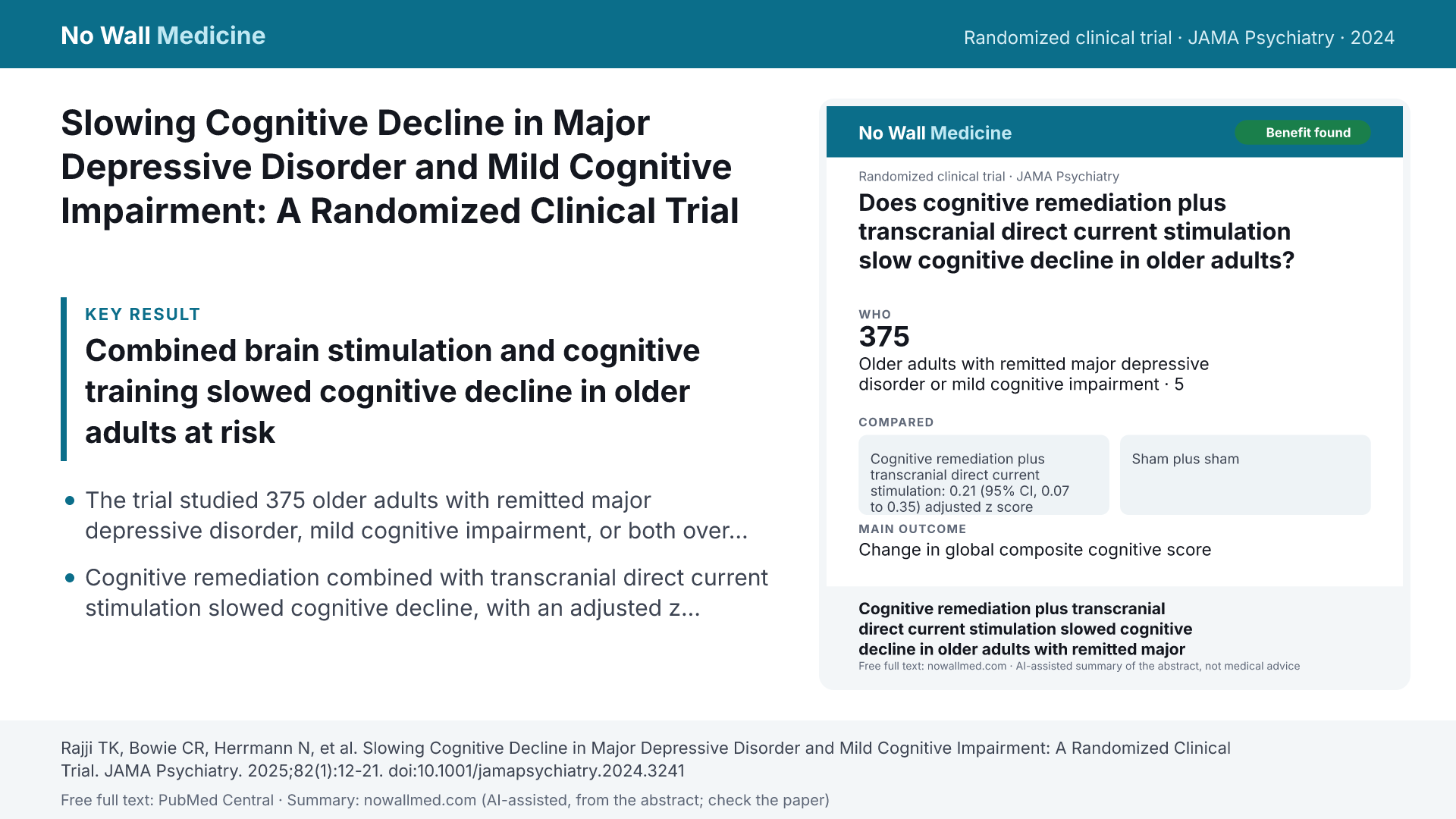
Key result: Combined brain stimulation and cognitive training slowed cognitive decline in older adults at risk
Randomized clinical trialBenefit found
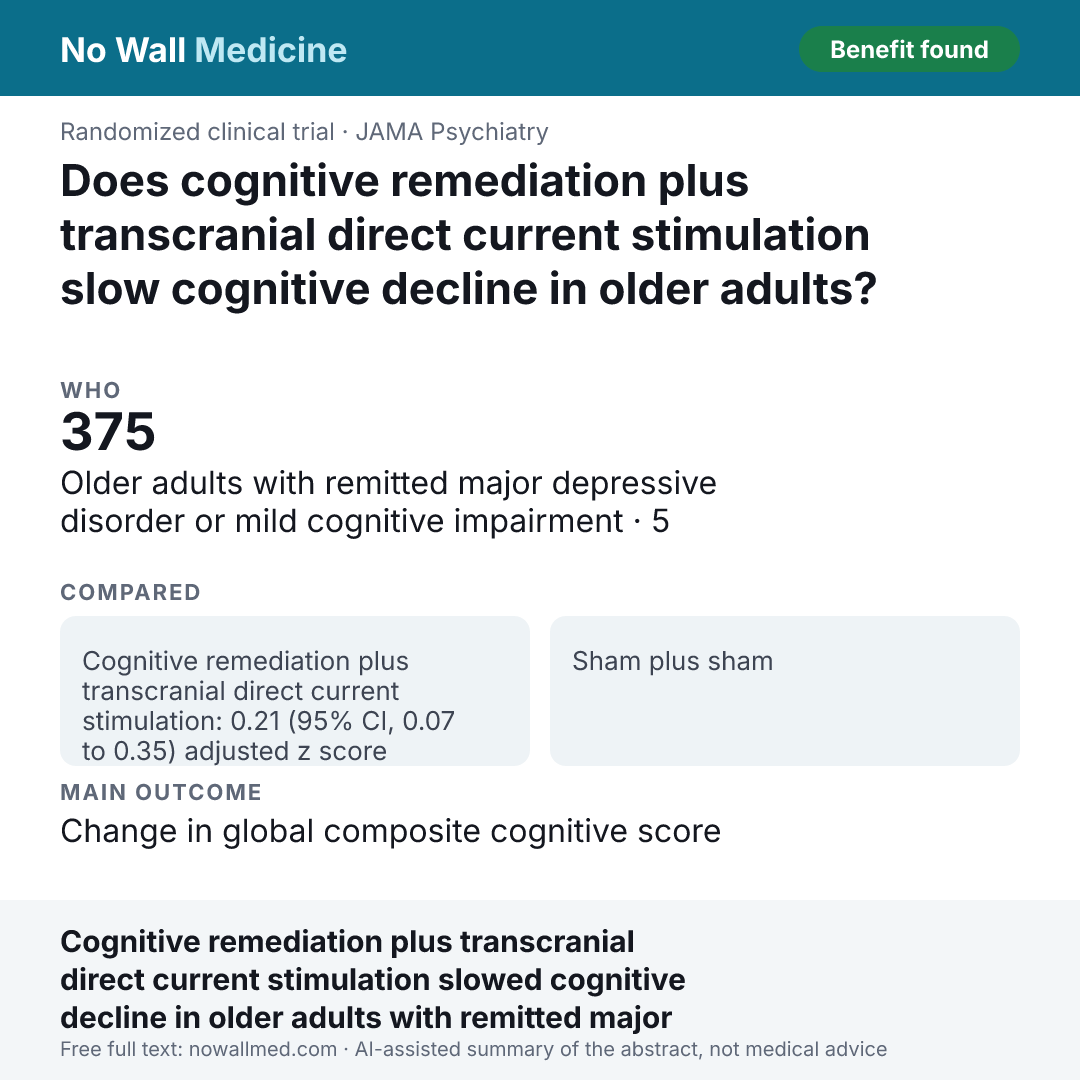
Does cognitive remediation plus transcranial direct current stimulation slow cognitive decline in older adults?
Who
375
Older adults with remitted major depressive disorder or mild cognitive impairment · 5 academic hospitals in Toronto, Ontario, Canada
Compared
Cognitive remediation plus transcranial direct current stimulation: 0.21 (95% CI, 0.07 to 0.35) adjusted z score difference
Sham plus sham
Main outcome
Change in global composite cognitive score
Result: adjusted z score difference 0.21 (95% CI, 0.07 to 0.35)
Bottom line: Cognitive remediation plus transcranial direct current stimulation slowed cognitive decline in older adults with remitted major depressive disorder or mild cognitive impairment.
JAMA Psychiatry · 2024-10-30 · Save PNG
Key points
- The trial studied 375 older adults with remitted major depressive disorder, mild cognitive impairment, or both over a median follow-up of 48.3 months.
- Cognitive remediation combined with transcranial direct current stimulation slowed cognitive decline, with an adjusted z score difference of 0.21 at month 60.
- The treatment did not show acute improvement in cognition at month 2 or a significant effect on delaying progression to dementia.
Discussion prompts
- Would these patients look like yours? Who was left out?
- Is the main outcome one that matters to patients?
- Is the difference large enough to change what you do?
Cite: Rajji TK, Bowie CR, Herrmann N, et al. Slowing Cognitive Decline in Major Depressive Disorder and Mild Cognitive Impairment: A Randomized Clinical Trial. JAMA Psychiatry. 2025;82(1):12-21. doi:10.1001/jamapsychiatry.2024.3241
Free full text: PubMed Central · Summary and visual abstract: nowallmed.com/a/slowing-cognitive-decline-in-major-depressive-disorder-and-mild-tznaym/ (AI-assisted from the abstract; check the paper before relying on it).