Baseline symptom plasticity predicts how quickly patients with major depression recover from their illness
A network-based analysis anticipates time to recovery from major depression revealing a plasticity by context interplay
Secondary analysis of two randomized clinical trialsBenefit found
Does baseline plasticity predict time to recovery from major depressive disorder?
Who
Patients with major depressive disorder · STAR*D and CO-MED clinical trials
Compared
Fast recovery: significantly lower connectivity strength
Slow recovery
Main outcome
Time to response or remission
Bottom line: Baseline plasticity predicts recovery trajectories, especially when combined with a favorable life context.
Transl Psychiatry · 2025-01-28Download image
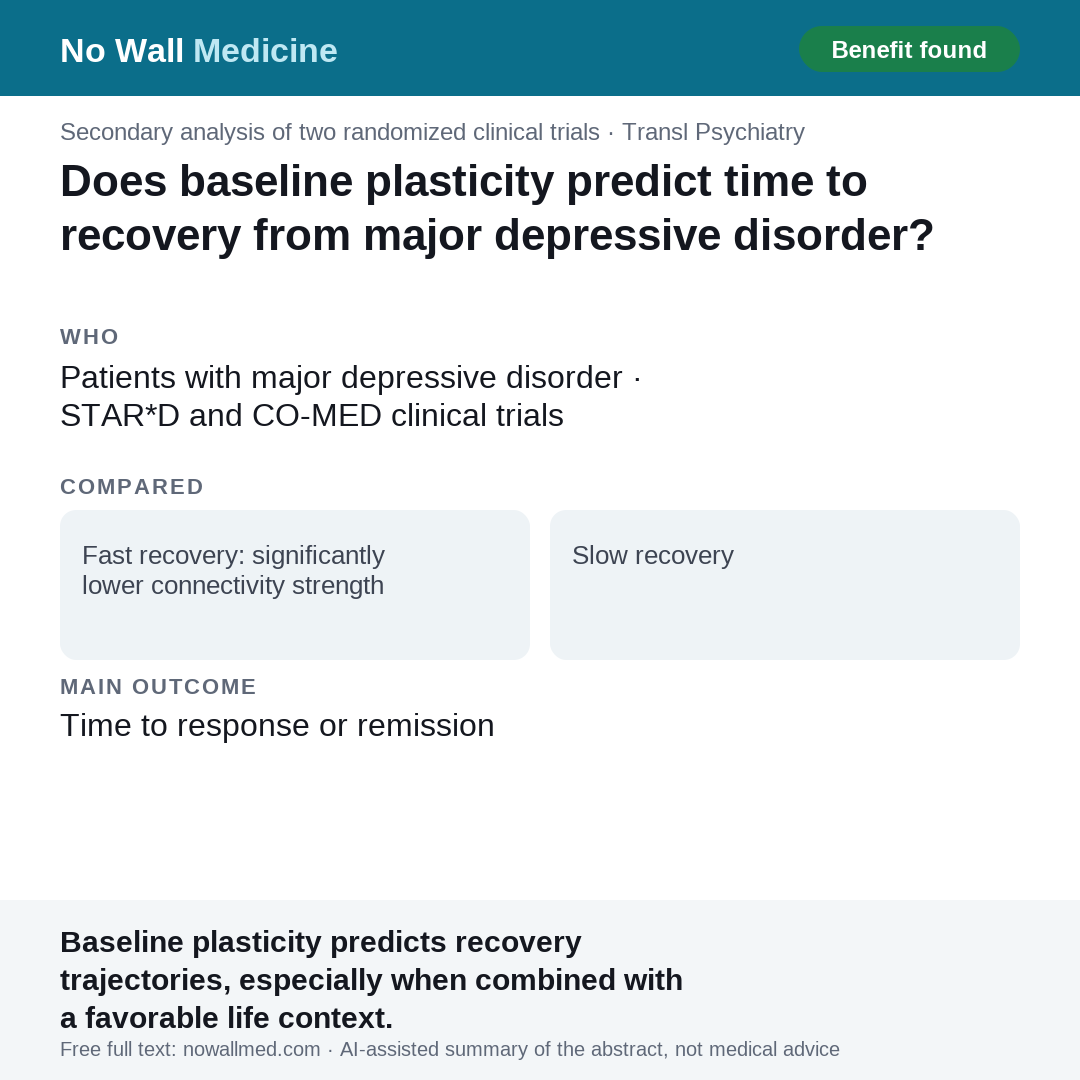
Clinical question: Does baseline plasticity predict time to recovery from major depressive disorder?
Why it matters: It is unknown if measuring a patient's susceptibility to mental state changes can predict the timing of recovery from major depressive disorder.
Key points
- Researchers performed a secondary analysis of two randomized clinical trials, STAR*D and CO-MED, measuring symptom severity and quality of life.
- Higher baseline plasticity, defined as lower connectivity strength among symptoms, was associated with faster time to response and remission.
- Plasticity was predictive of recovery trajectories only in patients experiencing a favorable context, suggesting it magnifies the influence of context on mood.
Headline and key points written with AI from the paper’s abstract, with every number checked against it. Read the paper before relying on them.
Was this summary helpful?
Subject terms
Cite this article
Delli Colli C, Viglione A, Poggini S, Cirulli F, Chiarotti F, Giuliani A. A network-based analysis anticipates time to recovery from major depression revealing a plasticity by context interplay. Transl Psychiatry. 2025. doi:10.1038/s41398-025-03246-1
Spotted a mistake? Suggest a correction
Top studies every Monday
The week’s key trials and guidelines in your specialties, plus any topics you follow. By email, free.
Get the weekly digest