Nano-iron supplement shows non-inferiority to standard treatment for iron deficiency anaemia in children
A novel nano-iron supplement versus standard treatment for iron deficiency anaemia in children 6-35 months (IHAT-GUT trial): a double-blind, randomised, placebo-controlled non-inferiority phase II trial in The Gambia
Randomised, double-blind, placebo-controlled, non-inferiority Phase II trialBenefit found
Is nano-iron supplement non-inferior to standard treatment for iron deficiency anaemia in children?
Who
642
Children 6-35 months with iron deficiency anaemia in The Gambia · The Gambia
Compared
Iron hydroxide adipate tartrate: 50/177 (28.2%)
Ferrous sulphate: 42/190 (22.1%)
Placebo: 2/186 (1.1%)
Main outcome
Haemoglobin response and correction of iron deficiency
Result: OR 1.39, 80% CI 1.01-1.91
Bottom line: Nano-iron showed non-inferiority to ferrous sulphate for treating iron deficiency anaemia in young children.
Funded by: Bill & Melinda Gates Foundation
eClinicalMedicine · 2023-02-09Download image
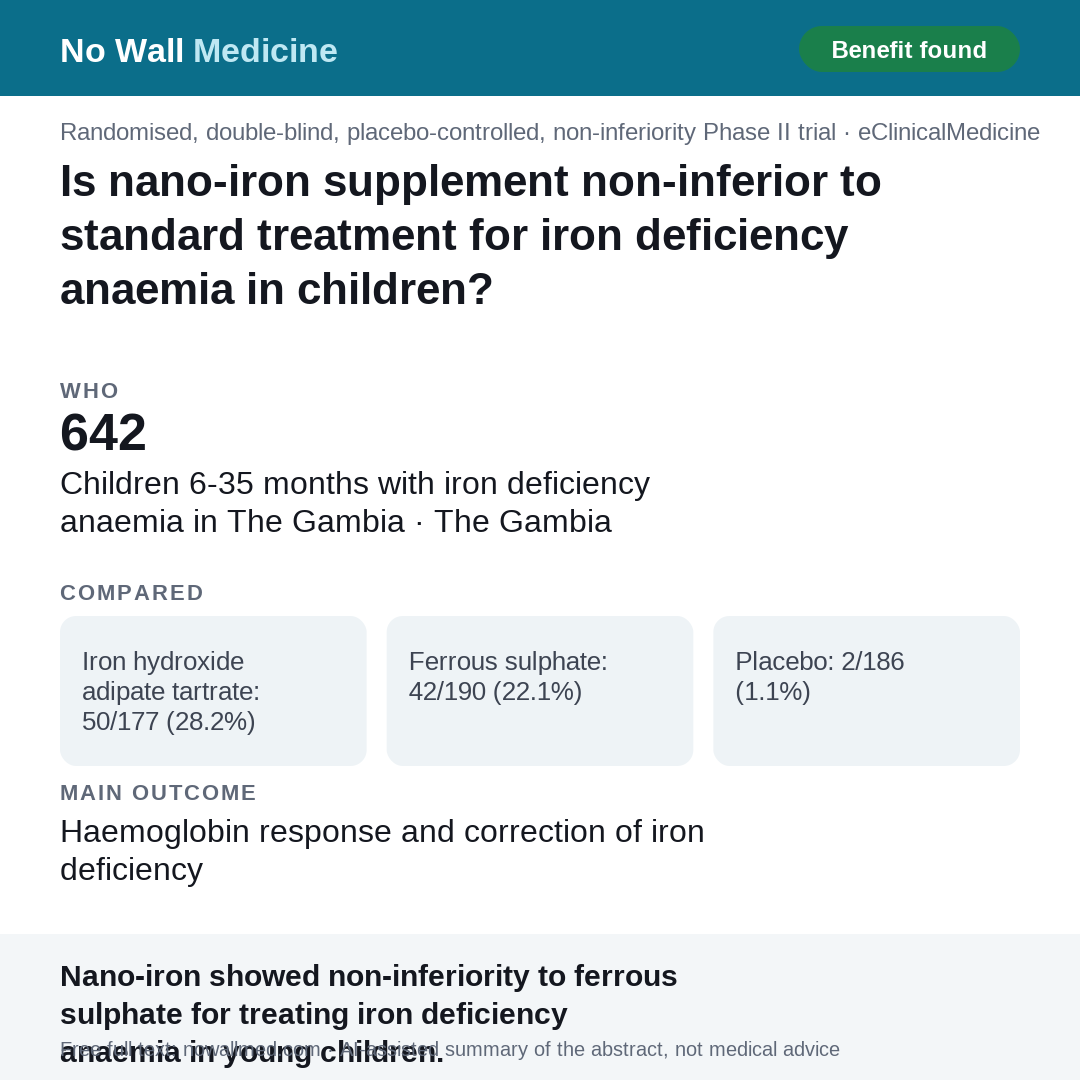
Clinical question: Is nano-iron supplement non-inferior to standard treatment for iron deficiency anaemia in children?
Key points
- Researchers studied 642 children aged 6 to 35 months in The Gambia, comparing a nano-iron supplement, ferrous sulphate, and a placebo.
- In the per-protocol analysis, 28.2% of children in the nano-iron group achieved the primary efficacy endpoint compared to 22.1% in the ferrous sulphate group.
- The incidence density of moderate-severe diarrhoea was 2.66 in the nano-iron group and 3.42 in the ferrous sulphate group.
Headline and key points written with AI from the paper’s abstract, with every number checked against it. Read the paper before relying on them.
Was this summary helpful?
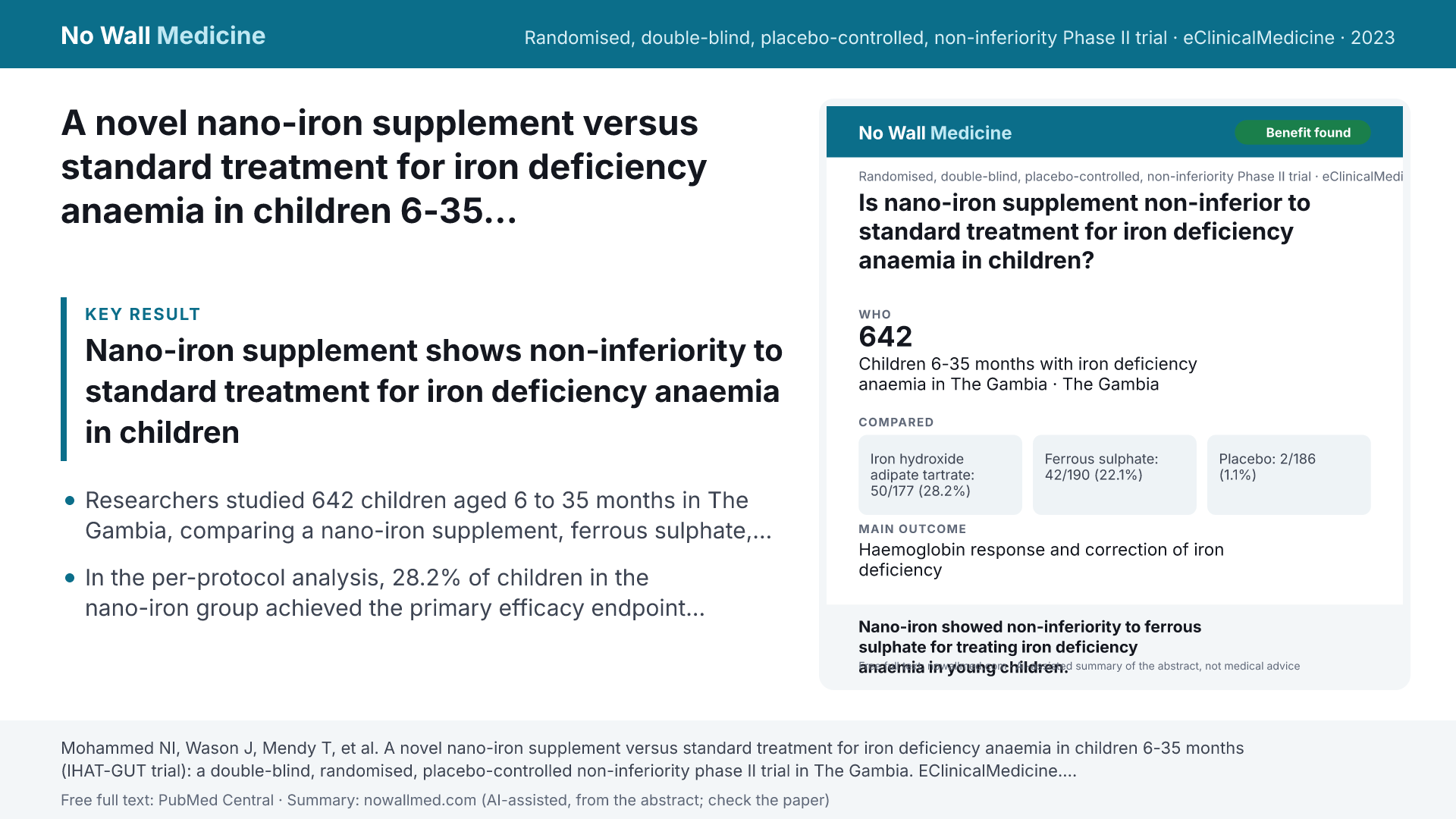
Headline, design, result, key points, caveat and citation as plain text.
Cite this article
Mohammed NI, Wason J, Mendy T, et al. A novel nano-iron supplement versus standard treatment for iron deficiency anaemia in children 6-35 months (IHAT-GUT trial): a double-blind, randomised, placebo-controlled non-inferiority phase II trial in The Gambia. EClinicalMedicine. 2023;56:101853. doi:10.1016/j.eclinm.2023.101853
Spotted a mistake? Suggest a correction