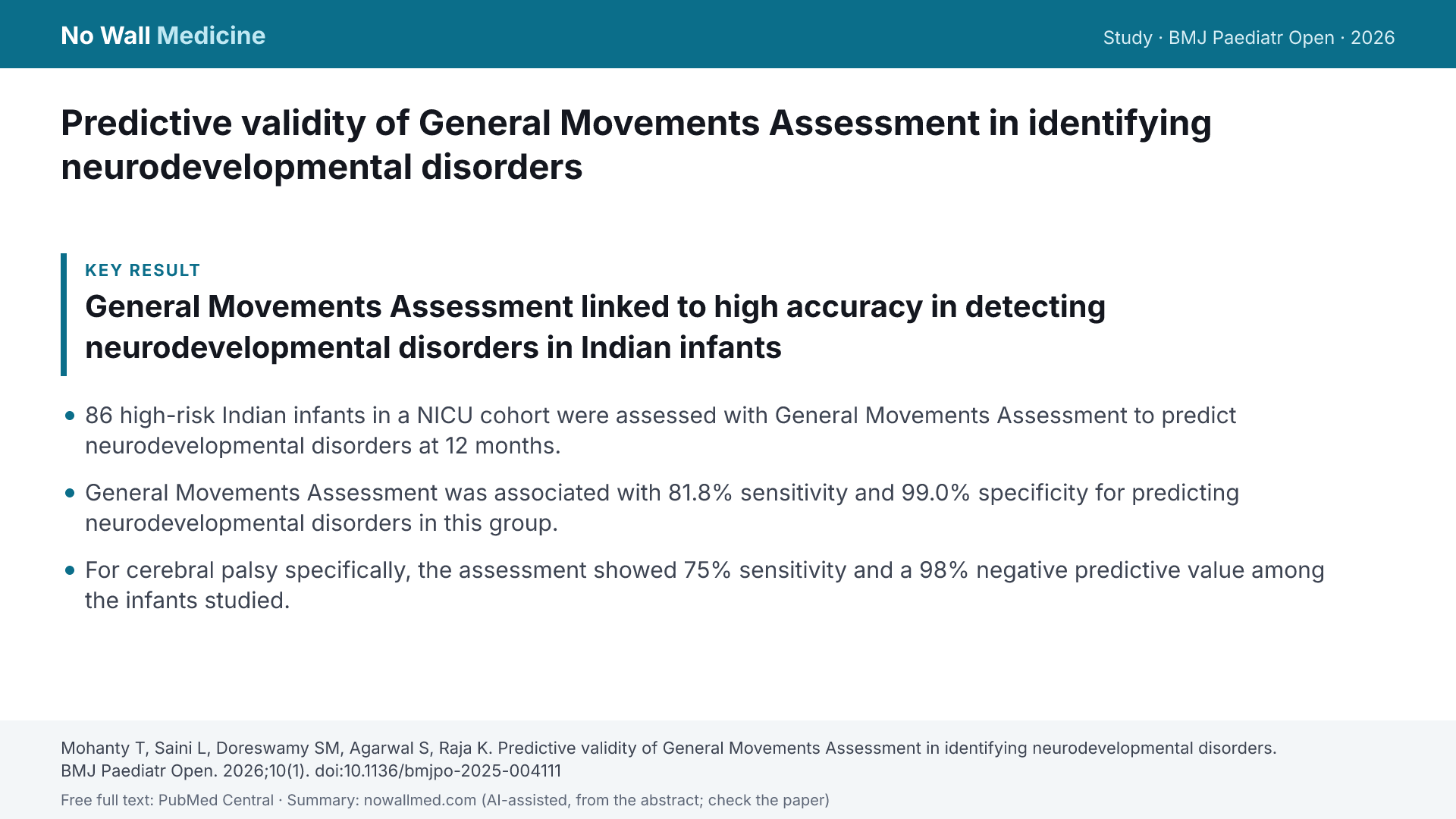
General Movements Assessment linked to high accuracy in detecting neurodevelopmental disorders in Indian infants
Predictive validity of General Movements Assessment in identifying neurodevelopmental disorders
Why it matters: The predictive validity of the General Movements Assessment for identifying neurodevelopmental disorders in Indian infants with diverse caregiving practices remained underexplored.
Key points
- 86 high-risk Indian infants in a NICU cohort were assessed with General Movements Assessment to predict neurodevelopmental disorders at 12 months.
- General Movements Assessment was associated with 81.8% sensitivity and 99.0% specificity for predicting neurodevelopmental disorders in this group.
- For cerebral palsy specifically, the assessment showed 75% sensitivity and a 98% negative predictive value among the infants studied.
Limitation the authors note: The authors highlight the need for larger, multicentre studies, including low-risk cohorts, to validate and generalise these results.
Study type: Observational study: it can show a link, but not prove that one thing causes another.
Headline and key points written with AI from the paper’s abstract, with every number checked against it. Read the paper before relying on them.
Was this summary helpful?
Headline, design, result, key points, caveat and citation as plain text.
Cite this article
Mohanty T, Saini L, Doreswamy SM, Agarwal S, Raja K. Predictive validity of General Movements Assessment in identifying neurodevelopmental disorders. BMJ Paediatr Open. 2026;10(1). doi:10.1136/bmjpo-2025-004111
Spotted a mistake? Suggest a correction