Multidimensional rehabilitation program shows feasibility and potential impact for blood and marrow transplant patients
A phase 2 study of a longitudinal multidimensional rehabilitation program for allogeneic blood and marrow transplantation patients
Phase 2 randomized controlled trialBenefit found
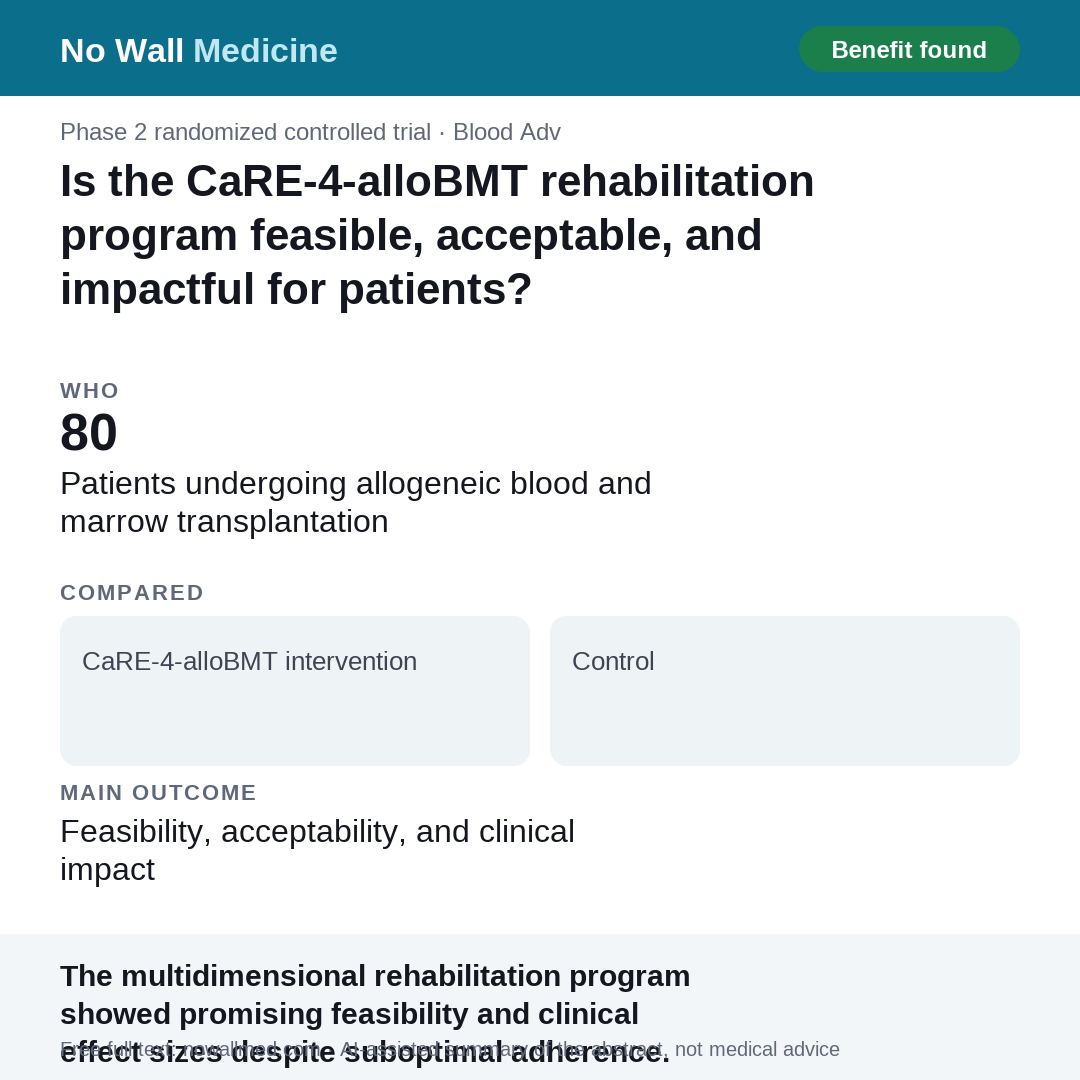
Is the CaRE-4-alloBMT rehabilitation program feasible, acceptable, and impactful for patients?
Who
80
Patients undergoing allogeneic blood and marrow transplantation
Compared
CaRE-4-alloBMT intervention
Control
Main outcome
Feasibility, acceptability, and clinical impact
Result: 0.70 (95% CI 0.20-1.21; 30-second sit-to-stand test)
Bottom line: The multidimensional rehabilitation program showed promising feasibility and clinical effect sizes despite suboptimal adherence.
Limitation: Findings are limited by missing data owing to attrition.
Blood Adv · 2024-07-10Download image
Clinical question: Is the CaRE-4-alloBMT rehabilitation program feasible, acceptable, and impactful for patients?
Why it matters: Rehabilitation programs for patients undergoing allogeneic blood and marrow transplantation are currently limited despite various treatment-related adverse events and morbidities.
Key points
- Researchers conducted a phase 2 randomized controlled trial with 80 participants undergoing allogeneic blood and marrow transplantation, a procedure where healthy stem cells from a donor are used to replace diseased ones.
- The program had a recruitment rate of 72% and a retention rate of 70%, though adherence was low with only 22.7% completion of educational modules.
- The intervention was associated with treatment effect sizes of 0.70 for the 30-second sit-to-stand test and 0.46 for the 36-Item Short Form Survey.
Limitation the authors note: The findings are limited by missing data owing to attrition.
Headline and key points written with AI from the paper’s abstract, with every number checked against it. Read the paper before relying on them.
Was this summary helpful?
Abstract
Allogeneic blood and marrow transplantation (alloBMT) is a curative treatment for blood cancers associated with various treatment-related adverse events and morbidities for which rehabilitation programs are currently limited. A phase 2 randomized controlled trial (RCT) was conducted to assess the feasibility, acceptability, and impact of CaRE-4-alloBMT, a longitudinal, multidimensional cancer rehabilitation program for patients undergoing alloBMT. The primary outcomes included the feasibility and acceptability of the intervention and the methods. Feasibility was assessed through recruitment, retention, and adherence rates. Acceptability was assessed through qualitative interviews. Secondary clinical outcomes were collected through questionnaires and physiological assessments at 4 time points. A total of 80 participants were recruited and randomized. Recruitment (72%) and retention (70%) rates, along with qualitative findings, support the feasibility of the intervention. Adherence was suboptimal, most notably educational module completion (22.7%). Treatment effect sizes of 0.70 (95% confidence interval [CI], 0.20-1.21; 30-second sit-to-stand test) and 0.46 (95% CI, -0.17 to 1.09; 36-Item Short Form Survey) were observed in favor of the intervention. The results appear promising; however, the findings are limited by missing data owing to attrition. Modifications will be required to refine the program and inform a phase 3 RCT. This trial was registered at www.ClinicalTrials.gov as #NCT04966156.
Abstract reproduced under the article’s CC BY NC ND licence.
Subject terms
Cite this article
Tam S, Alibhai SMH, Hassanieh D, Kumar R, Mattsson J, Atenafu EG. A phase 2 study of a longitudinal multidimensional rehabilitation program for allogeneic blood and marrow transplantation patients. Blood Adv. 2024. doi:10.1182/bloodadvances.2024012968
Spotted a mistake? Suggest a correction
Top studies every Monday
The week’s key trials and guidelines in your specialties, plus any topics you follow. By email, free.
Get the weekly digest