Pharmacist-led telehealth opioid tapering was associated with larger dose reductions before hip or knee replacement
A pilot multicentre randomised clinical trial to determine the effect of a pharmacist-partnered opioid tapering intervention before total hip or knee arthroplasty
Pilot multicentre randomised clinical trialBenefit found
Does a pharmacist-partnered opioid tapering intervention decrease baseline daily opioid dose?
Who
70
Patients aged 18 years or older scheduled for primary hip or knee arthroplasty · Seven hospitals in New South Wales, Australia
Compared
Pharmacist-partnered opioid tapering intervention: 27/30
Usual care: 5/30
Main outcome
Decreasing baseline daily opioid dose by 50% or more
Bottom line: A telehealth-delivered pharmacist-partnered opioid tapering service successfully decreased baseline daily opioid doses before surgery.
Anaesthesia · 2024-07-31Download image
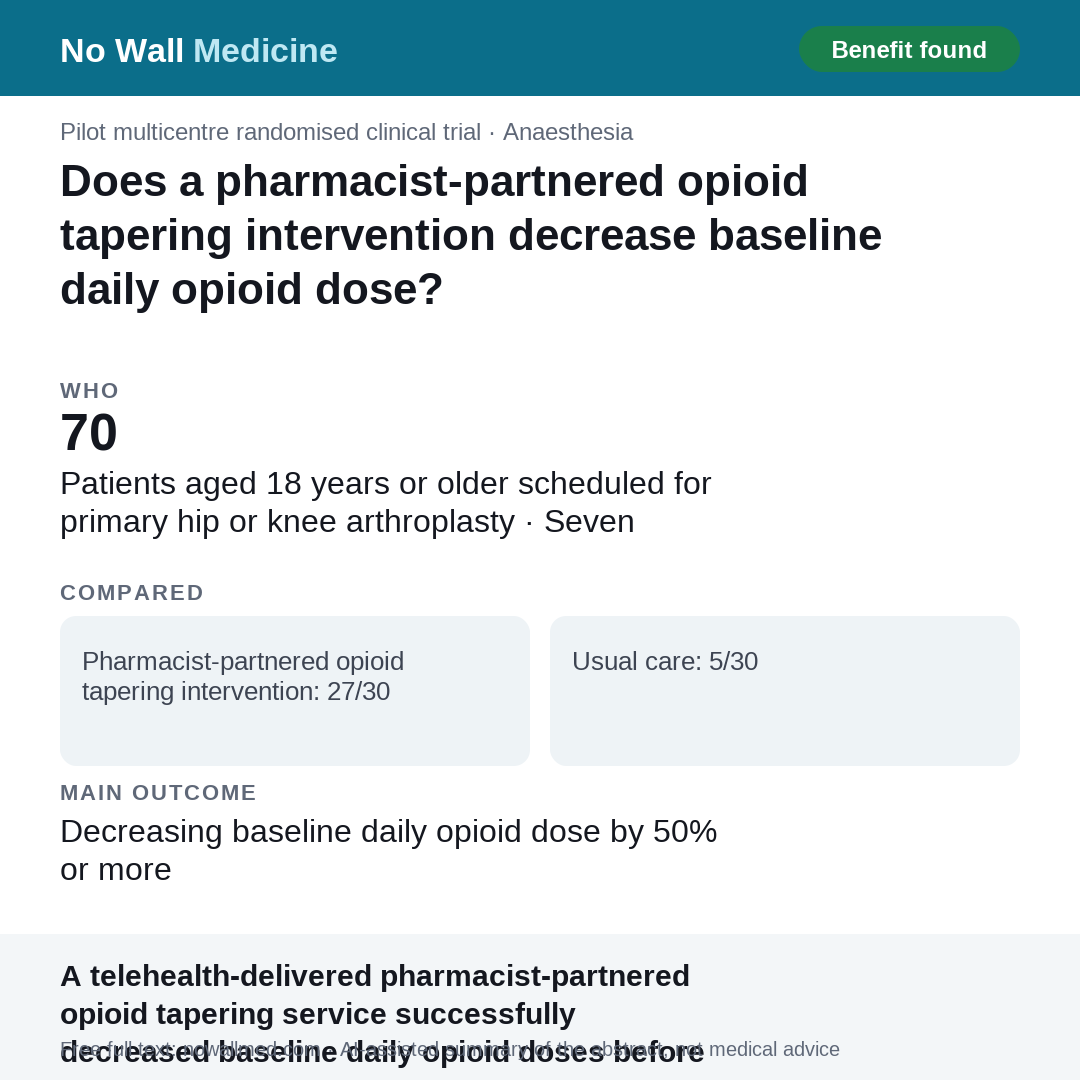
Clinical question: Does a pharmacist-partnered opioid tapering intervention decrease baseline daily opioid dose?
Why it matters: It is unknown if a telehealth-based pharmacist-partnered service can feasibly help patients reduce opioid use before elective hip or knee replacement surgery.
Key points
- Researchers conducted a pilot trial with 70 patients scheduled for hip or knee replacement surgery to compare a pharmacist-partnered telehealth tapering service with usual care.
- In the intervention group, 27/30 patients successfully decreased their baseline daily opioid dose by ≥ 50% before surgery, compared to 5/30 patients in the usual care group.
- All 35 patients assigned to the intervention group completed at least one appointment with a pharmacist, with a median of 2 appointments.
Headline and key points written with AI from the paper’s abstract, with every number checked against it. Read the paper before relying on them.
Topics
Cite this article
Liu S, Patanwala AE, Stevens J, Penm J, Naylor J, OpioidHALT Study Investigators and Coordinators. A pilot multicentre randomised clinical trial to determine the effect of a pharmacist-partnered opioid tapering intervention before total hip or knee arthroplasty. Anaesthesia. 2024. doi:10.1111/anae.16390
Spotted a mistake? Suggest a correction
Top studies every Monday
The week’s key trials and guidelines in your specialties, by email. Free.
Get the weekly digest