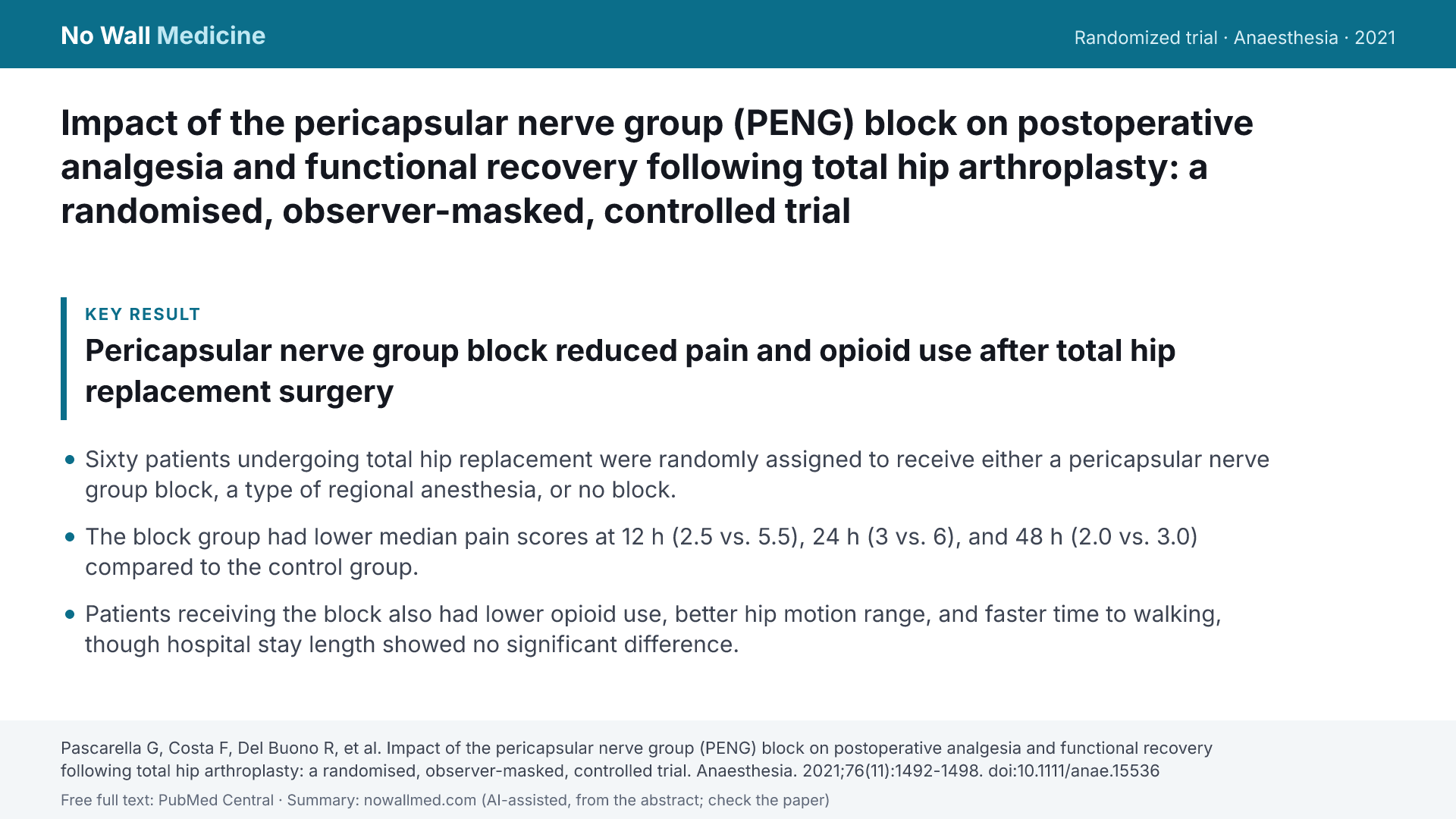
Pericapsular nerve group block reduced pain and opioid use after total hip replacement surgery
Impact of the pericapsular nerve group (PENG) block on postoperative analgesia and functional recovery following total hip arthroplasty: a randomised, observer-masked, controlled trial
Why it matters: Evidence is currently lacking regarding whether the pericapsular nerve group block provides hip pain relief while preserving motor function after total hip replacement.
Key points
- Sixty patients undergoing total hip replacement were randomly assigned to receive either a pericapsular nerve group block, a type of regional anesthesia, or no block.
- The block group had lower median pain scores at 12 h (2.5 vs. 5.5), 24 h (3 vs. 6), and 48 h (2.0 vs. 3.0) compared to the control group.
- Patients receiving the block also had lower opioid use, better hip motion range, and faster time to walking, though hospital stay length showed no significant difference.
Limitation the authors note: This was a single-centre trial.
Headline and key points written with AI from the paper’s abstract, with every number checked against it. Read the paper before relying on them.
Was this summary helpful?
Subject terms
Cite this article
Pascarella G, Costa F, Del Buono R, Pulitanò R, Strumia A, Piliego C. Impact of the pericapsular nerve group (PENG) block on postoperative analgesia and functional recovery following total hip arthroplasty: a randomised, observer-masked, controlled trial. Anaesthesia. 2021. doi:10.1111/anae.15536
Spotted a mistake? Suggest a correction
Top studies every Monday
The week’s key trials and guidelines in your specialties, plus any topics you follow. By email, free.
Get the weekly digest