Impact of the pericapsular nerve group (PENG) block on postoperative analgesia and functional recovery following total hip arthroplasty: a randomised, observer-masked, controlled trial
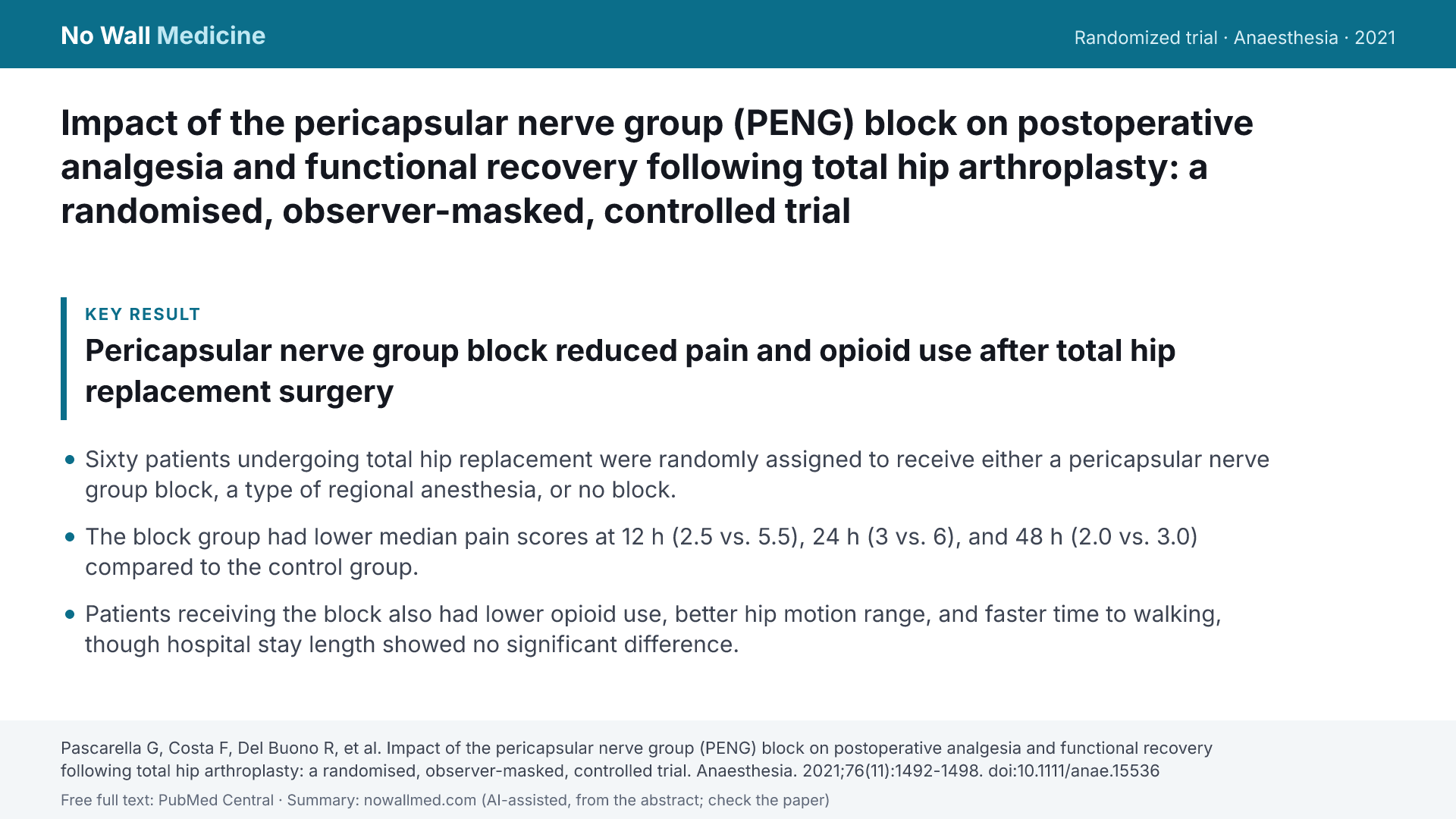
Key result: Pericapsular nerve group block reduced pain and opioid use after total hip replacement surgery
Key points
- Sixty patients undergoing total hip replacement were randomly assigned to receive either a pericapsular nerve group block, a type of regional anesthesia, or no block.
- The block group had lower median pain scores at 12 h (2.5 vs. 5.5), 24 h (3 vs. 6), and 48 h (2.0 vs. 3.0) compared to the control group.
- Patients receiving the block also had lower opioid use, better hip motion range, and faster time to walking, though hospital stay length showed no significant difference.
Why it matters: Evidence is currently lacking regarding whether the pericapsular nerve group block provides hip pain relief while preserving motor function after total hip replacement.
Limitation the authors note: This was a single-centre trial.
Discussion prompts
- Would these patients look like yours? Who was left out?
- Is the main outcome one that matters to patients?
- Is the difference large enough to change what you do?
Cite: Pascarella G, Costa F, Del Buono R, et al. Impact of the pericapsular nerve group (PENG) block on postoperative analgesia and functional recovery following total hip arthroplasty: a randomised, observer-masked, controlled trial. Anaesthesia. 2021;76(11):1492-1498. doi:10.1111/anae.15536
Free full text: PubMed Central · Summary and visual abstract: nowallmed.com/a/impact-of-the-pericapsular-nerve-group-peng-block-on-postoperative-d37blw/ (AI-assisted from the abstract; check the paper before relying on it).