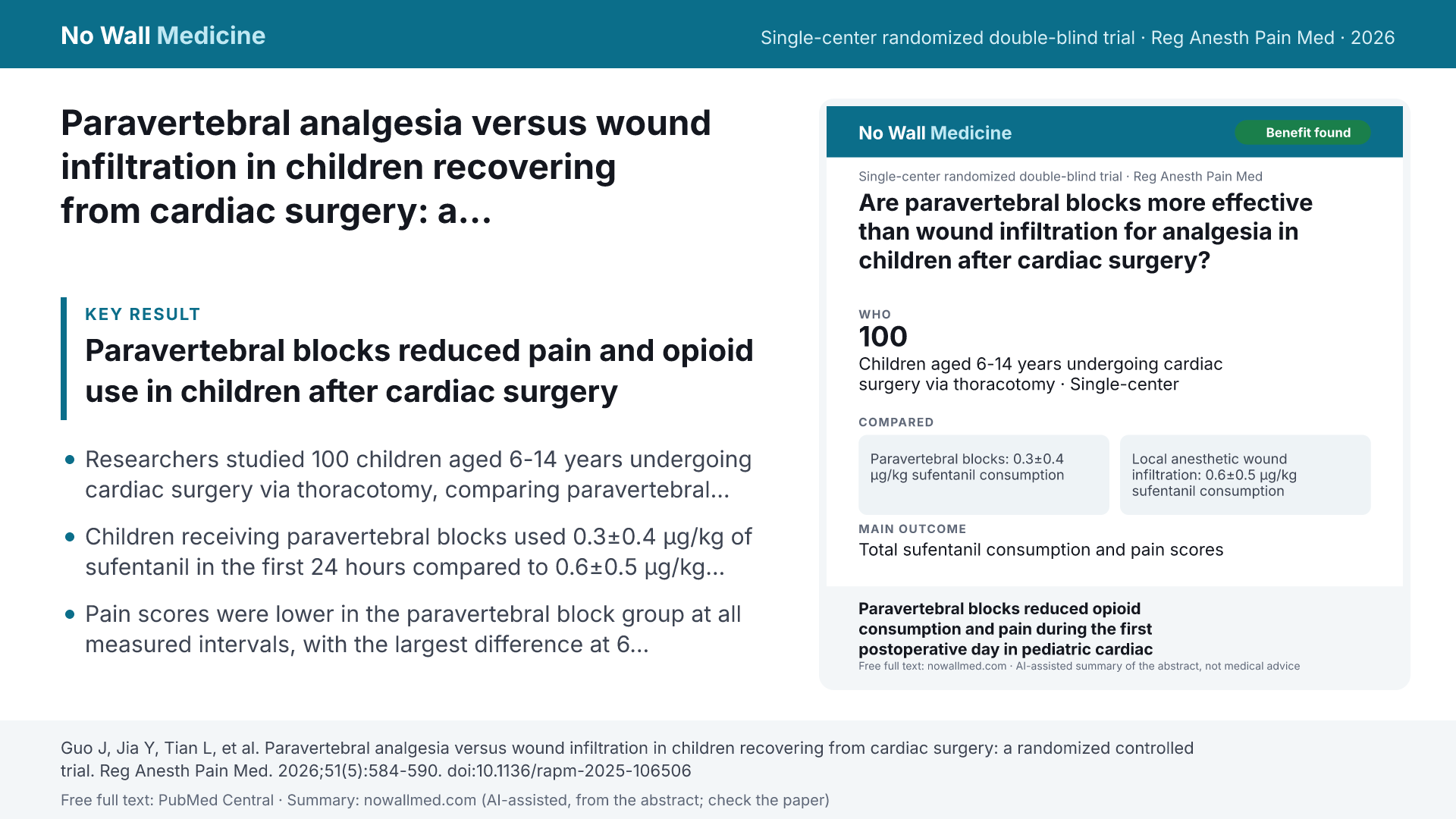
Paravertebral blocks reduced pain and opioid use in children after cardiac surgery
Paravertebral analgesia versus wound infiltration in children recovering from cardiac surgery: a randomized controlled trial
Single-center randomized double-blind trialBenefit found
Are paravertebral blocks more effective than wound infiltration for analgesia in children after cardiac surgery?
Who
100
Children aged 6-14 years undergoing cardiac surgery via thoracotomy · Single-center
Compared
Paravertebral blocks: 0.3±0.4 µg/kg sufentanil consumption
Local anesthetic wound infiltration: 0.6±0.5 µg/kg sufentanil consumption
Main outcome
Total sufentanil consumption and pain scores
Bottom line: Paravertebral blocks reduced opioid consumption and pain during the first postoperative day in pediatric cardiac thoracotomies.
Reg Anesth Pain Med · 2026-05-05 · Save PNG
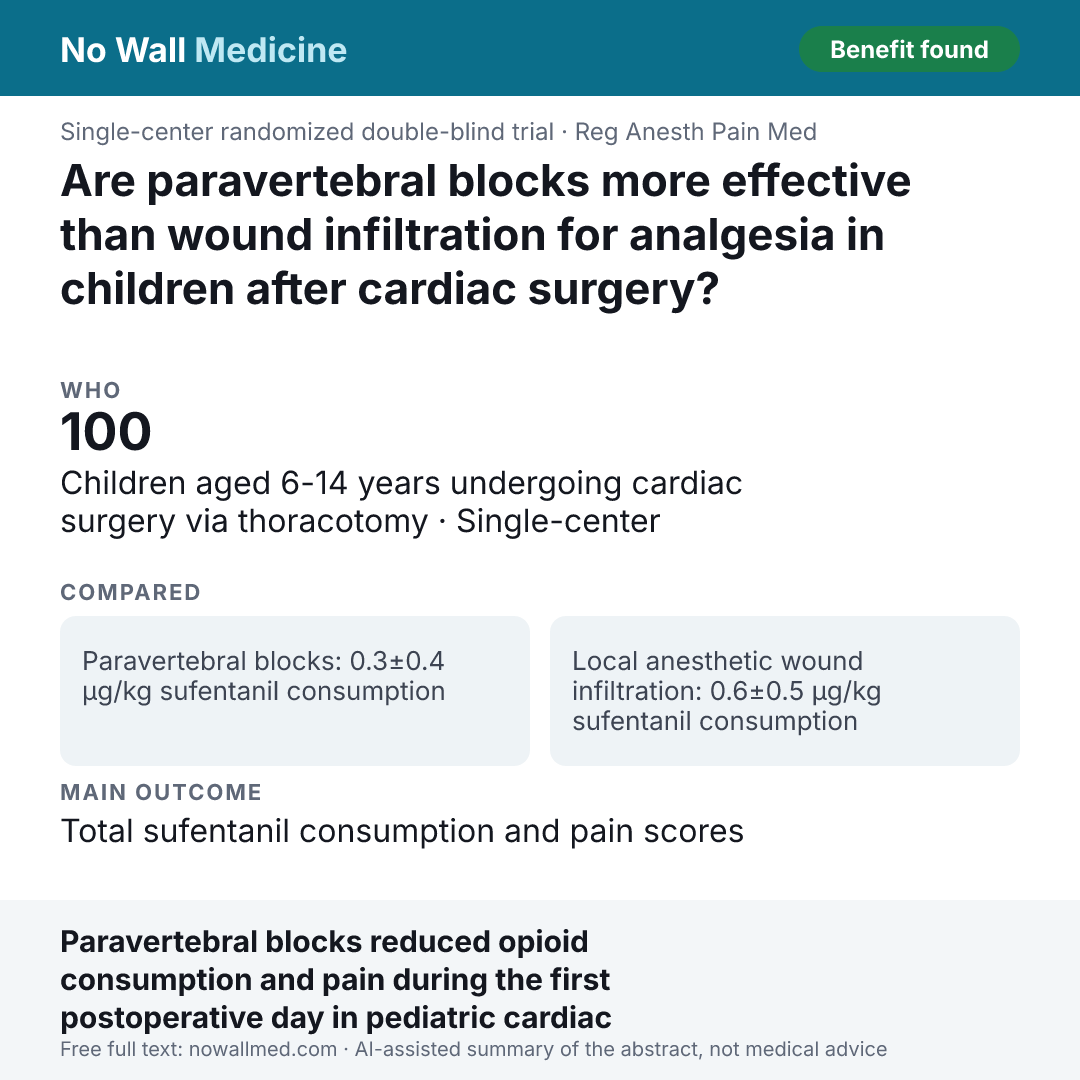
Clinical question: Are paravertebral blocks more effective than wound infiltration for analgesia in children after cardiac surgery?
Key points
- Researchers studied 100 children aged 6-14 years undergoing cardiac surgery via thoracotomy, comparing paravertebral blocks to local anesthetic wound infiltration.
- Children receiving paravertebral blocks used 0.3±0.4 µg/kg of sufentanil in the first 24 hours compared to 0.6±0.5 µg/kg in the wound infiltration group.
- Pain scores were lower in the paravertebral block group at all measured intervals, with the largest difference at 6 hours (1.7±2.2 vs 3.3±2.2).
Limitation the authors note: This was a single-center randomized trial.
Headline and key points written with AI from the paper’s abstract, with every number checked against it. Read the paper before relying on them.
Was this summary helpful?
Abstract
Introduction
Optimal analgesia for thoracotomies remains unclear. Paravertebral blocks are more complex than local anesthetic infiltration but may be more effective. We therefore tested the hypothesis that paravertebral blocks provide better postoperative analgesia than local anesthetic infiltration in children recovering from cardiac surgery thoracotomies. Methods
This was a single-center randomized double-blind trial. We recruited children aged 6-14 years with atrial or ventricular septal defects scheduled for cardiac surgery with cardiopulmonary bypass via thoracotomy were recruited. 100 patients were enrolled and randomized to either postoperative paravertebral blocks (n=50) or local anesthetic wound infiltration (n=50). We recorded opioid consumption during the initial 24 hours after surgery, along with pain scores at 6 hour intervals. Complications including postoperative nausea and vomiting and respiratory failure were also recorded. Results
100 patients (mean 7 years, 43% male) were included in the analysis. The only postoperative opioid used was sufentanil. Total sufentanil consumption in the first 24 hours postsurgery was 0.3±0.4 µg/kg for those receiving paravertebral blocks, significantly lower than the 0.6±0.5 µg/kg for wound infiltration (p=0.002). Faces Pain Scale-Revised pain scores were consistently lower in the paravertebral block group across all measured time points (6, 12, 18, and 24 hours), with the most pronounced difference observed at 6 hours postoperatively (1.7±2.2 vs 3.3±2.2; p<0.001). Postoperative mechanical ventilation time, ICU stay, hospitalization, and incidence of postoperative nausea and vomiting were comparable. Conclusion
Paravertebral blocks reduced opioid consumption and pain during the first postoperative day in pediatric cardiac thoracotomies but did not accelerate recovery.
Abstract reproduced under the article’s CC BY NC licence.
Subject terms
Headline, design, result, key points, caveat and citation as plain text.
Cite this article
Guo J, Jia Y, Tian L, et al. Paravertebral analgesia versus wound infiltration in children recovering from cardiac surgery: a randomized controlled trial. Reg Anesth Pain Med. 2026;51(5):584-590. doi:10.1136/rapm-2025-106506
Spotted a mistake? Suggest a correction