Suprazygomatic maxillary nerve block reduces postoperative opioid use in pediatric cleft palate surgery
Effectiveness of suprazygomatic maxillary nerve block on postoperative opioid use in pediatric primary cleft palate surgery: A systematic review of the literature
Systematic review with narrative synthesisBenefit found
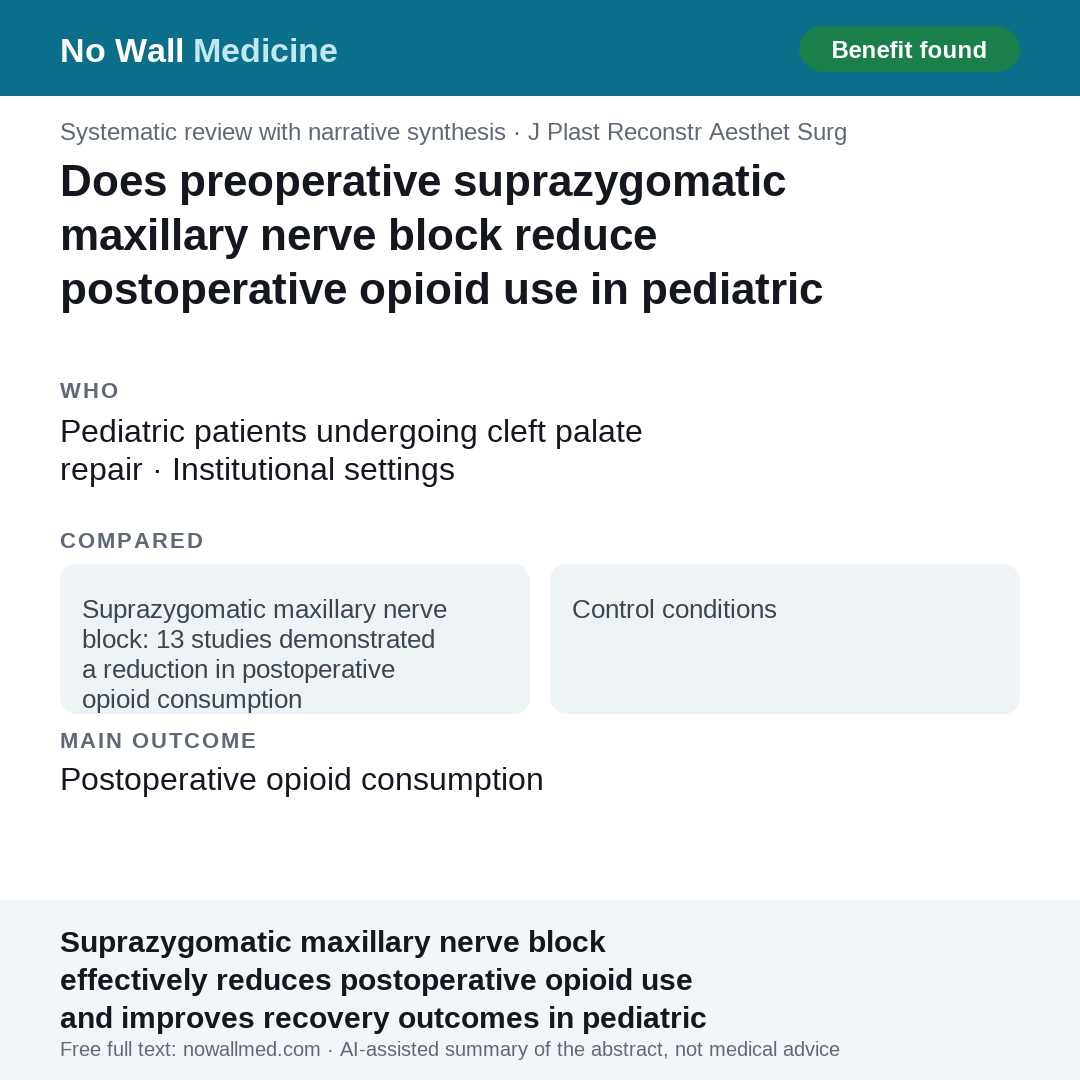
Does preoperative suprazygomatic maxillary nerve block reduce postoperative opioid use in pediatric cleft palate surgery?
Who
Pediatric patients undergoing cleft palate repair · Institutional settings
Compared
Suprazygomatic maxillary nerve block: 13 studies demonstrated a reduction in postoperative opioid consumption
Control conditions
Main outcome
Postoperative opioid consumption
Bottom line: Suprazygomatic maxillary nerve block effectively reduces postoperative opioid use and improves recovery outcomes in pediatric cleft palate surgery.
Limitation: Methodological heterogeneity and bias due to confounding or subjective assessments.
J Plast Reconstr Aesthet Surg · 2025-05-07Download image
Clinical question: Does preoperative suprazygomatic maxillary nerve block reduce postoperative opioid use in pediatric cleft palate surgery?
Key points
- 15 studies assessed pediatric patients undergoing cleft palate repair with SMNB.
- 13 studies showed a reduction in postoperative opioid consumption following SMNB.
- 5 studies showed statistically significant differences in opioid use.
Limitation the authors note: Methodological heterogeneity and bias due to confounding or subjective assessments were noted in 3 studies, limiting meta-analysis
Headline and key points written with AI from the paper’s abstract, with every number checked against it. Read the paper before relying on them.
Topics
Cite this article
Wijnants N, Kappen IFPM, van Kuijk SMJ, Hanot J, Najafi N, Booi DI. Effectiveness of suprazygomatic maxillary nerve block on postoperative opioid use in pediatric primary cleft palate surgery: A systematic review of the literature. J Plast Reconstr Aesthet Surg. 2025. doi:10.1016/j.bjps.2025.04.046
Spotted a mistake? Suggest a correction
Top studies every Monday
The week’s key trials and guidelines in your specialties, by email. Free.
Get the weekly digest