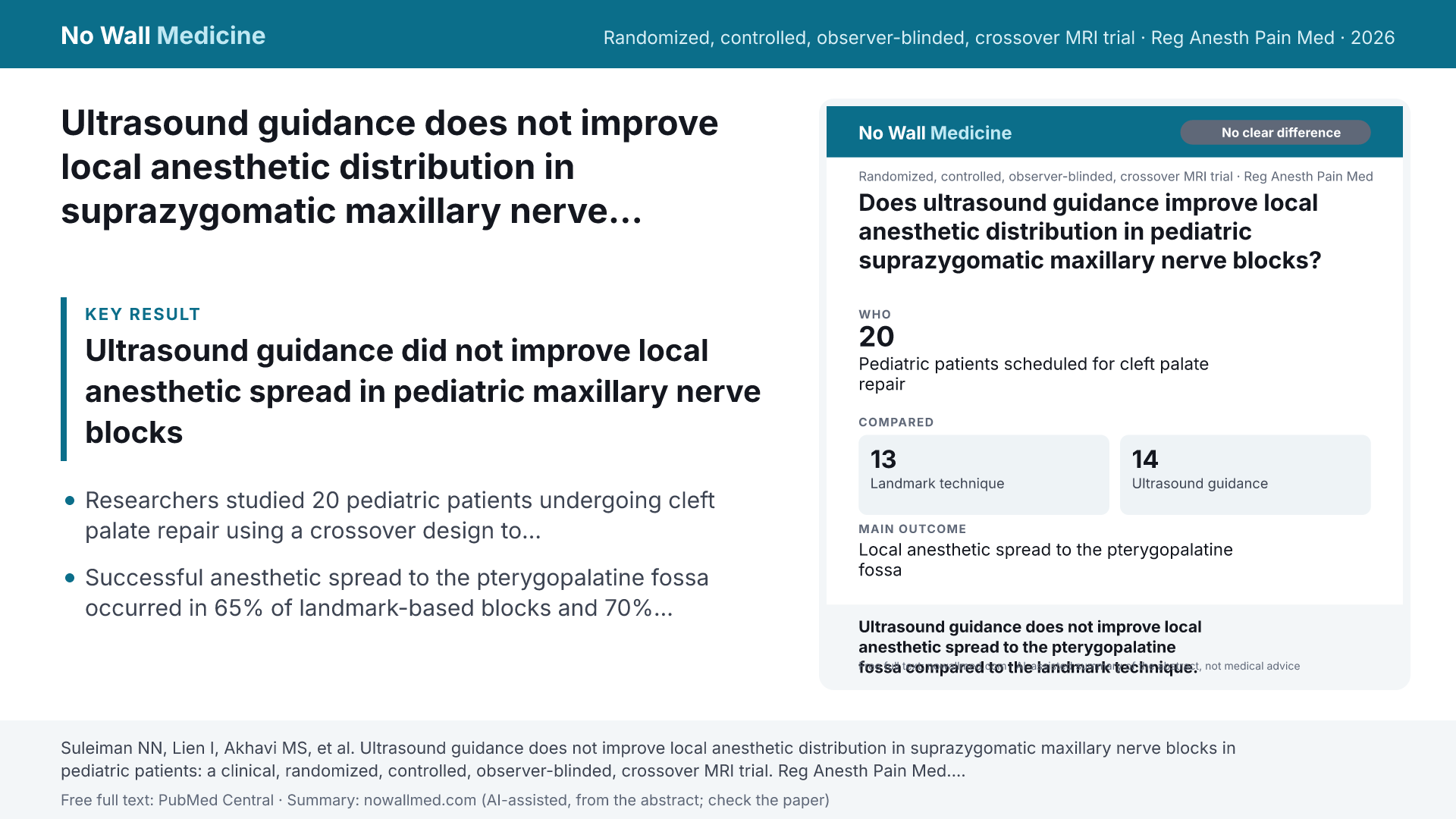
Ultrasound guidance did not improve local anesthetic spread in pediatric maxillary nerve blocks
Ultrasound guidance does not improve local anesthetic distribution in suprazygomatic maxillary nerve blocks in pediatric patients: a clinical, randomized, controlled, observer-blinded, crossover MRI trial
Randomized, controlled, observer-blinded, crossover MRI trialNo clear difference
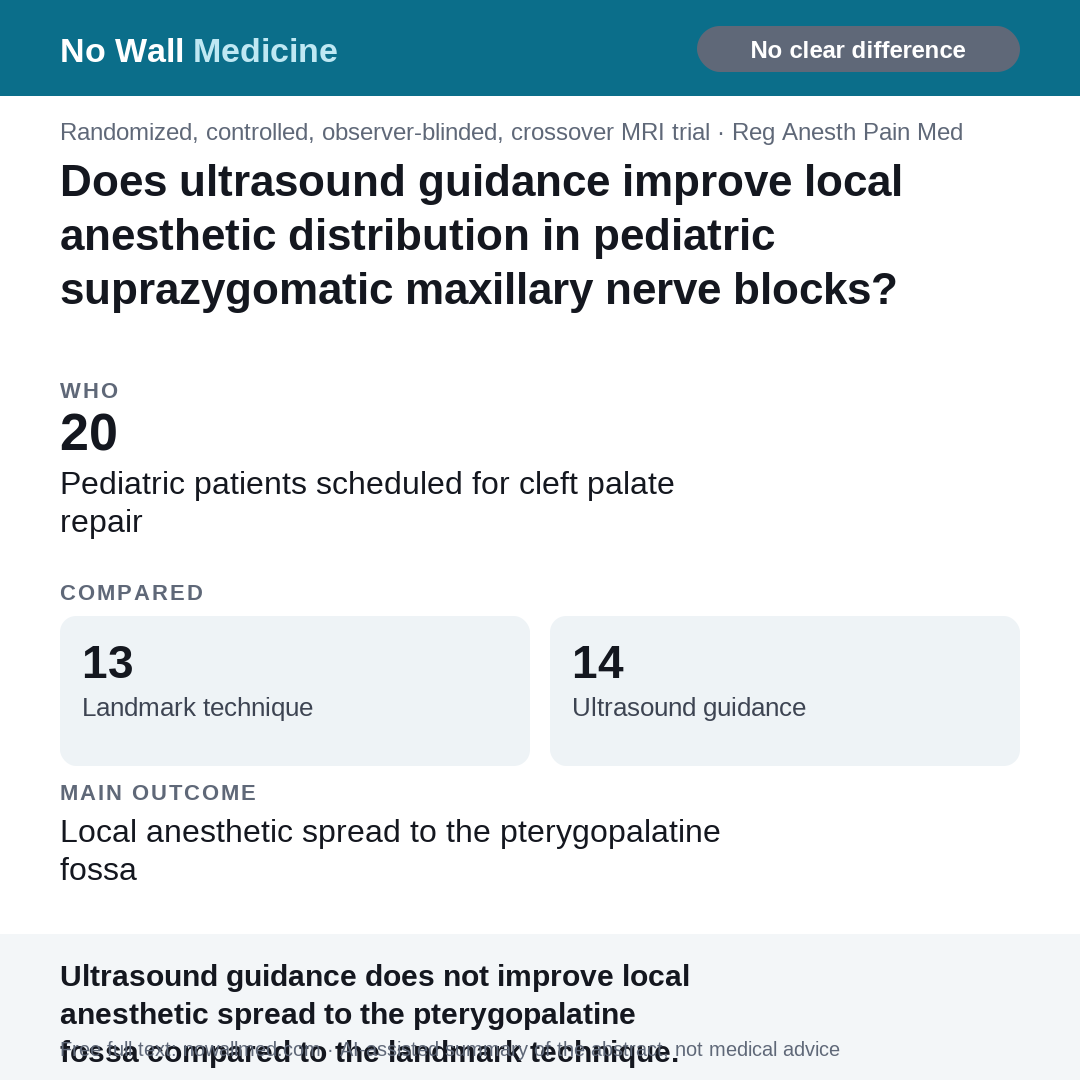
Does ultrasound guidance improve local anesthetic distribution in pediatric suprazygomatic maxillary nerve blocks?
Who
20
Pediatric patients scheduled for cleft palate repair
Compared
13Landmark technique (65%)
14Ultrasound guidance (70%)
Main outcome
Local anesthetic spread to the pterygopalatine fossa
Bottom line: Ultrasound guidance does not improve local anesthetic spread to the pterygopalatine fossa compared to the landmark technique.
Reg Anesth Pain Med · 2026-06-05Download image
Clinical question: Does ultrasound guidance improve local anesthetic distribution in pediatric suprazygomatic maxillary nerve blocks?
Key points
- Researchers studied 20 pediatric patients undergoing cleft palate repair using a crossover design to compare landmark-based and ultrasound-guided nerve blocks.
- Successful anesthetic spread to the pterygopalatine fossa occurred in 65% of landmark-based blocks and 70% of ultrasound-guided blocks.
- No adverse events or complications were observed during or after the block procedures.
Headline and key points written with AI from the paper’s abstract, with every number checked against it. Read the paper before relying on them.
Was this summary helpful?
Abstract
Background
Maxillary nerve blocks are often used as part of a multimodal postoperative pain management regimen for children undergoing cleft palate surgery. It has not been demonstrated yet that ultrasound guidance provides superior local anesthetic distribution and better success rates compared with the landmark-based block technique. The aim of the study was to compare the effect of ultrasound guidance for suprazygomatic maxillary nerve blocks on local anesthetic spread to the pterygopalatine fossa. Methods
20 pediatric patients scheduled for cleft palate repair received bilateral suprazygomatic maxillary blocks. Landmark technique was used on one side and ultrasound guidance on the contralateral side according to randomization. After the block procedure, MRI was used to determine the spread of the local anesthetic. Results
Local anesthetic spread to the pterygopalatine fossa with contact to the maxillary nerve (defined as successful block) was observed in 13 (65%) of the landmark-based blocks and in 14 (70%) of the ultrasound-guided blocks (p=0.56). No adverse events or complications were observed during or after the block procedures. Conclusion
Appropriate pain management for cleft palate repair can be achieved without the availability of imaging guidance. Future studies should focus on improving the success rate of maxillary nerve blocks, both with and without the aid of sonography. Trial registration number
NCT05778903.
Abstract reproduced under the article’s CC BY NC licence.
Subject terms
Cite this article
Suleiman NN, Lien I, Akhavi MS, et al. Ultrasound guidance does not improve local anesthetic distribution in suprazygomatic maxillary nerve blocks in pediatric patients: a clinical, randomized, controlled, observer-blinded, crossover MRI trial. Reg Anesth Pain Med. 2026;51(6):700-706. doi:10.1136/rapm-2025-106439
Spotted a mistake? Suggest a correction