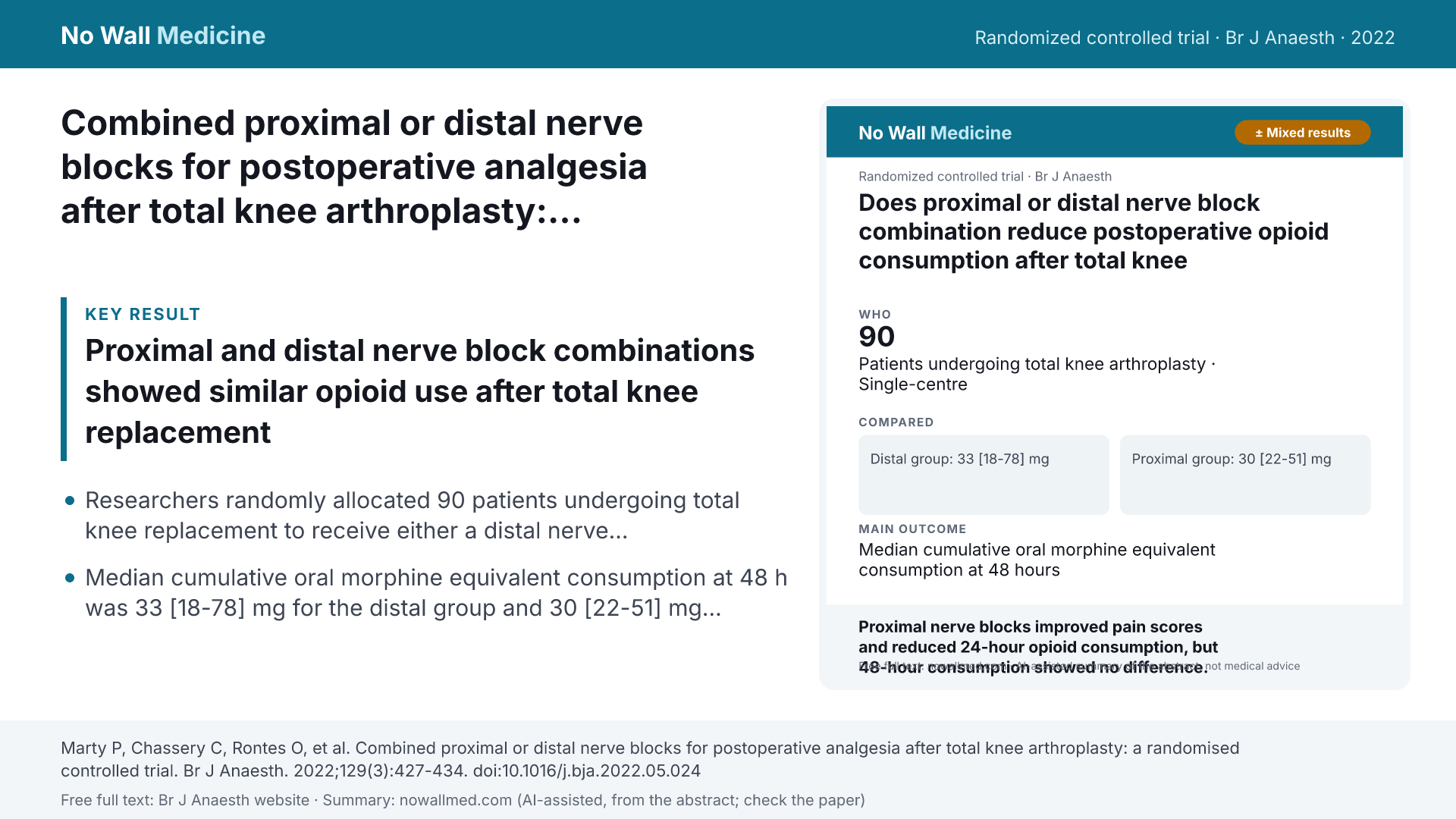
Proximal and distal nerve block combinations showed similar opioid use after total knee replacement
Combined proximal or distal nerve blocks for postoperative analgesia after total knee arthroplasty: a randomised controlled trial
Randomized controlled trialMixed results
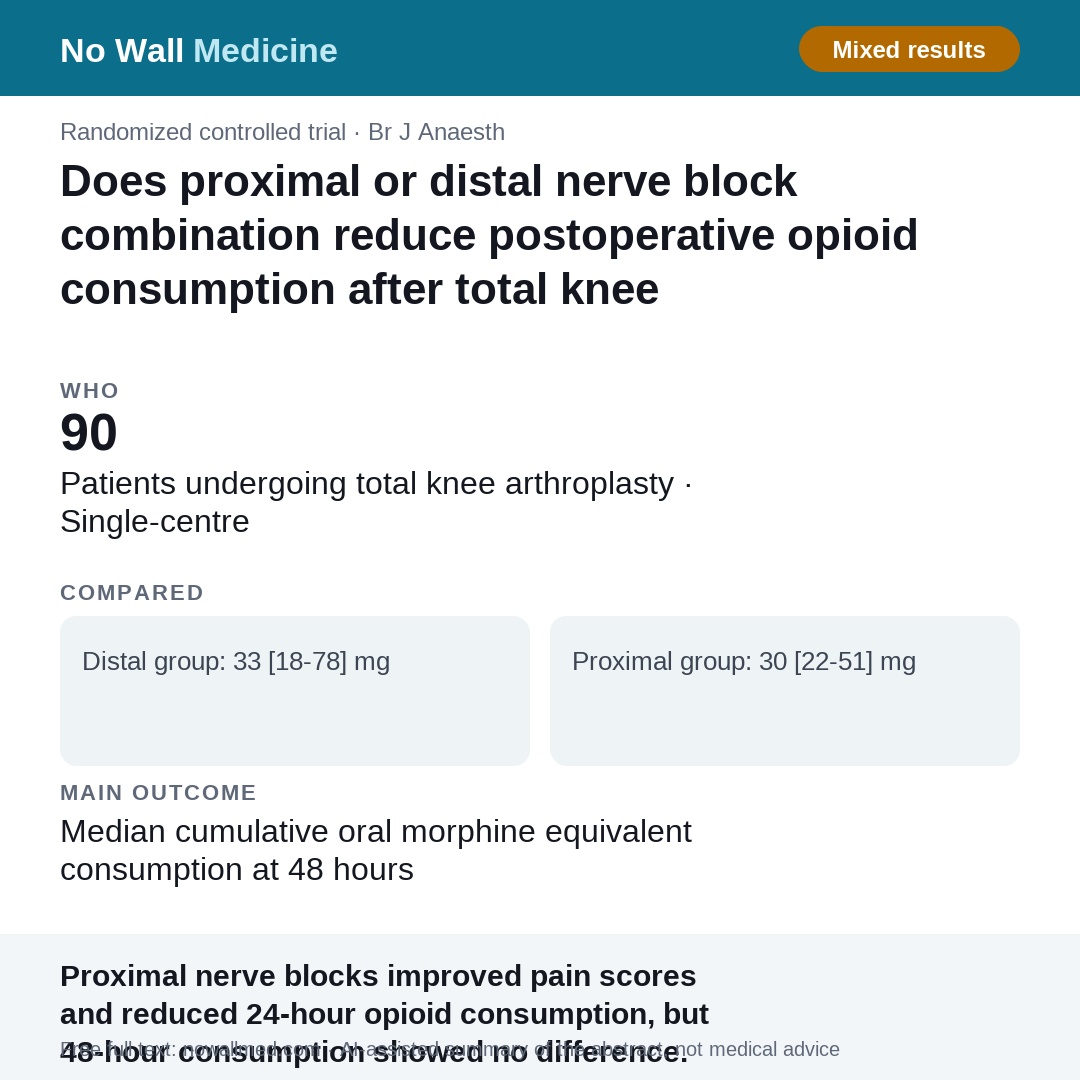
Does proximal or distal nerve block combination reduce postoperative opioid consumption after total knee arthroplasty?
Who
90
Patients undergoing total knee arthroplasty · Single-centre
Compared
Distal group: 33 [18-78] mg
Proximal group: 30 [22-51] mg
Main outcome
Median cumulative oral morphine equivalent consumption at 48 hours
Bottom line: Proximal nerve blocks improved pain scores and reduced 24-hour opioid consumption, but 48-hour consumption showed no difference.
Br J Anaesth · 2022-06-28Download image
Clinical question: Does proximal or distal nerve block combination reduce postoperative opioid consumption after total knee arthroplasty?
Why it matters: The best regional anesthesia strategy for managing pain after total knee arthroplasty remains unclear.
Key points
- Researchers randomly allocated 90 patients undergoing total knee replacement to receive either a distal nerve block combination or a proximal nerve block combination.
- Median cumulative oral morphine equivalent consumption at 48 h was 33 [18-78] mg for the distal group and 30 [22-51] mg for the proximal group.
- The proximal group had lower median oral morphine equivalent consumption at 24 h (15 [0-18] mg) compared to the distal group (30 [13-59] mg).
Limitation the authors note: This was a single-centre study.
Headline and key points written with AI from the paper’s abstract, with every number checked against it. Read the paper before relying on them.
Was this summary helpful?
Subject terms
Cite this article
Marty P, Chassery C, Rontes O, et al. Combined proximal or distal nerve blocks for postoperative analgesia after total knee arthroplasty: a randomised controlled trial. Br J Anaesth. 2022. doi:10.1016/j.bja.2022.05.024
Spotted a mistake? Suggest a correction