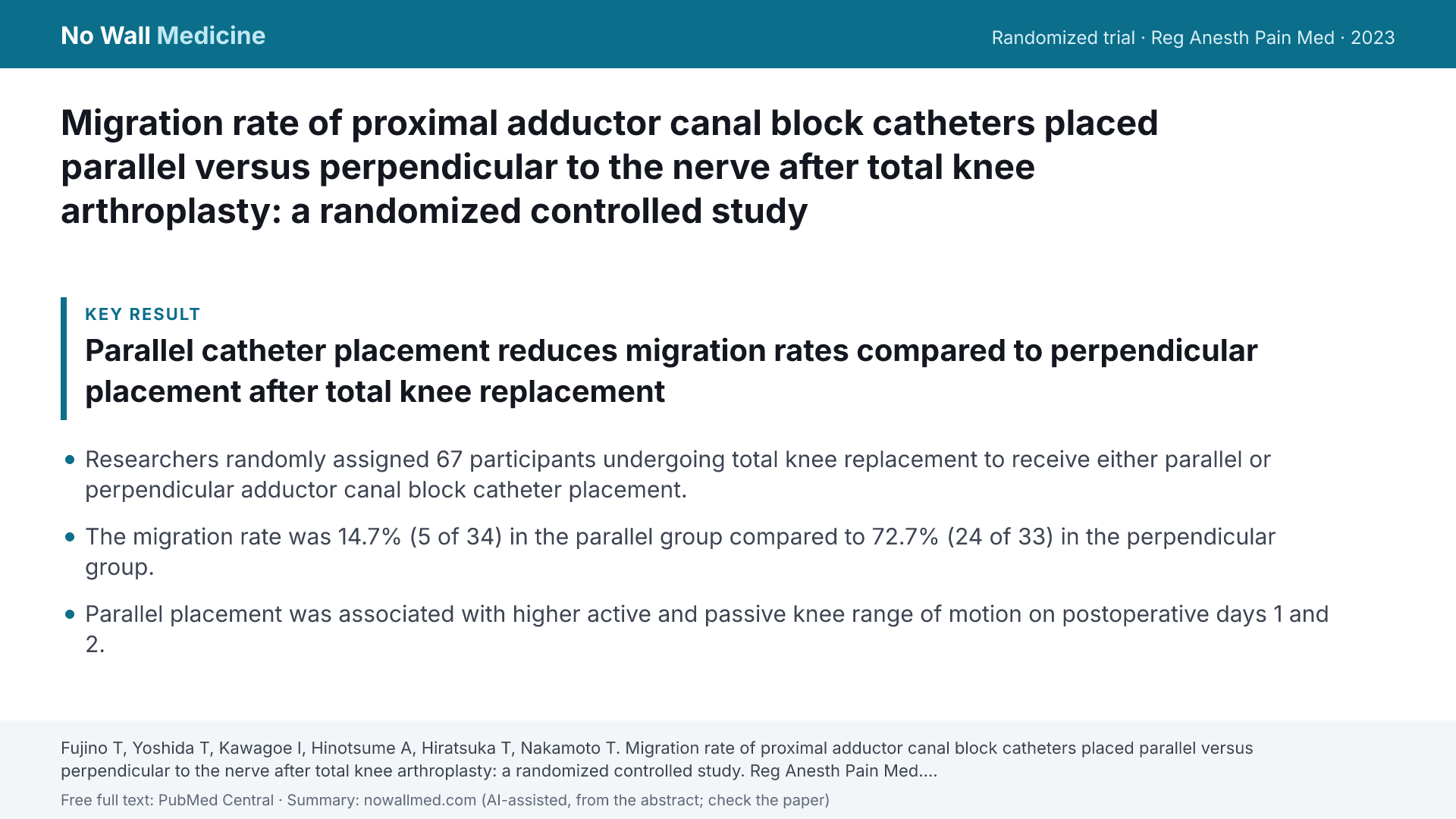
Parallel catheter placement reduces migration rates compared to perpendicular placement after total knee replacement
Migration rate of proximal adductor canal block catheters placed parallel versus perpendicular to the nerve after total knee arthroplasty: a randomized controlled study
Key points
- Researchers randomly assigned 67 participants undergoing total knee replacement to receive either parallel or perpendicular adductor canal block catheter placement.
- The migration rate was 14.7% (5 of 34) in the parallel group compared to 72.7% (24 of 33) in the perpendicular group.
- Parallel placement was associated with higher active and passive knee range of motion on postoperative days 1 and 2.
Headline and key points written with AI from the paper’s abstract, with every number checked against it. Read the paper before relying on them.
Was this summary helpful?
Abstract
Background
Perineural catheters placed parallel to the nerve course are reported to have lower migration rates than those placed perpendicular to it. However, catheter migration rates for a continuous adductor canal block (ACB) remain unknown. This study compared postoperative migration rates of proximal ACB catheters placed parallel and perpendicular to the saphenous nerve. Methods
Seventy participants scheduled for unilateral primary total knee arthroplasty were randomly assigned for parallel or perpendicular placement of the ACB catheter. The primary outcome was the migration rate of the ACB catheter on postoperative day (POD) 2. Catheter migration was defined as being unable to confirm saline administration via the catheter around the saphenous nerve at the mid-thigh level under ultrasound guidance. Secondary outcomes included active and passive range of motion (ROM) of the knee on postoperative rehabilitation. Results
Sixty-seven participants were included in the final analyses. The catheter migrated significantly less often in the parallel group (5 of 34 (14.7%)) than in the perpendicular group (24 of 33 (72.7%)) (p<0.001). The mean (SD) active and passive knee flexion ROM (degrees) improved significantly in the parallel than in the perpendicular group (POD 1: active, 88.4 (13.2) vs 80.0 (12.4), p=0.011; passive, 95.6 (12.8) vs 85.7 (13.6), p=0.004; POD 2: active, 88.7 (13.4) vs 82.2 (11.5), p=0.036; passive, 97.2 (12.8) vs 91.0 (12.0), p=0.045). Conclusion
Parallel placement of the ACB catheter provided a lower postoperative catheter migration rate than perpendicular placement of the ACB catheter along with corresponding improvements in ROM and secondary analgesic outcomes. Trial registration number
UMIN000045374.
Abstract reproduced under the article’s CC BY NC licence.
Subject terms
Headline, design, result, key points, caveat and citation as plain text.
Cite this article
Fujino T, Yoshida T, Kawagoe I, Hinotsume A, Hiratsuka T, Nakamoto T. Migration rate of proximal adductor canal block catheters placed parallel versus perpendicular to the nerve after total knee arthroplasty: a randomized controlled study. Reg Anesth Pain Med. 2023;48(8):420-424. doi:10.1136/rapm-2022-104303
Spotted a mistake? Suggest a correction