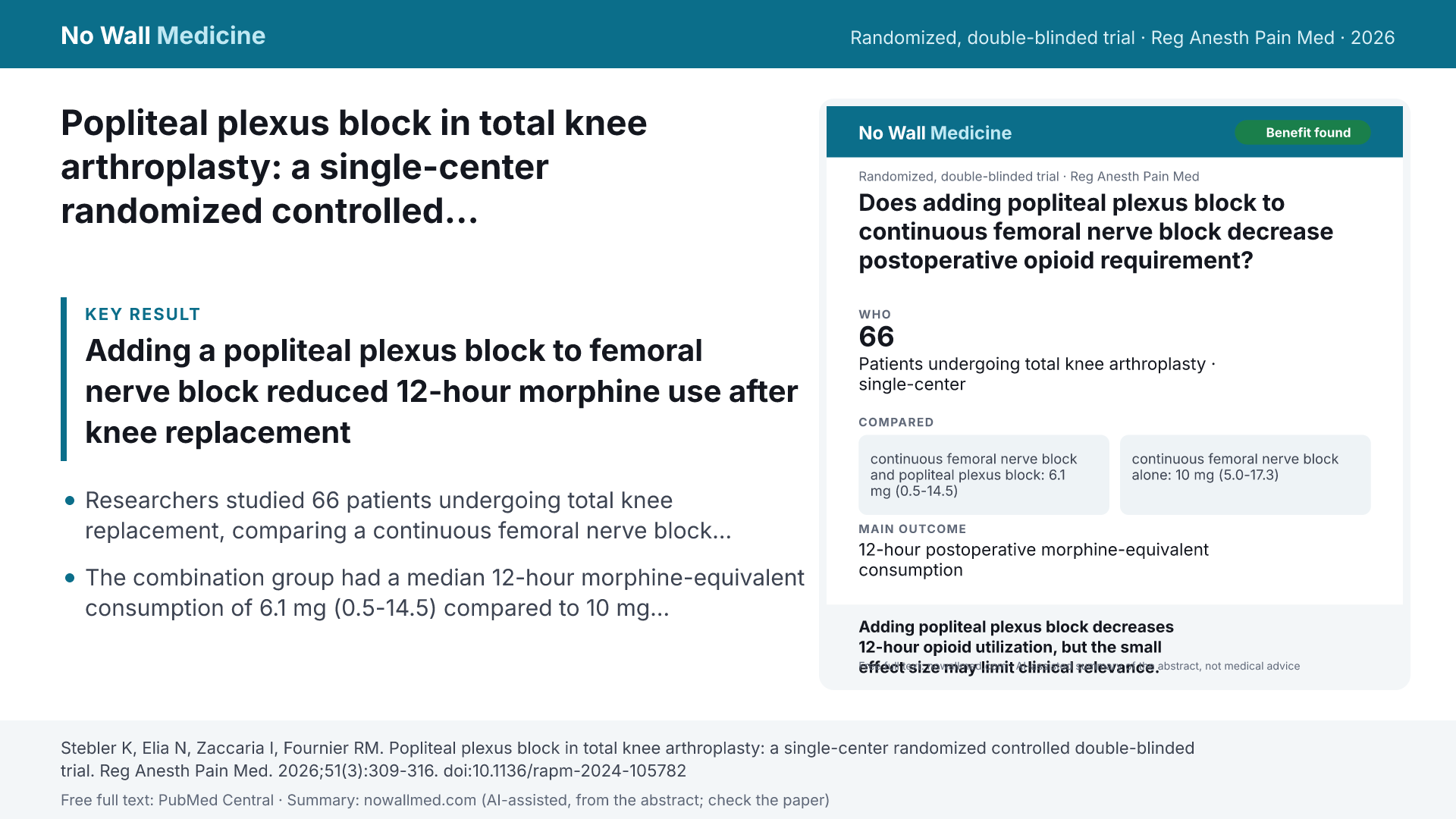
Adding a popliteal plexus block to femoral nerve block reduced 12-hour morphine use after knee replacement
Popliteal plexus block in total knee arthroplasty: a single-center randomized controlled double-blinded trial
Randomized, double-blinded trialBenefit found
Does adding popliteal plexus block to continuous femoral nerve block decrease postoperative opioid requirement?
Who
66
Patients undergoing total knee arthroplasty · single-center
Compared
continuous femoral nerve block and popliteal plexus block: 6.1 mg (0.5-14.5)
continuous femoral nerve block alone: 10 mg (5.0-17.3)
Main outcome
12-hour postoperative morphine-equivalent consumption
Bottom line: Adding popliteal plexus block decreases 12-hour opioid utilization, but the small effect size may limit clinical relevance.
Reg Anesth Pain Med · 2026-03-05Download image
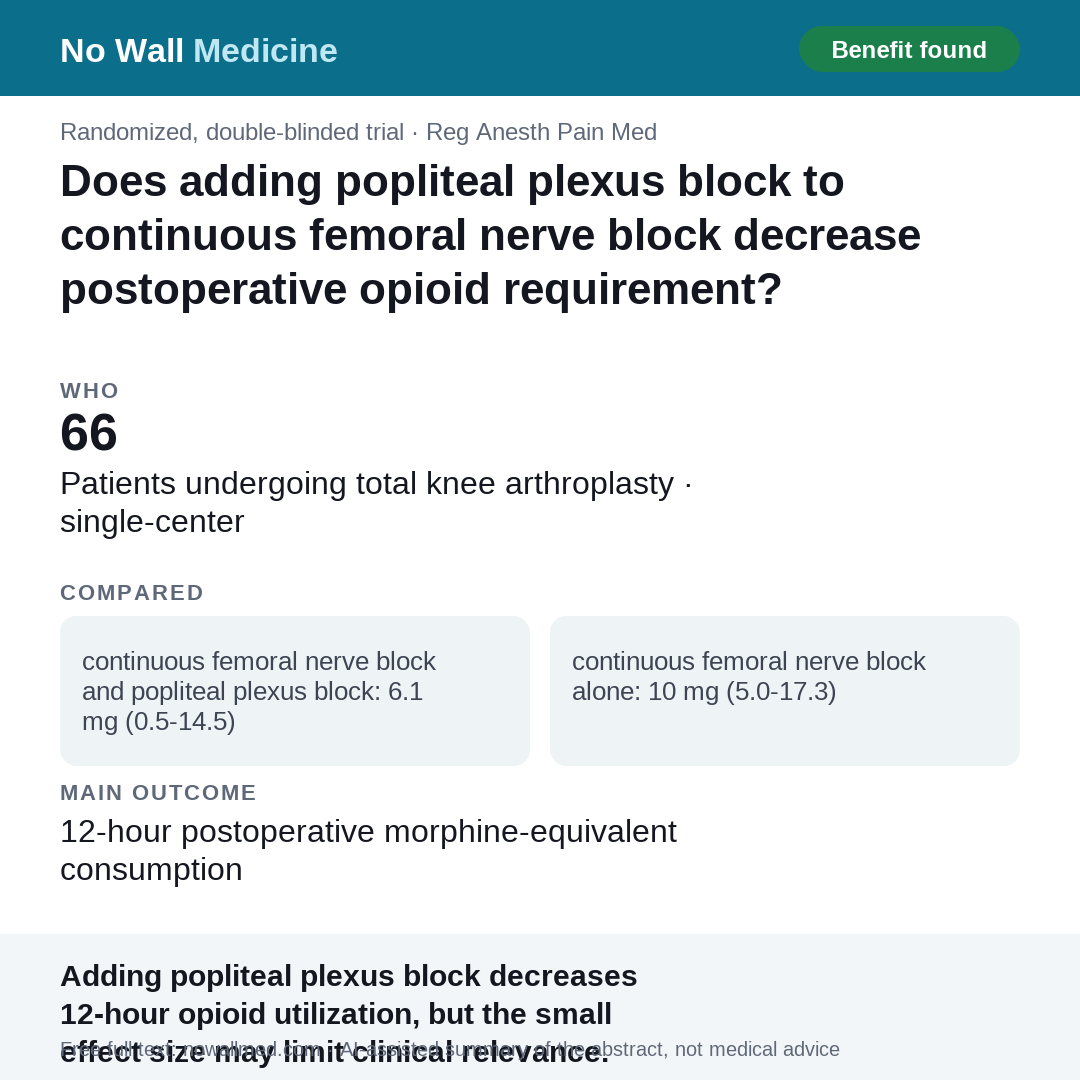
Clinical question: Does adding popliteal plexus block to continuous femoral nerve block decrease postoperative opioid requirement?
Why it matters: It is debated whether adding a popliteal plexus block to a continuous femoral nerve block improves postoperative pain following total knee arthroplasty.
Key points
- Researchers studied 66 patients undergoing total knee replacement, comparing a continuous femoral nerve block alone to a combination of femoral and popliteal plexus nerve blocks.
- The combination group had a median 12-hour morphine-equivalent consumption of 6.1 mg (0.5-14.5) compared to 10 mg (5.0-17.3) in the control group.
- The intervention group reported lower pain intensity in the postanesthesia care unit and fewer cases of lateroposterior knee pain, though these benefits disappeared after 24 hours.
Headline and key points written with AI from the paper’s abstract, with every number checked against it. Read the paper before relying on them.
Was this summary helpful?
Abstract
Introduction
Whether a popliteal plexus block improves postoperative pain following total knee arthroplasty remains debated. This randomized trial tested if adding a popliteal plexus block to a continuous femoral nerve block decreases postoperative opioid requirement. Methods
We included 66 patients undergoing total knee arthroplasty. 32 received continuous femoral nerve block and popliteal plexus block (intervention), and 34 received continuous femoral nerve block alone (control). The primary endpoint was the 12-hour postoperative morphine-equivalent consumption (mg). Secondary outcomes included opioid consumption, Visual Analog Pain Score (0-10), and sensorimotor extension of the block in postanesthesia care unit, at 12 hours, 24 hours and 48 hours postoperatively. Results
66 patients with a median body mass index of 28.7 (IQR 26.3-33.8) were included in the study. In an intention-to-treat analysis, the median 12-hour morphine-equivalent consumption was lower in the intervention group (6.1 mg (0.5-14.5) vs 10 mg (5.0-17.3); one-sided Wilcoxon test (p=0.04)). The average pain intensity experienced in postanesthesia care unit was lower in the intervention group (median: 3.0 (3.0-5.0) vs 2.0 (1.0-4.0), two-sided Wilcoxon p=0.01) and fewer patients reported lateroposterior pain of the knee (11 (34.4%) vs 21 (61.8%) p=0.03). These benefits disappeared after 24 hours. The median duration of the popliteal plexus block procedure was 5.0 min (2.0-5.0). Conclusions
Adding a popliteal plexus block to a continuous femoral nerve block decreases 12-hour opioid utilization, but the effect size is small, calling into question its clinical relevance. Trial registration number
NCT04048889.
Abstract reproduced under the article’s CC BY NC licence.
Subject terms
Cite this article
Stebler K, Elia N, Zaccaria I, Fournier RM. Popliteal plexus block in total knee arthroplasty: a single-center randomized controlled double-blinded trial. Reg Anesth Pain Med. 2026. doi:10.1136/rapm-2024-105782
Spotted a mistake? Suggest a correction
Top studies every Monday
The week’s key trials and guidelines in your specialties, plus any topics you follow. By email, free.
Get the weekly digest