Genetic risk scores improve coronary artery disease risk prediction in a large Chinese cohort
A polygenic risk score improves risk stratification of coronary artery disease: a large-scale prospective Chinese cohort study
Prospective cohort studyBenefit found
Does a polygenic risk score improve coronary artery disease risk stratification in Chinese populations?
Who
41271
Chinese individuals in large prospective cohorts
Compared
Highest 20% polygenic risk score: lifetime risk of 15.9%
Lowest 20% polygenic risk score: lifetime risk of 5.8%
Main outcome
incident coronary artery disease
Result: hazard ratio 2.91 (95% confidence interval 2.43-3.49)
Bottom line: Adding a polygenic risk score to clinical risk scores improves coronary artery disease risk stratification in Chinese populations.
Eur Heart J · 2022-02-24Download image
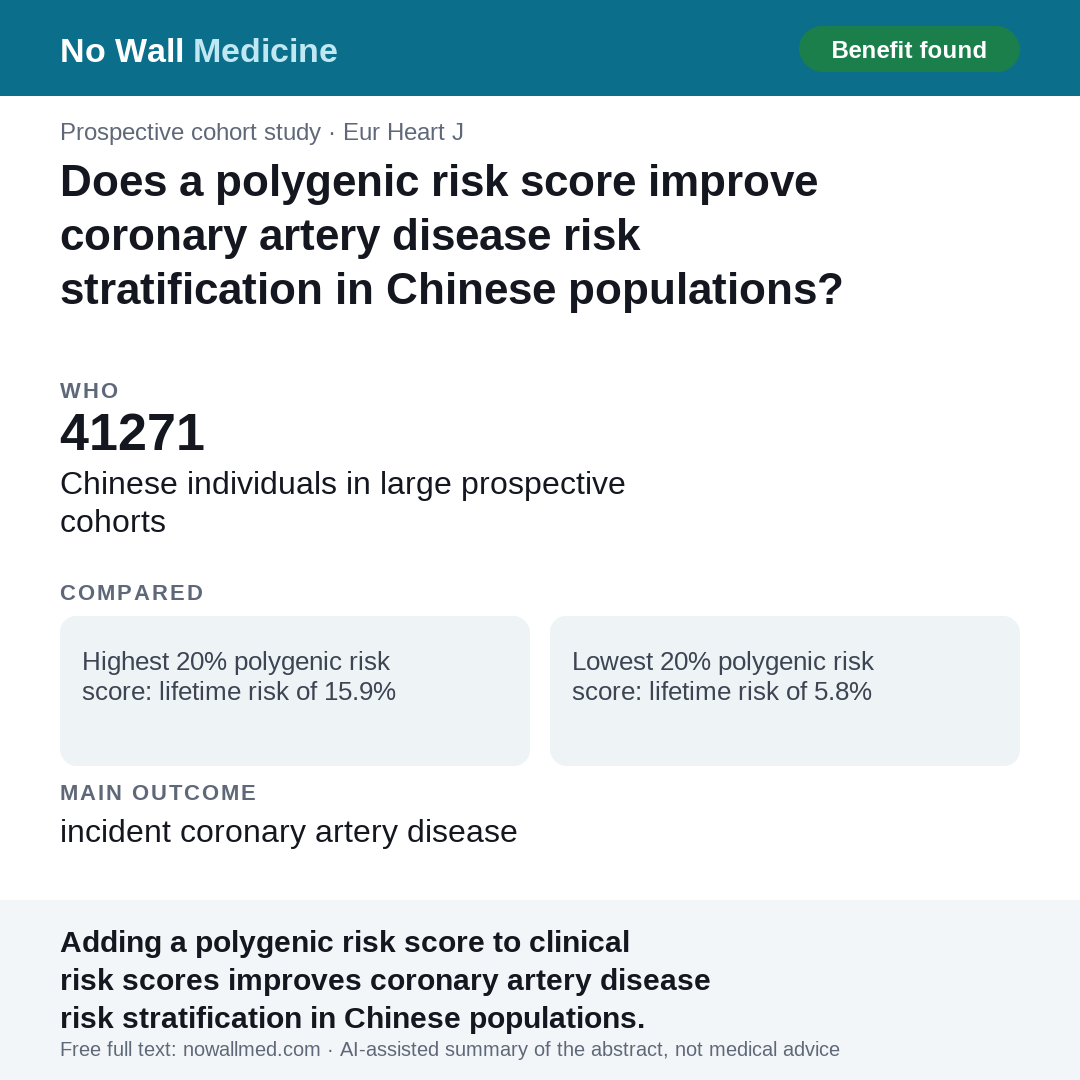
Clinical question: Does a polygenic risk score improve coronary artery disease risk stratification in Chinese populations?
Why it matters: It was unknown if a polygenic risk score could improve the ability to identify individuals at risk for coronary artery disease in Chinese populations.
Key points
- Researchers studied 41,271 individuals over a mean follow-up of 13.0 years to evaluate a polygenic risk score, which uses 540 genetic variants to predict coronary artery disease.
- Individuals in the highest 20% of genetic risk had a hazard ratio of 2.91 for coronary artery disease compared to the lowest 20%, with lifetime risks of 15.9% and 5.8%.
- Adding the genetic score to standard clinical risk scores was associated with a 1% improvement in the C-statistic and a 3.5% net reclassification improvement.
Headline and key points written with AI from the paper’s abstract, with every number checked against it. Read the paper before relying on them.
Was this summary helpful?
Subject terms
Cite this article
Lu X, Liu Z, Cui Q, Liu F, Li J, Niu X. A polygenic risk score improves risk stratification of coronary artery disease: a large-scale prospective Chinese cohort study. Eur Heart J. 2022. doi:10.1093/eurheartj/ehac093
Spotted a mistake? Suggest a correction
Top studies every Monday
The week’s key trials and guidelines in your specialties, plus any topics you follow. By email, free.
Get the weekly digest