Guided internet therapy shows higher remission probabilities for most students with anxiety and depression
A Precision Treatment Model for Internet-Delivered Cognitive Behavioral Therapy for Anxiety and Depression Among University Students: A Secondary Analysis of a Randomized Clinical Trial
Assessor-blinded, multisite randomized clinical trialBenefit found
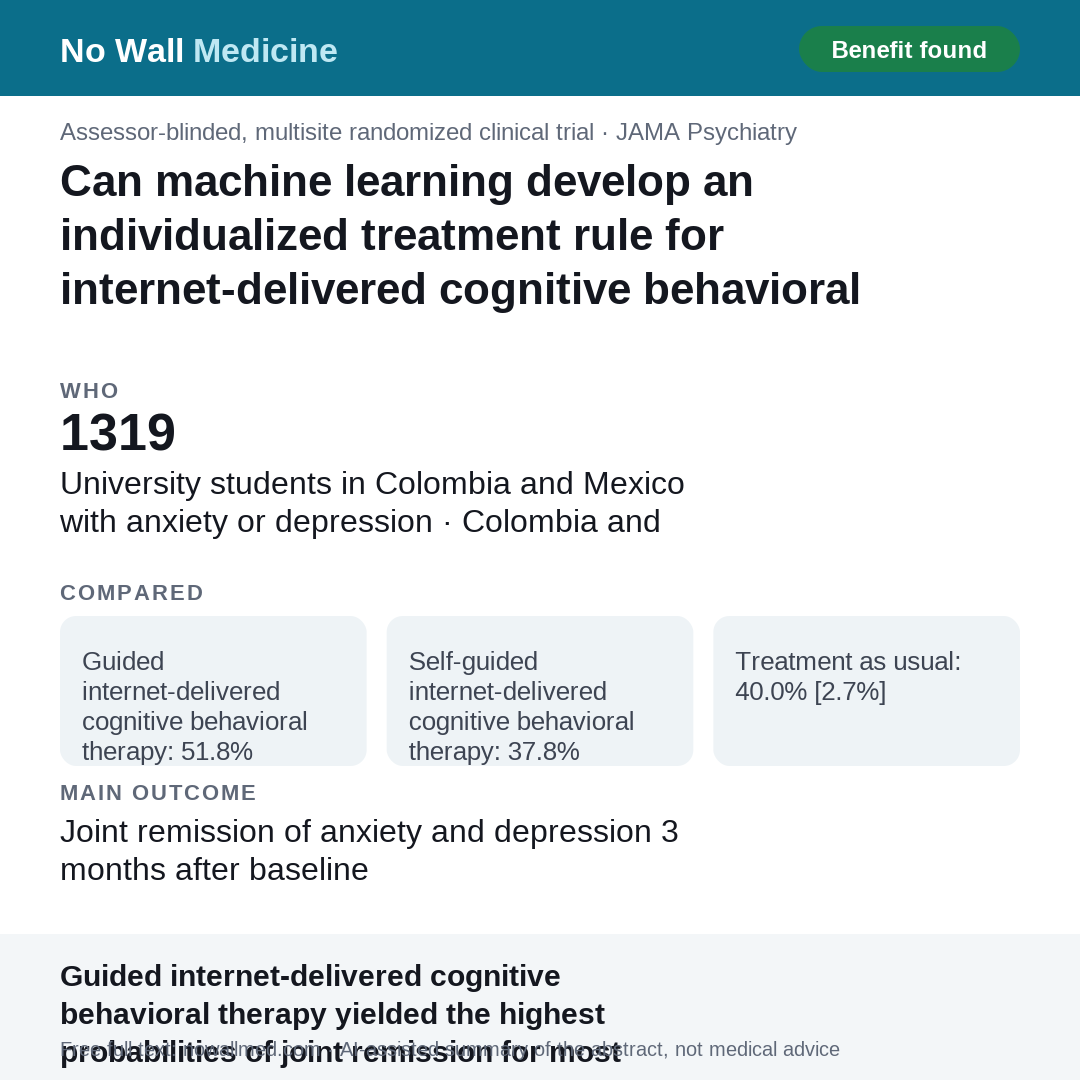
Can machine learning develop an individualized treatment rule for internet-delivered cognitive behavioral therapy?
Who
1319
University students in Colombia and Mexico with anxiety or depression · Colombia and Mexico
Compared
Guided internet-delivered cognitive behavioral therapy: 51.8% [3.0%]
Self-guided internet-delivered cognitive behavioral therapy: 37.8% [3.0%]
Treatment as usual: 40.0% [2.7%]
Main outcome
Joint remission of anxiety and depression 3 months after baseline
Bottom line: Guided internet-delivered cognitive behavioral therapy yielded the highest probabilities of joint remission for most participants.
JAMA Psychiatry · 2023-06-07Download image
Clinical question: Can machine learning develop an individualized treatment rule for internet-delivered cognitive behavioral therapy?
Why it matters: It is unknown if certain patients could be helped as much by self-guided internet-delivered cognitive behavioral therapy as by guided versions to increase treatment scalability.
Key points
- Researchers analyzed 1319 university students in Colombia and Mexico randomized to guided internet-delivered cognitive behavioral therapy, self-guided therapy, or standard care.
- For 91.7% of participants, guided internet-delivered cognitive behavioral therapy was associated with a 51.8% probability of joint remission of anxiety and depression compared to 37.8% for self-guided therapy.
- Among 71.5% of students with baseline depression, guided therapy was associated with a 61.5% probability of remission, while 28.5% of those students had higher remission probabilities with self-guided therapy.
Headline and key points written with AI from the paper’s abstract, with every number checked against it. Read the paper before relying on them.
Was this summary helpful?
Subject terms
Cite this article
Benjet C, Zainal NH, Albor Y, Alvis-Barranco L, Carrasco-Tapias N, Contreras-Ibáñez CC. A Precision Treatment Model for Internet-Delivered Cognitive Behavioral Therapy for Anxiety and Depression Among University Students: A Secondary Analysis of a Randomized Clinical Trial. JAMA Psychiatry. 2023. doi:10.1001/jamapsychiatry.2023.1675
Spotted a mistake? Suggest a correction
Top studies every Monday
The week’s key trials and guidelines in your specialties, plus any topics you follow. By email, free.
Get the weekly digest