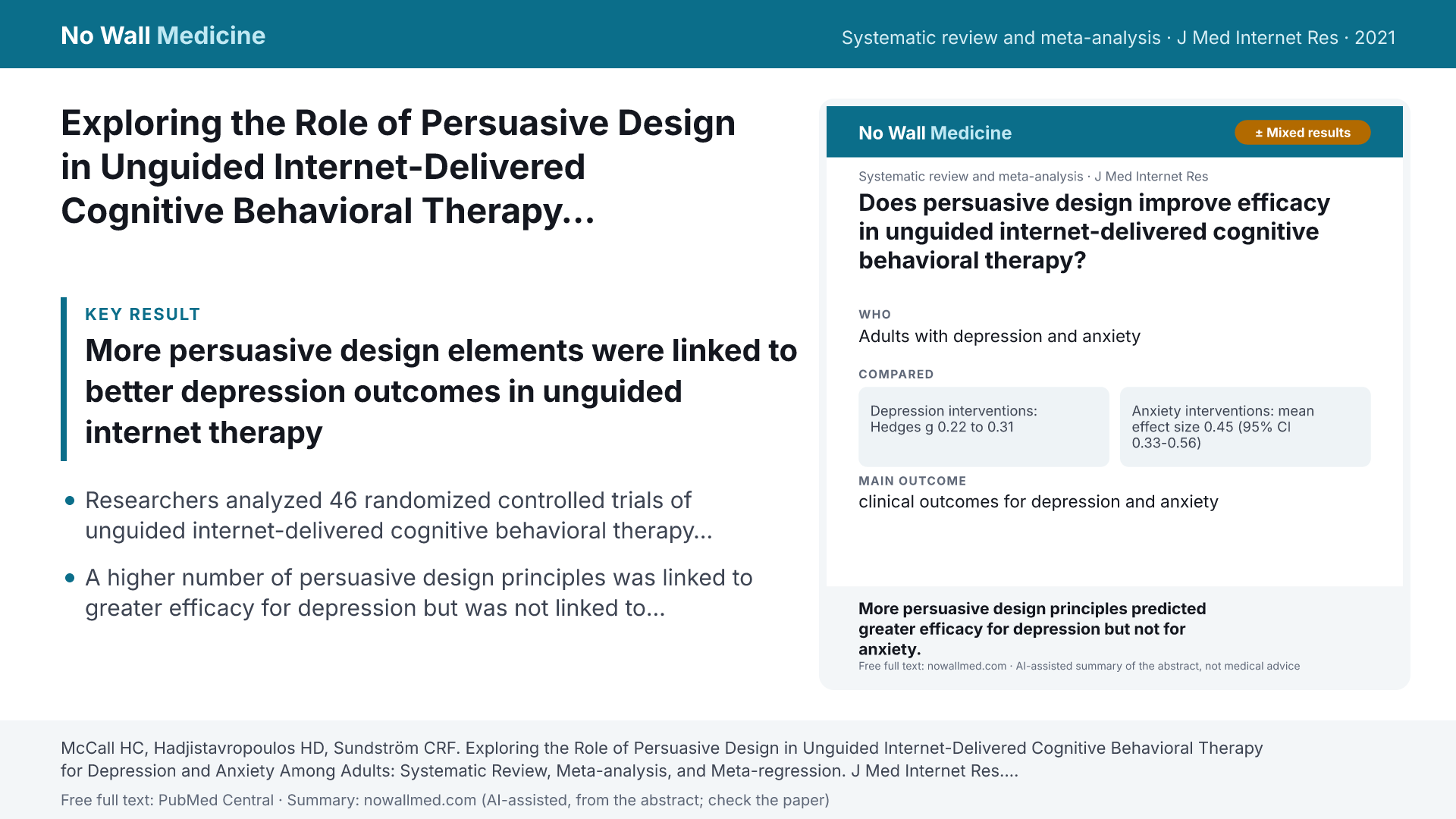
More persuasive design elements were linked to better depression outcomes in unguided internet therapy
Exploring the Role of Persuasive Design in Unguided Internet-Delivered Cognitive Behavioral Therapy for Depression and Anxiety Among Adults: Systematic Review, Meta-analysis, and Meta-regression
Systematic review and meta-analysisMixed results
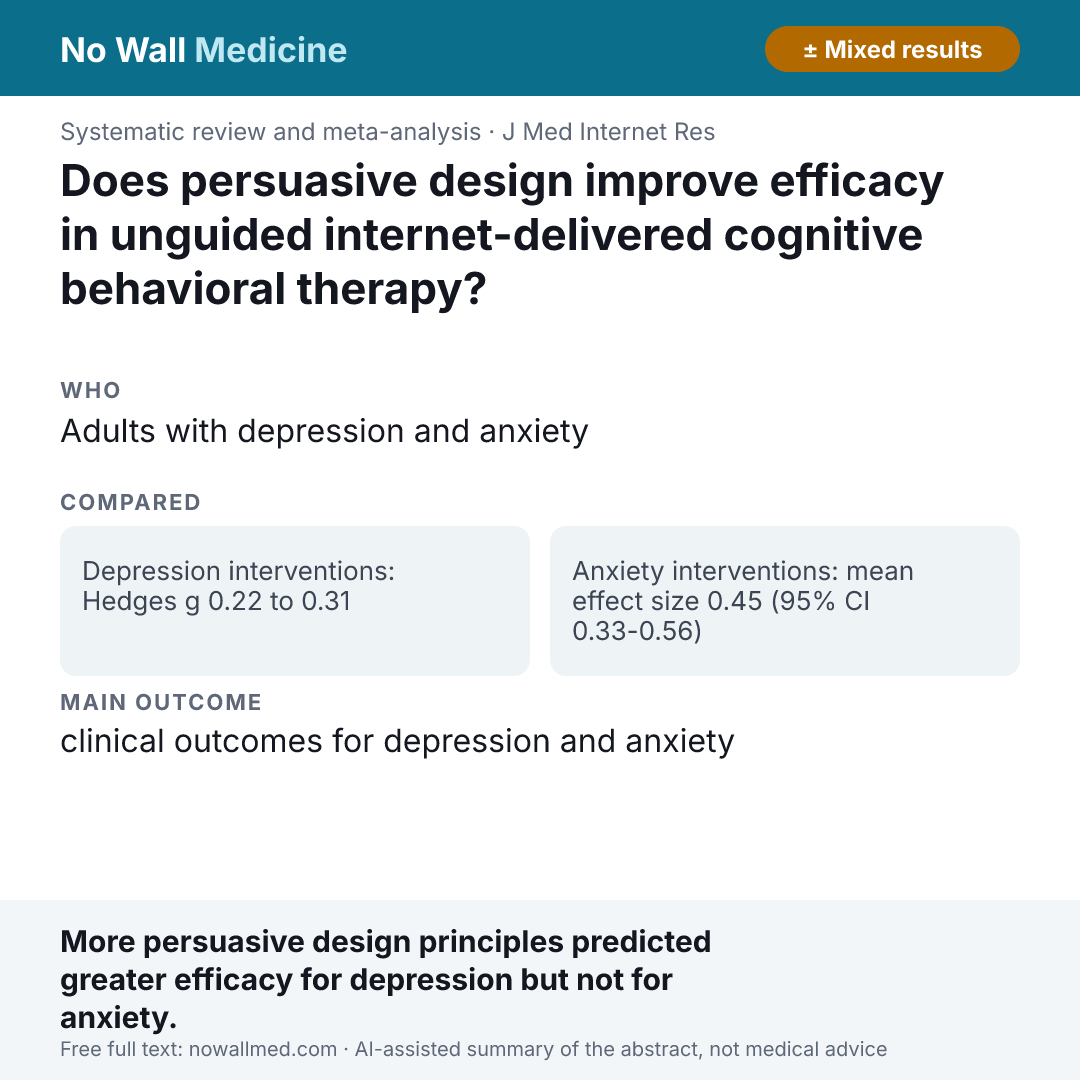
Does persuasive design improve efficacy in unguided internet-delivered cognitive behavioral therapy?
Who
Adults with depression and anxiety
Compared
Depression interventions: Hedges g 0.22 to 0.31
Anxiety interventions: mean effect size 0.45 (95% CI 0.33-0.56)
Main outcome
clinical outcomes for depression and anxiety
Bottom line: More persuasive design principles predicted greater efficacy for depression but not for anxiety.
Limitation: Further research is needed to clarify the role of persuasive design in internet-delivered cognitive behavioral therapy.
J Med Internet Res · 2021-04-29 · Save PNG
Clinical question: Does persuasive design improve efficacy in unguided internet-delivered cognitive behavioral therapy?
Key points
- Researchers analyzed 46 randomized controlled trials of unguided internet-delivered cognitive behavioral therapy for depression and anxiety.
- A higher number of persuasive design principles was linked to greater efficacy for depression but was not linked to anxiety outcomes.
- Included interventions used between 1 and 13 persuasive design principles, with an average of 4.95 (SD 2.85).
Headline and key points written with AI from the paper’s abstract, with every number checked against it. Read the paper before relying on them.
Was this summary helpful?
Subject terms
Headline, design, result, key points, caveat and citation as plain text.
Cite this article
McCall HC, Hadjistavropoulos HD, Sundström CRF. Exploring the Role of Persuasive Design in Unguided Internet-Delivered Cognitive Behavioral Therapy for Depression and Anxiety Among Adults: Systematic Review, Meta-analysis, and Meta-regression. J Med Internet Res. 2021;23(4):e26939. doi:10.2196/26939
Spotted a mistake? Suggest a correction