Remote endarterectomy showed higher long-term artery openness than stenting for long femoral artery blockages
A prospective randomized trial on endovascular recanalization with stenting versus remote endarterectomy for the superficial femoral artery total occlusive lesions
Prospective randomized trialBenefit found
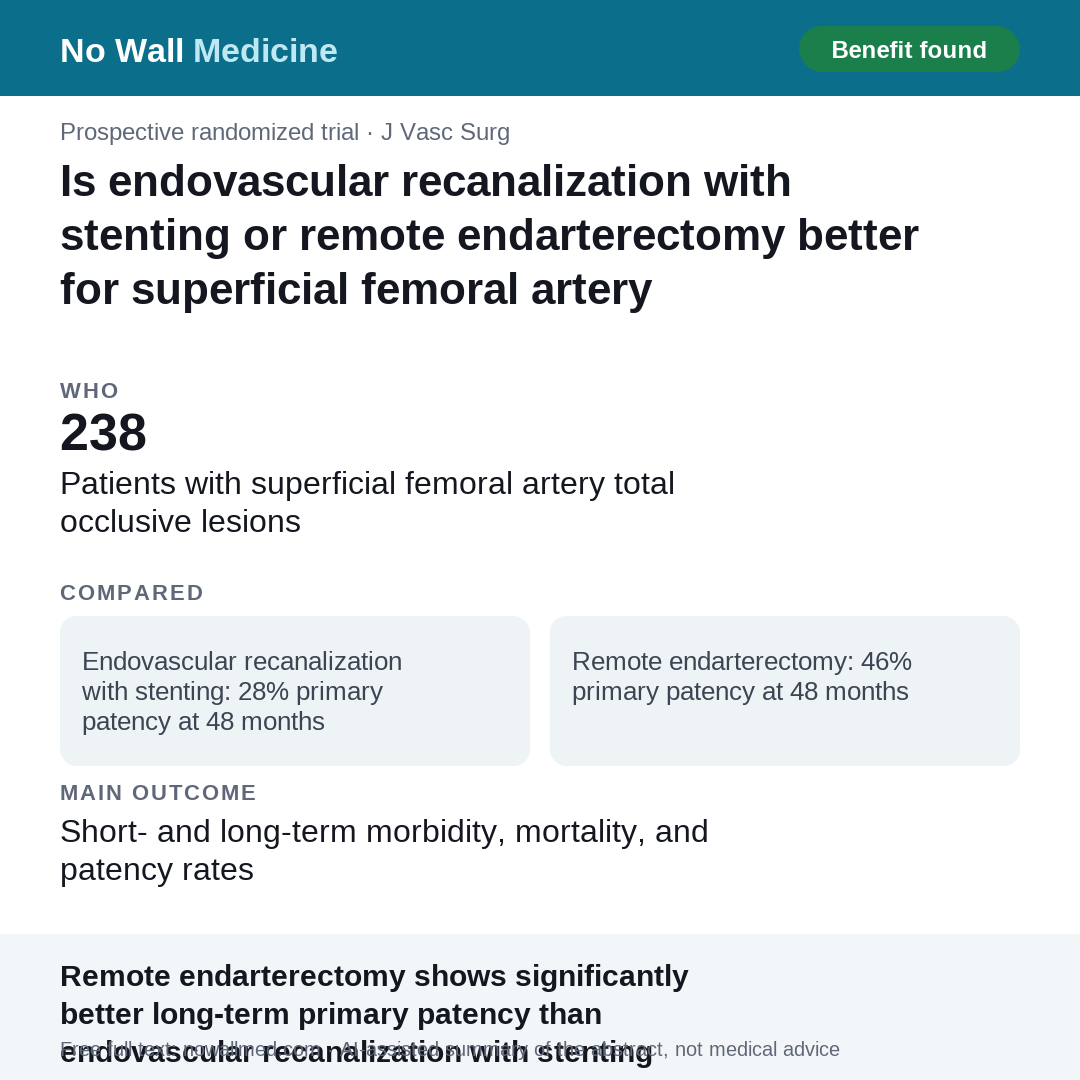
Is endovascular recanalization with stenting or remote endarterectomy better for superficial femoral artery occlusions?
Who
238
Patients with superficial femoral artery total occlusive lesions
Compared
Endovascular recanalization with stenting: 28% primary patency at 48 months
Remote endarterectomy: 46% primary patency at 48 months
Main outcome
Short- and long-term morbidity, mortality, and patency rates
Bottom line: Remote endarterectomy shows significantly better long-term primary patency than endovascular recanalization with stenting for long superficial femoral artery lesions.
J Vasc Surg · 2022-02-26Download image
Clinical question: Is endovascular recanalization with stenting or remote endarterectomy better for superficial femoral artery occlusions?
Why it matters: It is unknown whether stenting or surgical plaque removal provides better long-term safety and efficacy for patients with long superficial femoral artery total occlusive lesions.
Key points
- Researchers randomized 238 patients with long superficial femoral artery blockages to receive either endovascular recanalization with stenting or remote endarterectomy, which is a surgical procedure to remove plaque.
- At 48 months, the primary patency rate, or the percentage of time the artery remained open, was 28% for the stenting group compared to 46% for the endarterectomy group.
- Limb salvage rates at 48 months were 87% for the stenting group and 92% for the endarterectomy group, which was not a statistically significant difference.
Headline and key points written with AI from the paper’s abstract, with every number checked against it. Read the paper before relying on them.
Was this summary helpful?
Subject terms
Cite this article
Saaya S, Osipova O, Gostev A, Rabtsun A, Starodubtsev V, Cheban A. A prospective randomized trial on endovascular recanalization with stenting versus remote endarterectomy for the superficial femoral artery total occlusive lesions. J Vasc Surg. 2022. doi:10.1016/j.jvs.2022.02.019
Spotted a mistake? Suggest a correction
Top studies every Monday
The week’s key trials and guidelines in your specialties, plus any topics you follow. By email, free.
Get the weekly digest