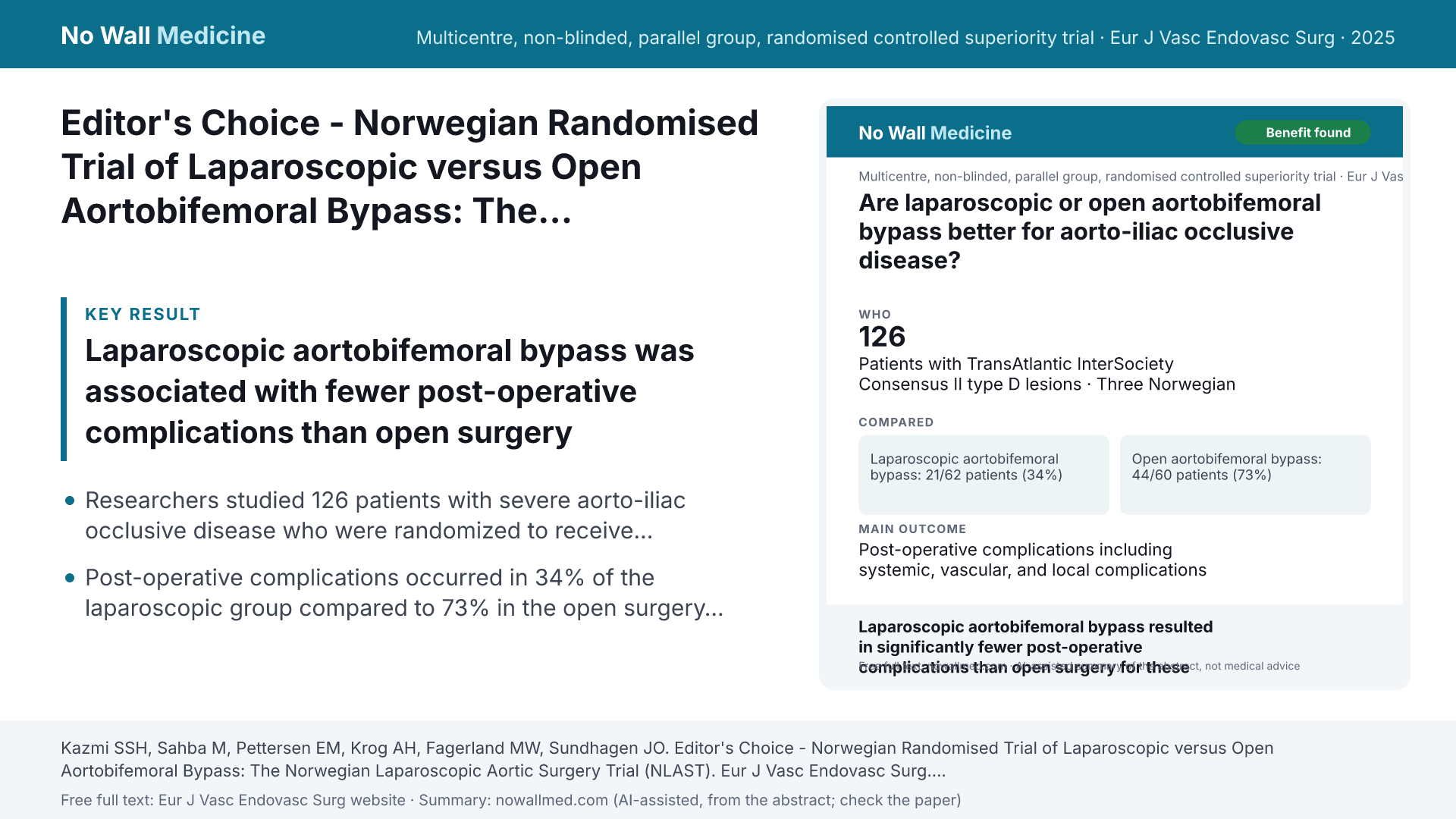
Laparoscopic aortobifemoral bypass was associated with fewer post-operative complications than open surgery
Editor's Choice - Norwegian Randomised Trial of Laparoscopic versus Open Aortobifemoral Bypass: The Norwegian Laparoscopic Aortic Surgery Trial (NLAST)
Multicentre, non-blinded, parallel group, randomised controlled superiority trialBenefit found
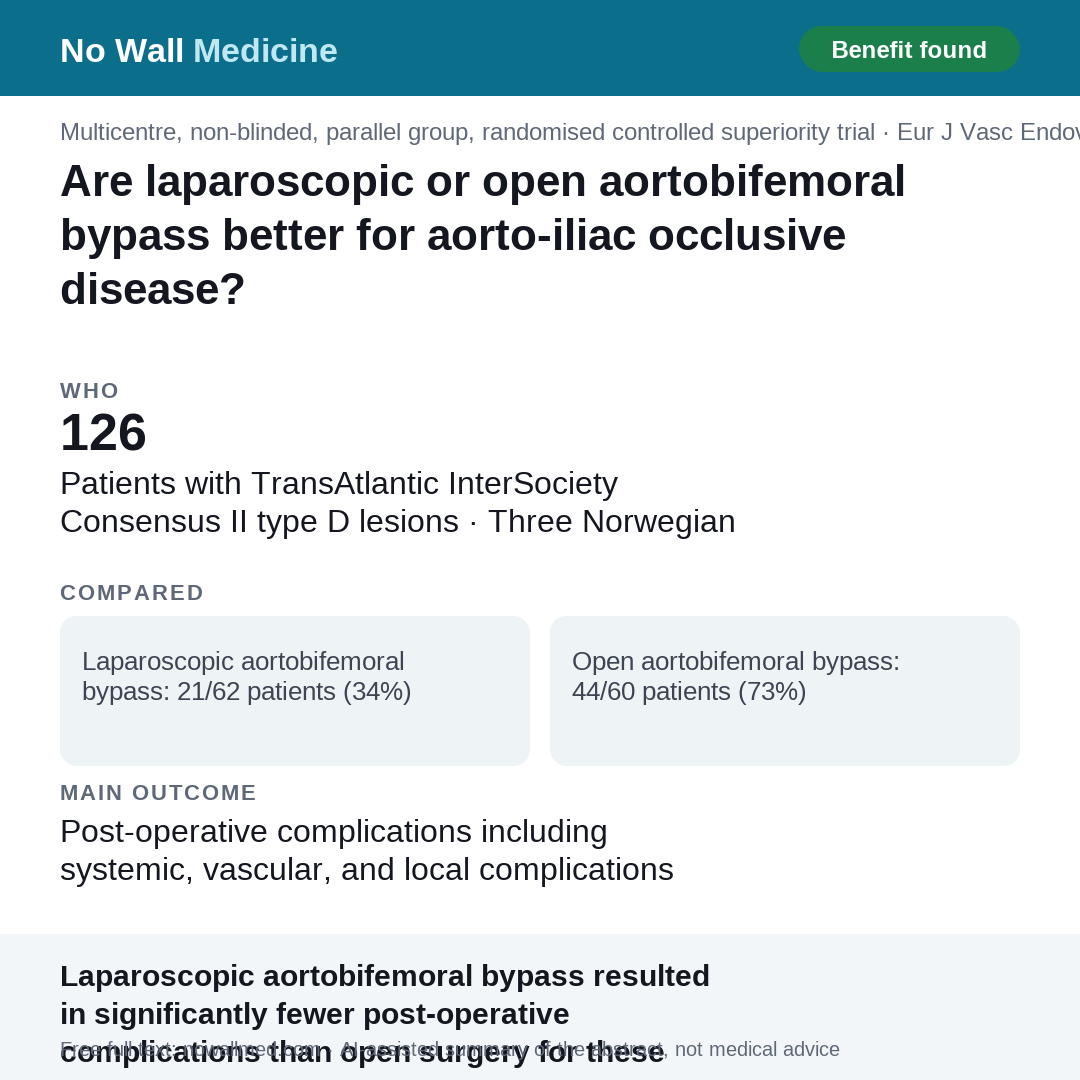
Are laparoscopic or open aortobifemoral bypass better for aorto-iliac occlusive disease?
Who
126
Patients with TransAtlantic InterSociety Consensus II type D lesions · Three Norwegian public hospitals
Compared
Laparoscopic aortobifemoral bypass: 21/62 patients (34%)
Open aortobifemoral bypass: 44/60 patients (73%)
Main outcome
Post-operative complications including systemic, vascular, and local complications
Result: difference -40 percentage points, 95% confidence interval -54 to -22
Bottom line: Laparoscopic aortobifemoral bypass resulted in significantly fewer post-operative complications than open surgery for these patients.
Funded by: Oslo University Hospital
Eur J Vasc Endovasc Surg · 2025-11-07Download image
Clinical question: Are laparoscopic or open aortobifemoral bypass better for aorto-iliac occlusive disease?
Why it matters: It was unknown if laparoscopic surgery for aortobifemoral bypass results in fewer post-operative complications than traditional open surgery for patients with severe aorto-iliac occlusive disease.
Key points
- Researchers studied 126 patients with severe aorto-iliac occlusive disease who were randomized to receive either laparoscopic or open aortobifemoral bypass surgery.
- Post-operative complications occurred in 34% of the laparoscopic group compared to 73% in the open surgery group during a mean follow-up of 3.6 ± 2.5 years.
- The 30 day mortality rate was 2% for both the laparoscopic and open surgery groups.
Headline and key points written with AI from the paper’s abstract, with every number checked against it. Read the paper before relying on them.
Was this summary helpful?
Subject terms
Cite this article
Kazmi SSH, Sahba M, Pettersen EM, Krog AH, Fagerland MW, Sundhagen JO. Editor's Choice - Norwegian Randomised Trial of Laparoscopic versus Open Aortobifemoral Bypass: The Norwegian Laparoscopic Aortic Surgery Trial (NLAST). Eur J Vasc Endovasc Surg. 2025. doi:10.1016/j.ejvs.2025.09.046
Spotted a mistake? Suggest a correction