Goal setting with psychosocial support improved goal attainment for people with dementia and their carers
A psychosocial goal-setting and manualised support intervention for independence in dementia (NIDUS-Family) versus goal setting and routine care: a single-masked, phase 3, superiority, randomised controlled trial
Single-masked, phase 3, superiority, randomised controlled trialBenefit found
Does NIDUS-Family plus goal setting improve attainment of personalised goals in dementia dyads?
Who
247
Patient-carer dyads from community settings · Multi-site community settings
Compared
NIDUS-Family plus goal setting: mean GAS score at 12 months 58·7 [SD 13·0; n=163]
Goal setting and routine care: mean GAS score at 12 months 49·0 [14·1; n=84]
Main outcome
Carer-rated goal attainment scaling score at 12 months
Result: adjusted difference in means 10·23 [95% CI 5·75-14·71]
Bottom line: NIDUS-Family plus goal setting significantly improves the attainment of personalised goals for people with dementia and their carers.
Funded by: UK Alzheimer's Society
Lancet Healthy Longev · 2024-02-05Download image
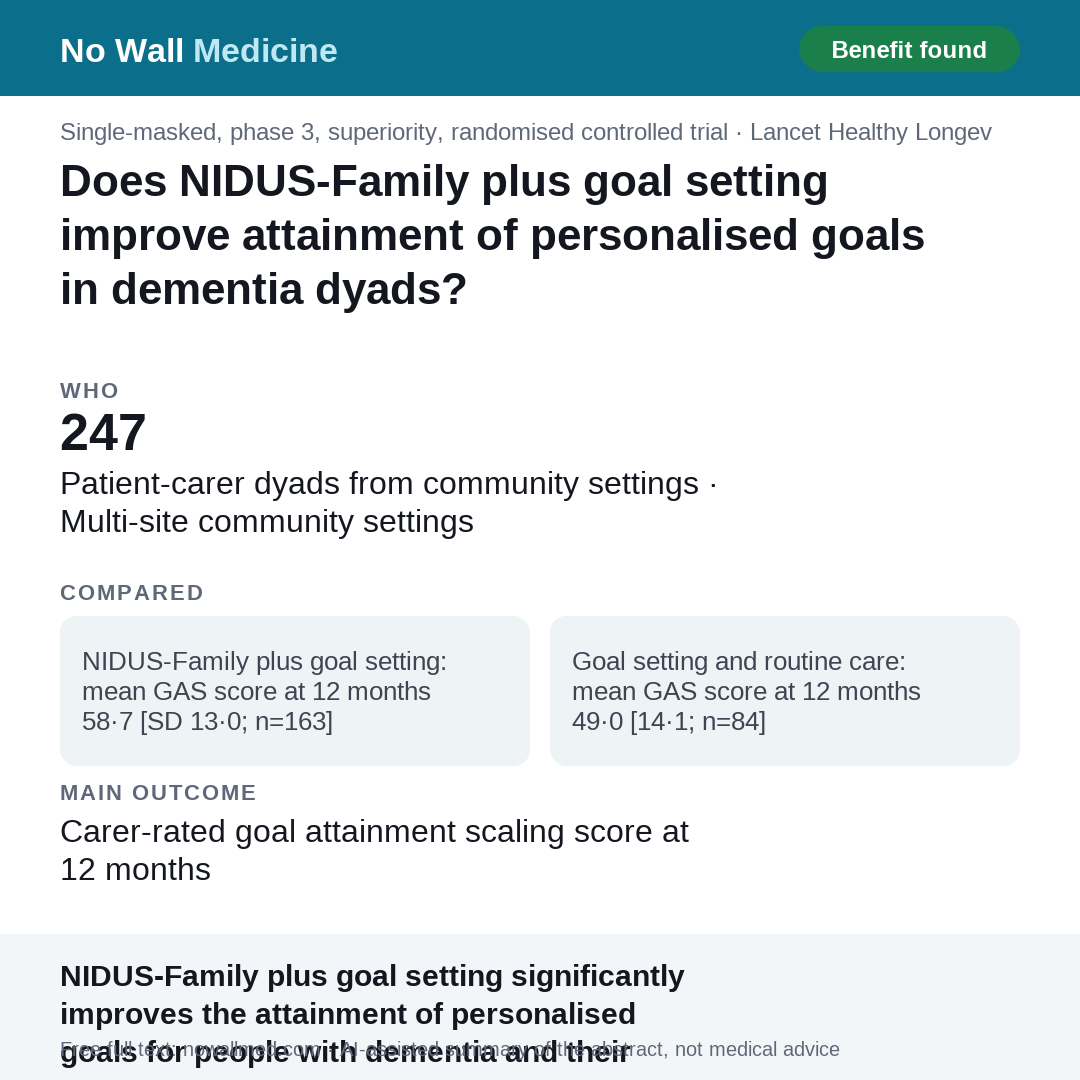
Clinical question: Does NIDUS-Family plus goal setting improve attainment of personalised goals in dementia dyads?
Why it matters: National guidelines recommend personalized post-diagnostic support for people with dementia, but few individuals actually receive it.
Key points
- Researchers conducted a randomized trial with 204 dyads receiving the NIDUS-Family intervention and 98 dyads receiving goal setting and routine care.
- The intervention group had a higher mean goal attainment scaling score at 12 months of 58.7 compared to 49.0 in the control group.
- Serious adverse events occurred in 15.2% of the intervention group and 14.3% of the control group.
Headline and key points written with AI from the paper’s abstract, with every number checked against it. Read the paper before relying on them.
Abstract
Background
Although national guidelines recommend that everyone with dementia receives personalised post-diagnostic support, few do. Unlike previous interventions that improved personalised outcomes in people with dementia, the NIDUS-Family intervention is fully manualised and deliverable by trained and supervised, non-clinical facilitators. We aimed to investigate the effectiveness of home-based goal setting plus NIDUS-Family in supporting the attainment of personalised goals set by people with dementia and their carers. Methods
We did a two-arm, single-masked, multi-site, randomised, clinical trial recruiting patient-carer dyads from community settings. We randomly assigned dyads to either home-based goal setting plus NIDUS-Family or goal setting and routine care (control). Randomisation was blocked and stratified by site (2:1; intervention to control), with allocations assigned via a remote web-based system. NIDUS-Family is tailored to goals set by dyads by selecting modules involving behavioural interventions, carer support, psychoeducation, communication and coping skills, enablement, and environmental adaptations. The intervention involved six to eight video-call or telephone sessions (or in person when COVID-19-related restrictions allowed) over 6 months, then telephone follow-ups every 2-3 months for 6 months. The primary outcome was carer-rated goal attainment scaling (GAS) score at 12 months. Analyses were done by intention to treat. This trial is registered with the ISRCTN registry, ISRCTN11425138. Findings
Between April 30, 2020, and May 9, 2021, we assessed 1083 potential dyads for eligibility, 781 (72·1%) of whom were excluded. Of 302 eligible dyads, we randomly assigned 98 (32·4%) to the control group and 204 (67·5%) to the intervention group. The mean age of participants with dementia was 79·9 years (SD 8·2), 169 (56%) were women, and 133 (44%) were men. 247 (82%) dyads completed the primary outcome, which favoured the intervention (mean GAS score at 12 months 58·7 [SD 13·0; n=163] vs 49·0 [14·1; n=84]; adjusted difference in means 10·23 [95% CI 5·75-14·71]; p<0·001). 31 (15·2%) participants in the intervention group and 14 (14·3%) in the control group experienced serious adverse events. Interpretation
To our knowledge, NIDUS-Family is the first readily scalable intervention for people with dementia and their family carers that improves attainment of personalised goals. We therefore recommend that it be implemented in health and care services. Funding
UK Alzheimer's Society.
Abstract reproduced under the article’s CC BY licence.
Topics
Cite this article
Cooper C, Vickerstaff V, Barber J, Phillips R, Ogden M, Walters K. A psychosocial goal-setting and manualised support intervention for independence in dementia (NIDUS-Family) versus goal setting and routine care: a single-masked, phase 3, superiority, randomised controlled trial. Lancet Healthy Longev. 2024. doi:10.1016/S2666-7568(23)00262-3
Spotted a mistake? Suggest a correction
Top studies every Monday
The week’s key trials and guidelines in your specialties, by email. Free.
Get the weekly digest