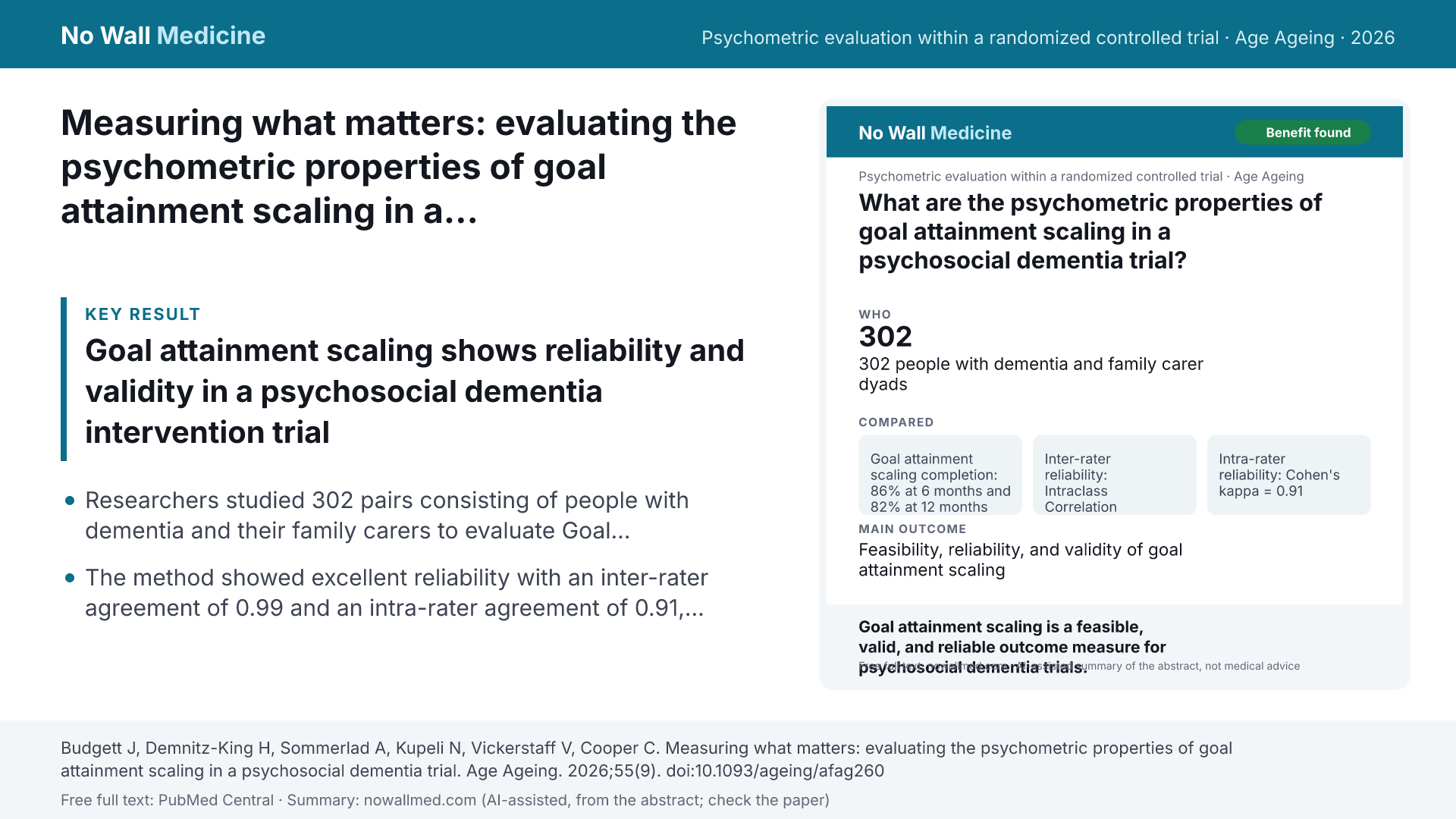
Goal attainment scaling shows reliability and validity in a psychosocial dementia intervention trial
Measuring what matters: evaluating the psychometric properties of goal attainment scaling in a psychosocial dementia trial
Psychometric evaluation within a randomized controlled trialBenefit found
What are the psychometric properties of goal attainment scaling in a psychosocial dementia trial?
Who
302
302 people with dementia and family carer dyads
Compared
Goal attainment scaling completion: 86% at 6 months and 82% at 12 months
Inter-rater reliability: Intraclass Correlation Coefficient = 0.99
Intra-rater reliability: Cohen's kappa = 0.91
Main outcome
Feasibility, reliability, and validity of goal attainment scaling
Result: odds ratio 1.08 per point increase
Bottom line: Goal attainment scaling is a feasible, valid, and reliable outcome measure for psychosocial dementia trials.
Limitation: Correlations with global quality of life were significant but modest.
Age Ageing · 2026-09-14 · Save PNG
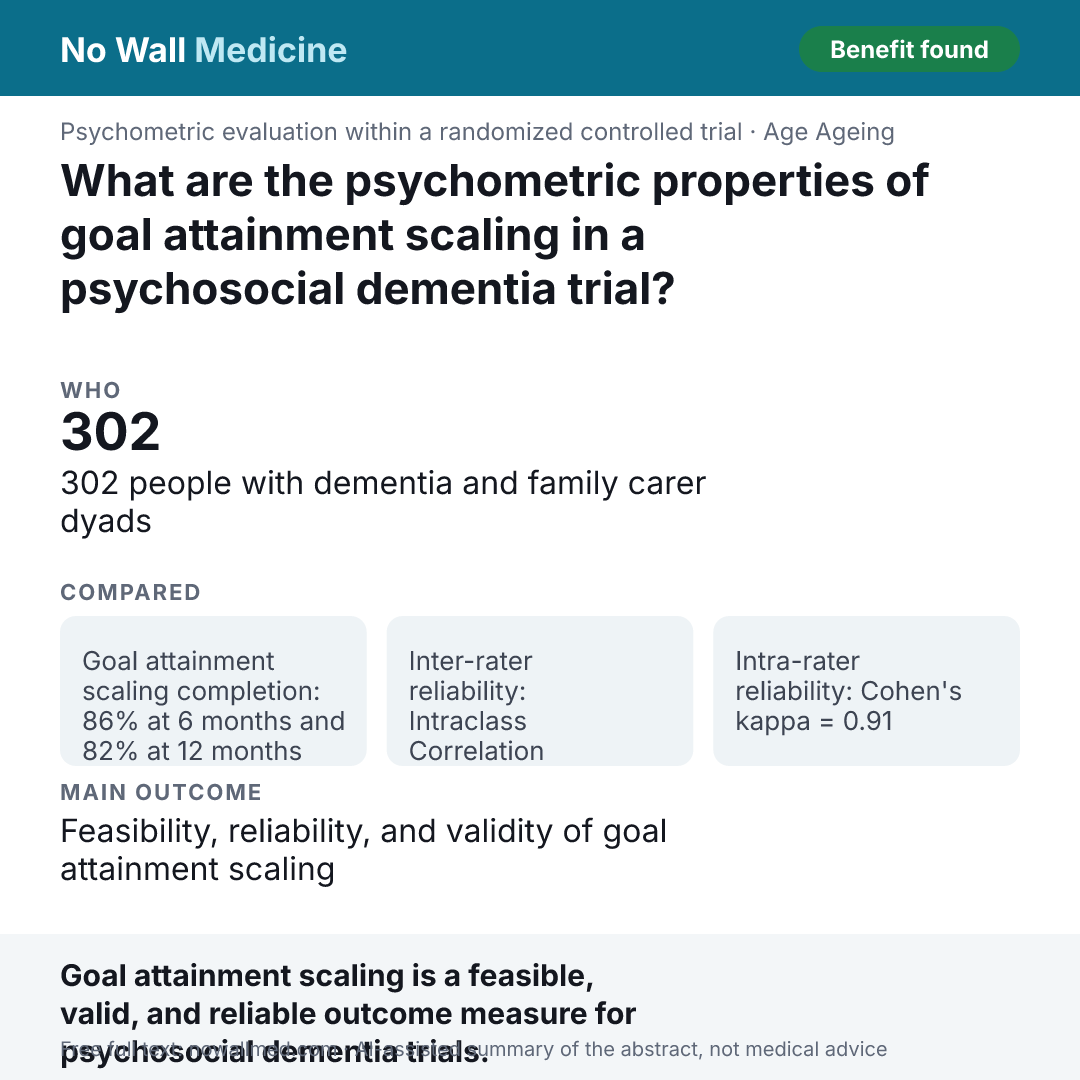
Clinical question: What are the psychometric properties of goal attainment scaling in a psychosocial dementia trial?
Why it matters: It is difficult to identify clinically meaningful and responsive primary outcomes for psychosocial intervention trials in people living with dementia.
Key points
- Researchers studied 302 pairs consisting of people with dementia and their family carers to evaluate Goal Attainment Scaling, a personalized way to measure progress toward specific goals.
- The method showed excellent reliability with an inter-rater agreement of 0.99 and an intra-rater agreement of 0.91, with completion rates of 86% at 6 months and 82% at 12 months.
- Changes in goal attainment were associated with remaining at home with an odds ratio of 1.08 per point increase, though correlations with quality-of-life scores were significant but weak.
Headline and key points written with AI from the paper’s abstract, with every number checked against it. Read the paper before relying on them.
Was this summary helpful?
Subject terms
Headline, design, result, key points, caveat and citation as plain text.
Cite this article
Budgett J, Demnitz-King H, Sommerlad A, Kupeli N, Vickerstaff V, Cooper C. Measuring what matters: evaluating the psychometric properties of goal attainment scaling in a psychosocial dementia trial. Age Ageing. 2026;55(9). doi:10.1093/ageing/afag260
Spotted a mistake? Suggest a correction