Manual pressure augmentation during defibrillation did not improve survival after out-of-hospital cardiac arrest
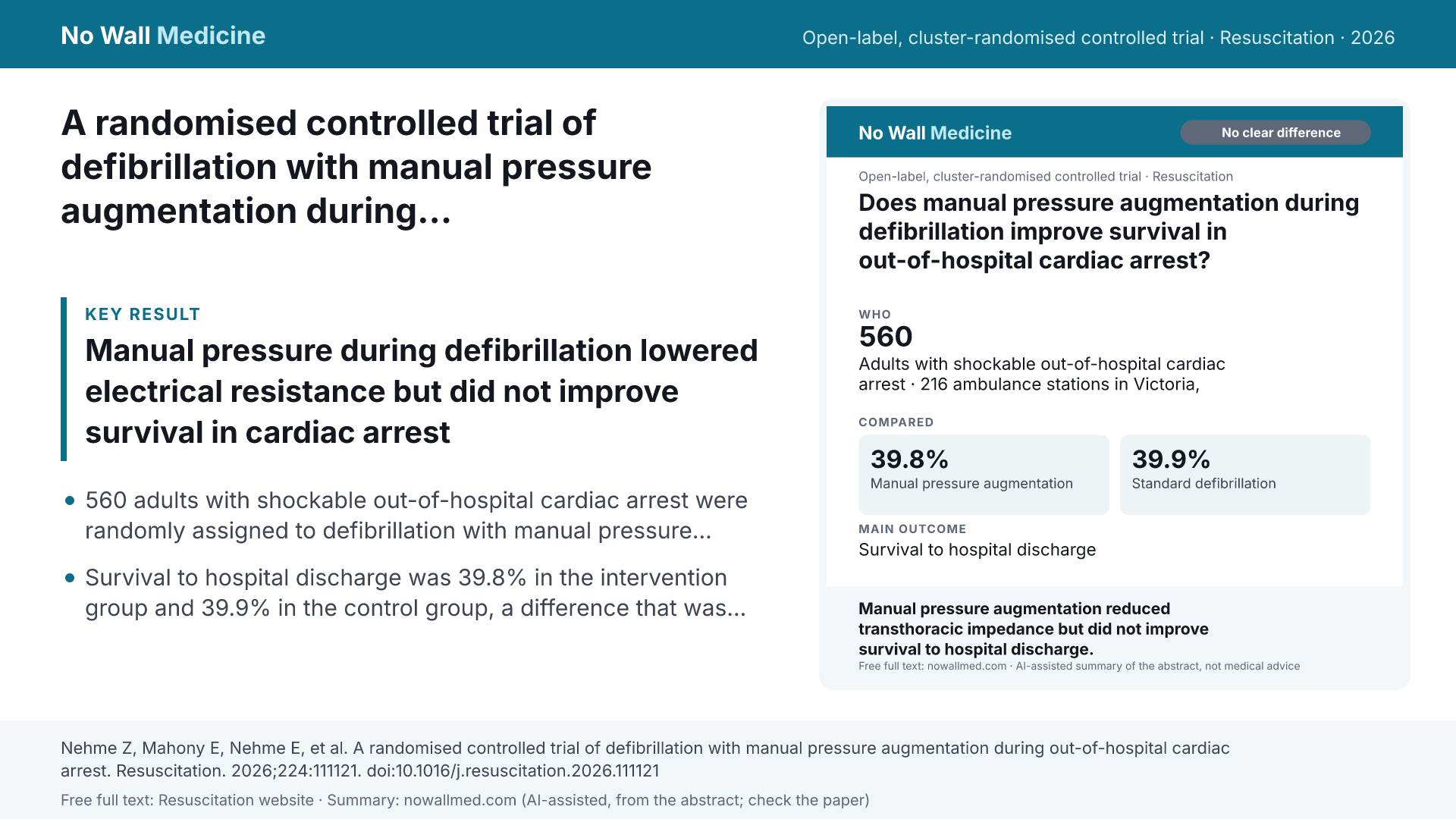
A randomised controlled trial of defibrillation with manual pressure augmentation during out-of-hospital cardiac arrest
Open-label, cluster-randomised controlled trialNo clear difference
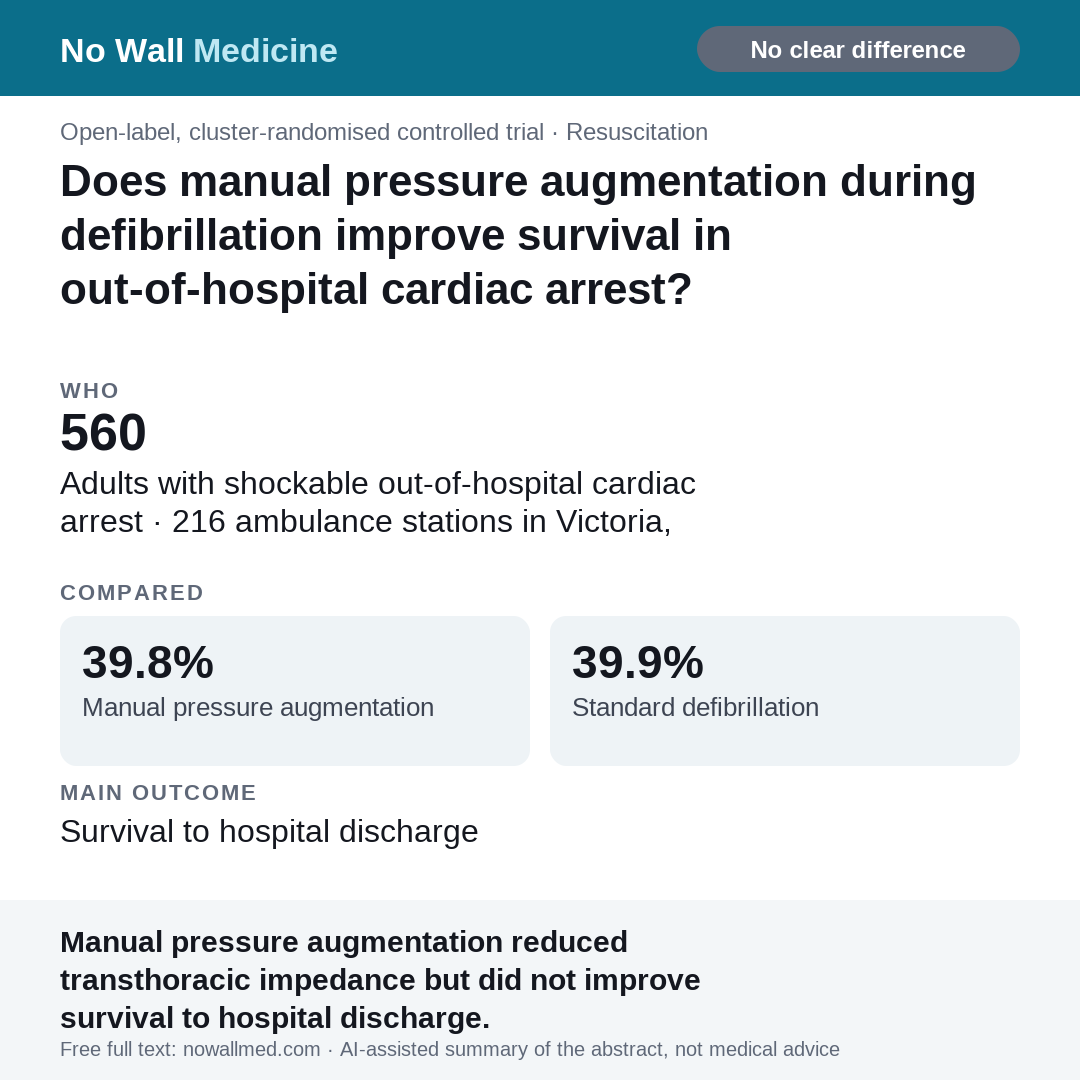
Does manual pressure augmentation during defibrillation improve survival in out-of-hospital cardiac arrest?
Who
560
Adults with shockable out-of-hospital cardiac arrest · 216 ambulance stations in Victoria, Australia
Compared
39.8%Manual pressure augmentation (111/279)
39.9%Standard defibrillation (112/281)
Main outcome
Survival to hospital discharge
Result: adjusted odds ratio 1.00 (95% CI 0.71, 1.40)
Bottom line: Manual pressure augmentation reduced transthoracic impedance but did not improve survival to hospital discharge.
Resuscitation · 2026-05-04Download image
Clinical question: Does manual pressure augmentation during defibrillation improve survival in out-of-hospital cardiac arrest?
Why it matters: It was unclear if using manual pressure during defibrillation could reduce electrical resistance and improve survival for patients experiencing cardiac arrest outside of a hospital.
Key points
- Researchers studied 560 adults with out-of-hospital cardiac arrest and shockable rhythms across 216 ambulance stations in Australia.
- Survival to hospital discharge was 39.8% in the manual pressure augmentation group compared to 39.9% in the standard defibrillation group.
- Manual pressure augmentation significantly reduced transthoracic impedance, which is the resistance to electrical current, by an absolute risk difference of -8.5 ohms.
Headline and key points written with AI from the paper’s abstract, with every number checked against it. Read the paper before relying on them.
Was this summary helpful?
Subject terms
Cite this article
Nehme Z, Mahony E, Nehme E, et al. A randomised controlled trial of defibrillation with manual pressure augmentation during out-of-hospital cardiac arrest. Resuscitation. 2026. doi:10.1016/j.resuscitation.2026.111121
Spotted a mistake? Suggest a correction