A randomised controlled trial of defibrillation with manual pressure augmentation during out-of-hospital cardiac arrest
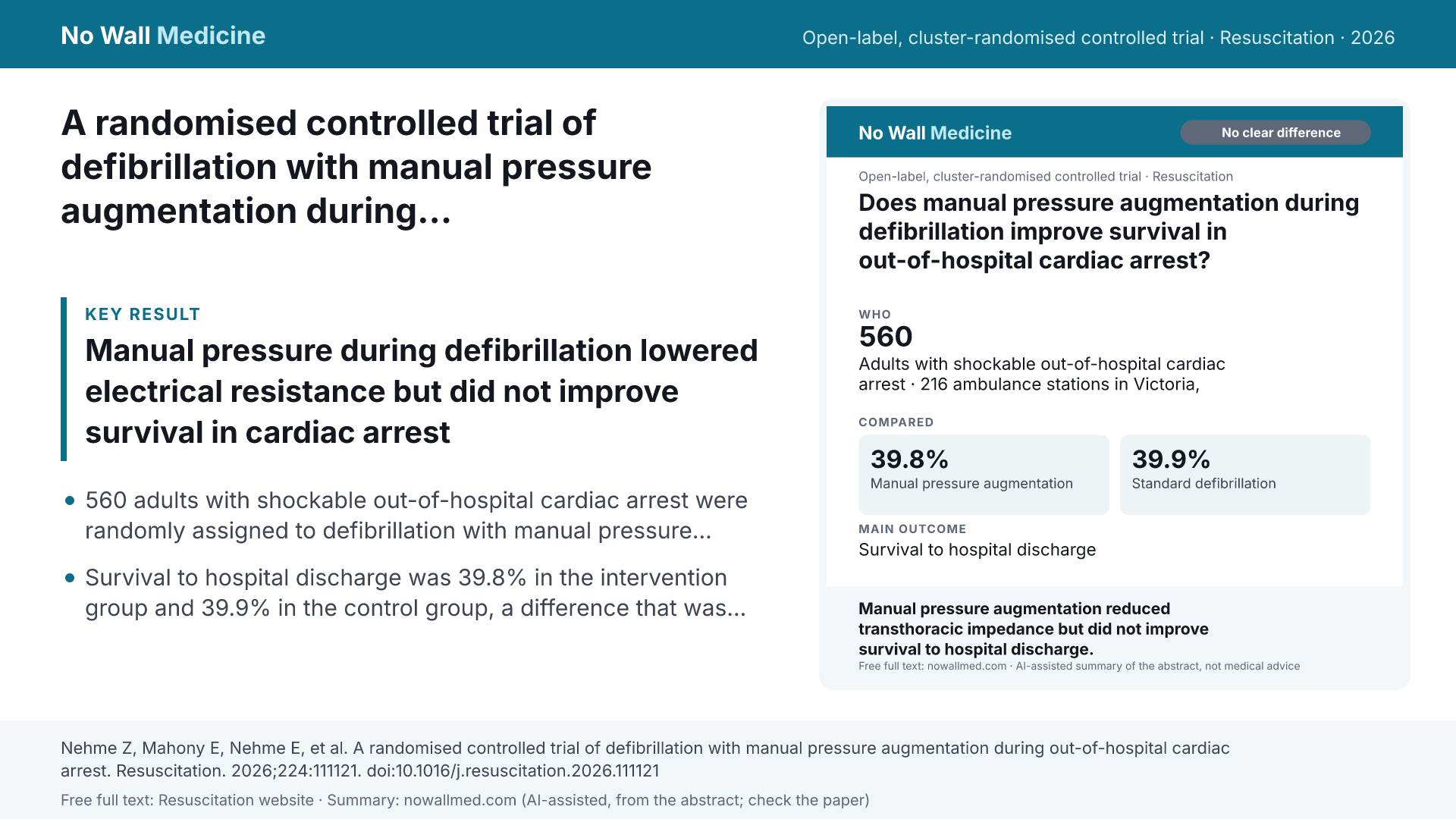
Key result: Manual pressure during defibrillation lowered electrical resistance but did not improve survival in cardiac arrest
Open-label, cluster-randomised controlled trialNo clear difference
Does manual pressure augmentation during defibrillation improve survival in out-of-hospital cardiac arrest?
Who
560
Adults with shockable out-of-hospital cardiac arrest · 216 ambulance stations in Victoria, Australia
Compared
39.8%Manual pressure augmentation (111/279)
39.9%Standard defibrillation (112/281)
Main outcome
Survival to hospital discharge
Result: adjusted odds ratio 1.00 (95% CI 0.71, 1.40)
Bottom line: Manual pressure augmentation reduced transthoracic impedance but did not improve survival to hospital discharge.
Resuscitation · 2026-05-04
Key points
- 560 adults with shockable out-of-hospital cardiac arrest were randomly assigned to defibrillation with manual pressure or standard defibrillation.
- Survival to hospital discharge was 39.8% in the intervention group and 39.9% in the control group, a difference that was not statistically significant.
- Transthoracic impedance was significantly reduced with manual pressure, but compliance with the technique was low at 23.6%.
Discussion prompts
- Would these patients look like yours? Who was left out?
- Is the main outcome one that matters to patients?
- Is the difference large enough to change what you do?
Cite: Nehme Z, Mahony E, Nehme E, et al. A randomised controlled trial of defibrillation with manual pressure augmentation during out-of-hospital cardiac arrest. Resuscitation. 2026;224:111121. doi:10.1016/j.resuscitation.2026.111121
Free full text: Resuscitation website · Summary and visual abstract: nowallmed.com/a/a-randomised-controlled-trial-of-defibrillation-with-manual-pressure-1iy9knv/ (AI-assisted from the abstract; check the paper before relying on it).