A randomised, double-blind, sham-controlled, 2×2 factorial trial of aerobic vs. non-aerobic exercise and motor cortex transcranial direct current stimulation in fibromyalgia: effects on clinical outcomes and descending pain modulation
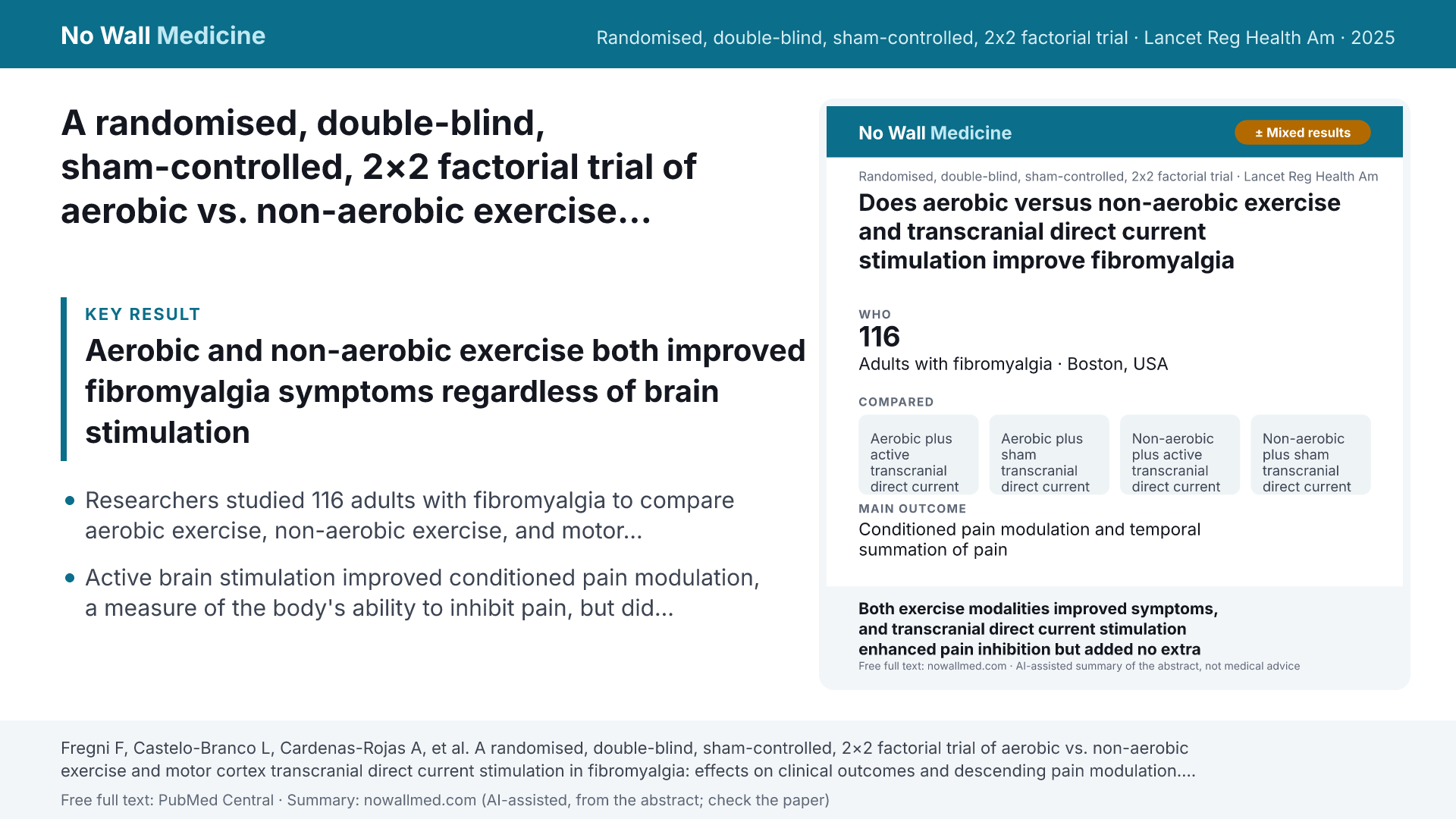
Key result: Aerobic and non-aerobic exercise both improved fibromyalgia symptoms regardless of brain stimulation
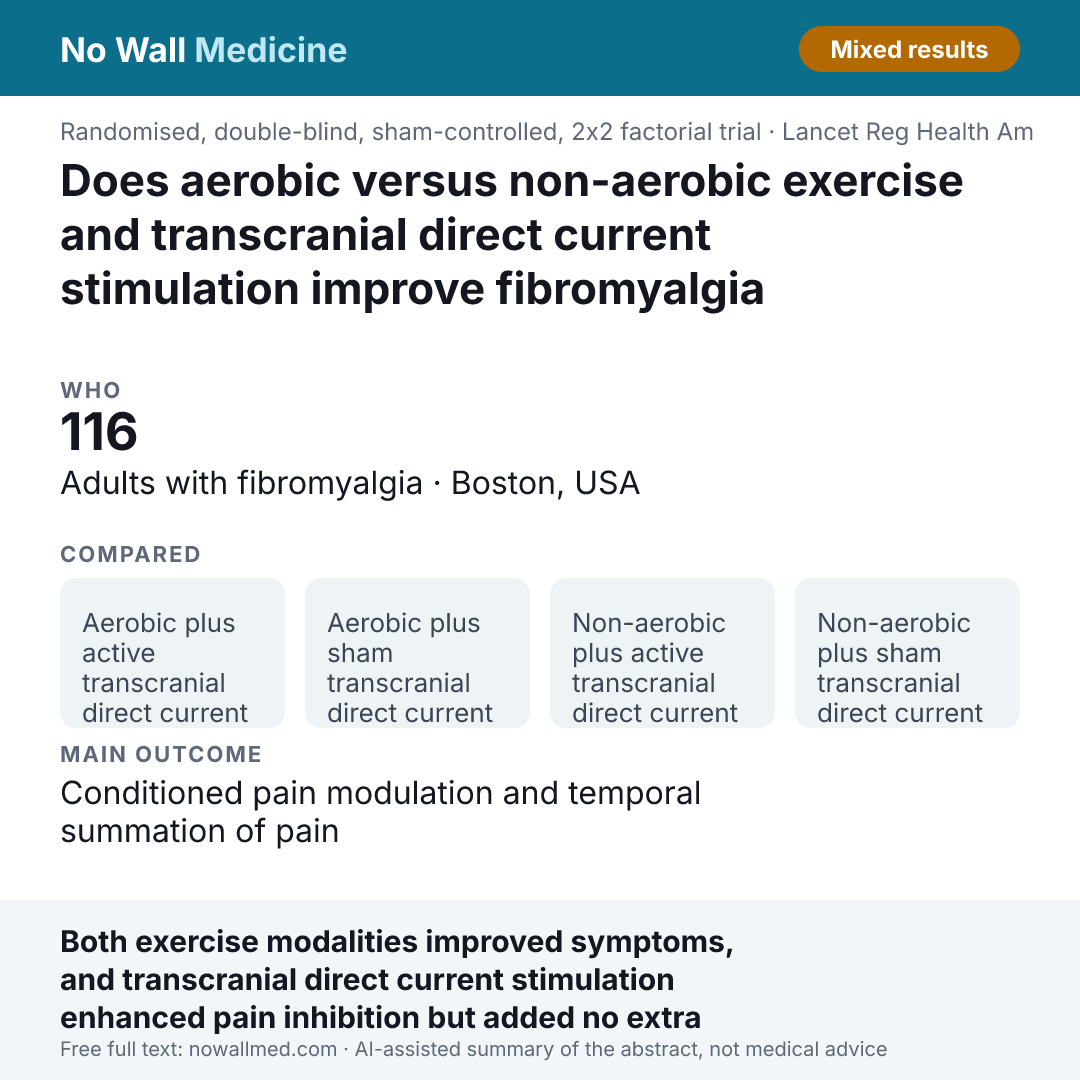
Randomised, double-blind, sham-controlled, 2x2 factorial trialMixed results
Does aerobic versus non-aerobic exercise and transcranial direct current stimulation improve fibromyalgia outcomes?
Who
116
Adults with fibromyalgia · Boston, USA
Compared
Aerobic plus active transcranial direct current stimulation
Aerobic plus sham transcranial direct current stimulation
Non-aerobic plus active transcranial direct current stimulation
Non-aerobic plus sham transcranial direct current stimulation
Main outcome
Conditioned pain modulation and temporal summation of pain
Result: Cohen's d = 0.66 (for CPM improvement with active tDCS)
Bottom line: Both exercise modalities improved symptoms, and transcranial direct current stimulation enhanced pain inhibition but added no extra clinical benefit.
Funded by: National Institutes of health
Lancet Reg Health Am · 2025-12-12 · Save PNG
Key points
- Researchers studied 116 adults with fibromyalgia to compare aerobic exercise, non-aerobic exercise, and motor cortex transcranial direct current stimulation, which is a type of brain stimulation.
- Active brain stimulation improved conditioned pain modulation, a measure of the body's ability to inhibit pain, but did not provide extra clinical benefits beyond exercise alone.
- All exercise groups showed moderate-to-large improvements in pain, fatigue, and quality of life, with aerobic and non-aerobic exercise producing comparable results.
Discussion prompts
- Would these patients look like yours? Who was left out?
- Is the main outcome one that matters to patients?
- Is the difference large enough to change what you do?
Cite: Fregni F, Castelo-Branco L, Cardenas-Rojas A, et al. A randomised, double-blind, sham-controlled, 2×2 factorial trial of aerobic vs. non-aerobic exercise and motor cortex transcranial direct current stimulation in fibromyalgia: effects on clinical outcomes and descending pain modulation. Lancet Reg Health Am. 2026;53:101314. doi:10.1016/j.lana.2025.101314
Free full text: PubMed Central · Summary and visual abstract: nowallmed.com/a/a-randomised-double-blind-sham-controlled-2-2-factorial-trial-of-1j3jsoi/ (AI-assisted from the abstract; check the paper before relying on it).