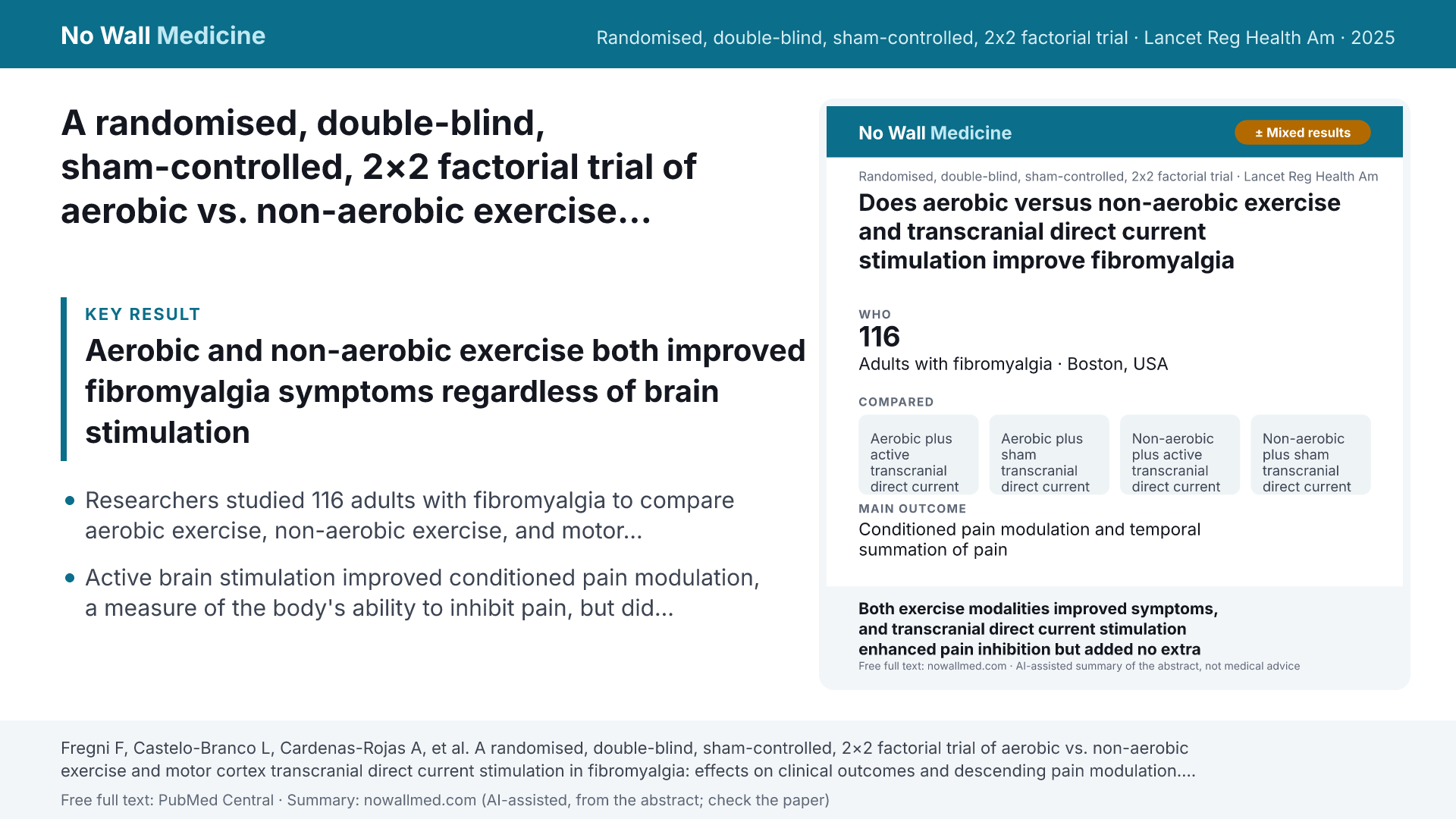
Aerobic and non-aerobic exercise both improved fibromyalgia symptoms regardless of brain stimulation
A randomised, double-blind, sham-controlled, 2×2 factorial trial of aerobic vs. non-aerobic exercise and motor cortex transcranial direct current stimulation in fibromyalgia: effects on clinical outcomes and descending pain modulation
Randomised, double-blind, sham-controlled, 2x2 factorial trialMixed results
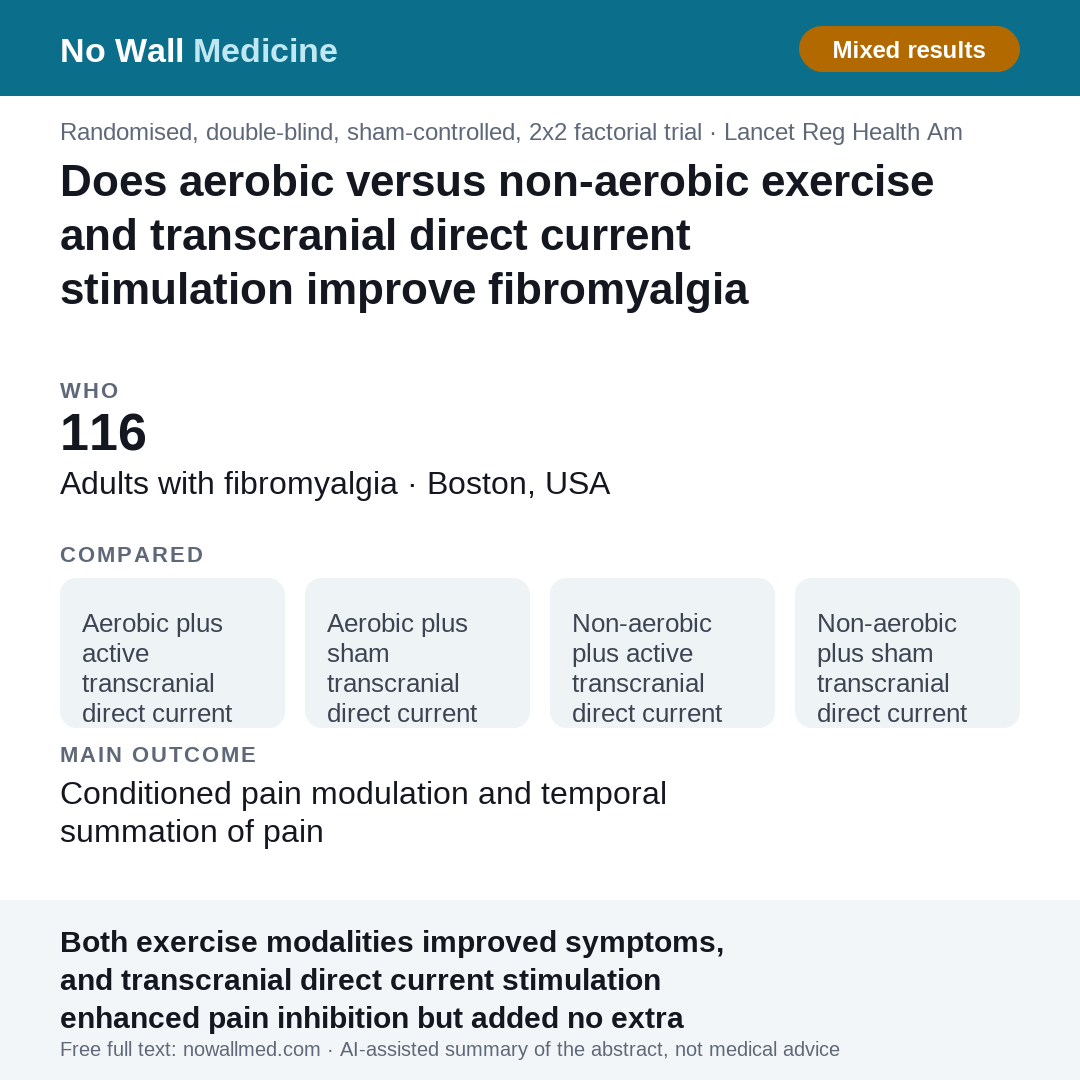
Does aerobic versus non-aerobic exercise and transcranial direct current stimulation improve fibromyalgia outcomes?
Who
116
Adults with fibromyalgia · Boston, USA
Compared
Aerobic plus active transcranial direct current stimulation
Aerobic plus sham transcranial direct current stimulation
Non-aerobic plus active transcranial direct current stimulation
Non-aerobic plus sham transcranial direct current stimulation
Main outcome
Conditioned pain modulation and temporal summation of pain
Result: Cohen's d = 0.66 (for CPM improvement with active tDCS)
Bottom line: Both exercise modalities improved symptoms, and transcranial direct current stimulation enhanced pain inhibition but added no extra clinical benefit.
Funded by: National Institutes of health
Lancet Reg Health Am · 2025-12-12Download image
Clinical question: Does aerobic versus non-aerobic exercise and transcranial direct current stimulation improve fibromyalgia outcomes?
Why it matters: It is uncertain whether aerobic exercise is superior to non-aerobic exercise for fibromyalgia and if brain stimulation can enhance the body's natural pain inhibition.
Key points
- Researchers studied 116 adults with fibromyalgia to compare aerobic exercise, non-aerobic exercise, and motor cortex transcranial direct current stimulation, which is a type of brain stimulation.
- Active brain stimulation improved conditioned pain modulation, a measure of the body's ability to inhibit pain, but did not provide extra clinical benefits beyond exercise alone.
- All exercise groups showed moderate-to-large improvements in pain, fatigue, and quality of life, with aerobic and non-aerobic exercise producing comparable results.
Headline and key points written with AI from the paper’s abstract, with every number checked against it. Read the paper before relying on them.
Was this summary helpful?
Cite this article
Fregni F, Castelo-Branco L, Cardenas-Rojas A, et al. A randomised, double-blind, sham-controlled, 2×2 factorial trial of aerobic vs. non-aerobic exercise and motor cortex transcranial direct current stimulation in fibromyalgia: effects on clinical outcomes and descending pain modulation. Lancet Reg Health Am. 2025. doi:10.1016/j.lana.2025.101314
Spotted a mistake? Suggest a correction