Emotional Freedom Techniques were associated with lower self-reported cognitive impairment in cancer survivors
A randomised wait-list controlled trial to evaluate Emotional Freedom Techniques for self-reported cancer-related cognitive impairment in cancer survivors (EMOTICON)
Randomised wait-list controlled trialBenefit found
Does Emotional Freedom Techniques reduce self-reported cancer-related cognitive impairment in cancer survivors?
Who
121
Cancer survivors aged 18 or older with self-reported cognitive impairment · Multicentre
Compared
40.8%Immediate treatment group
87.3%Wait-list control group
Main outcome
Proportion of patients with self-reported cancer-related cognitive impairment
Bottom line: Emotional Freedom Techniques significantly reduced the proportion of cancer survivors with self-reported cognitive impairment.
eClinicalMedicine · 2021-08-19 · Save PNG
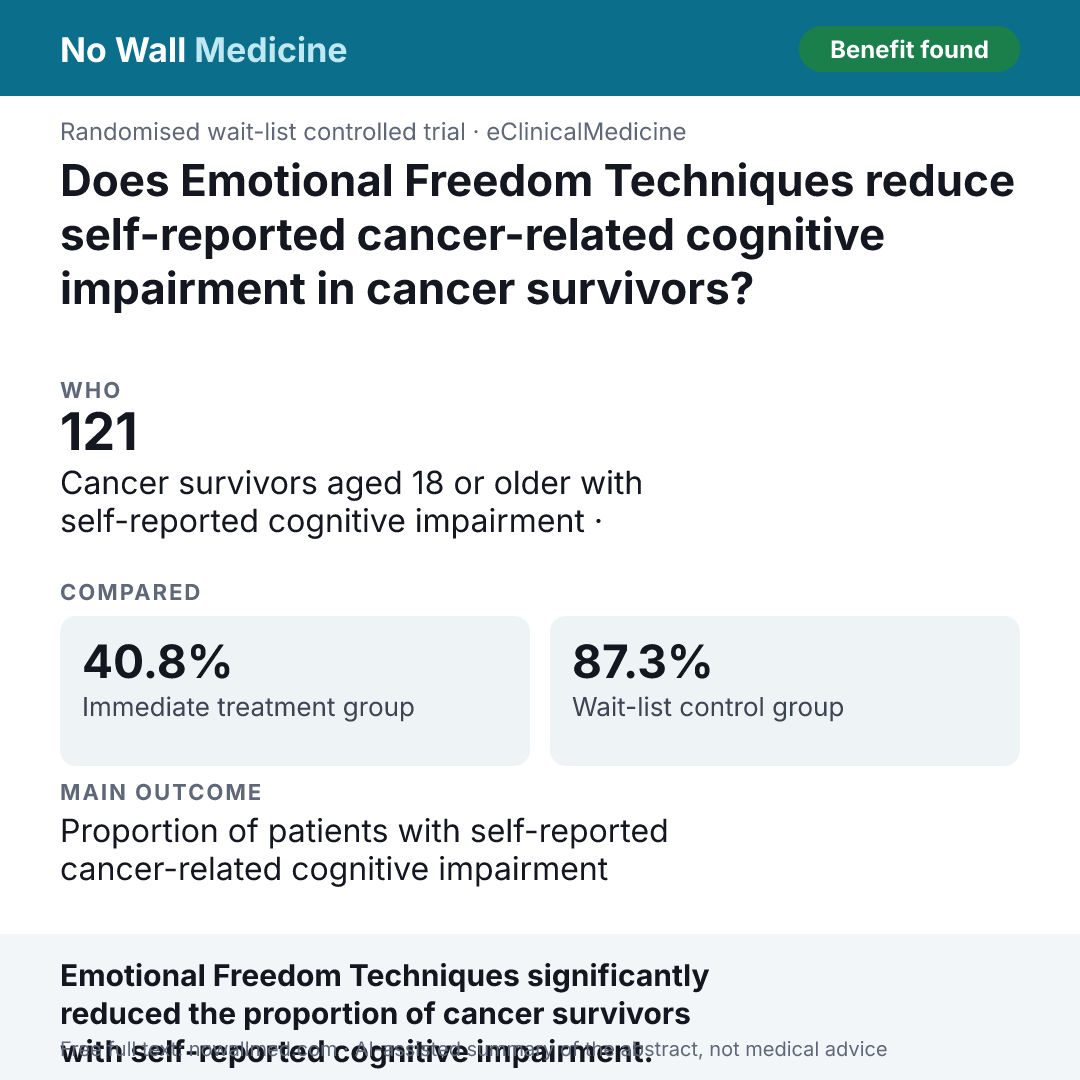
Clinical question: Does Emotional Freedom Techniques reduce self-reported cancer-related cognitive impairment in cancer survivors?
In absolute numbers
Immediate treatment group: 40.8% · Wait-list control group: 87.3% → a difference of 46.5 percentage points, so about 3 people would need the treatment for 1 more to benefit (number needed to treat) over the trial’s follow-up.
Worked out by us from the two group results above, not reported by the authors. Check the paper for the exact outcome and timing.
Key points
- Researchers conducted a randomized trial with 121 cancer survivors who reported cognitive impairment using the Cognitive Failures Questionnaire.
- At 8 weeks, the proportion of patients with cognitive impairment was 40.8% in the immediate treatment group compared to 87.3% in the wait-list group.
- The treatment was also associated with reductions in distress, depressive symptoms, and fatigue, as well as improved quality of life.
Headline and key points written with AI from the paper’s abstract, with every number checked against it. Read the paper before relying on them.
Was this summary helpful?
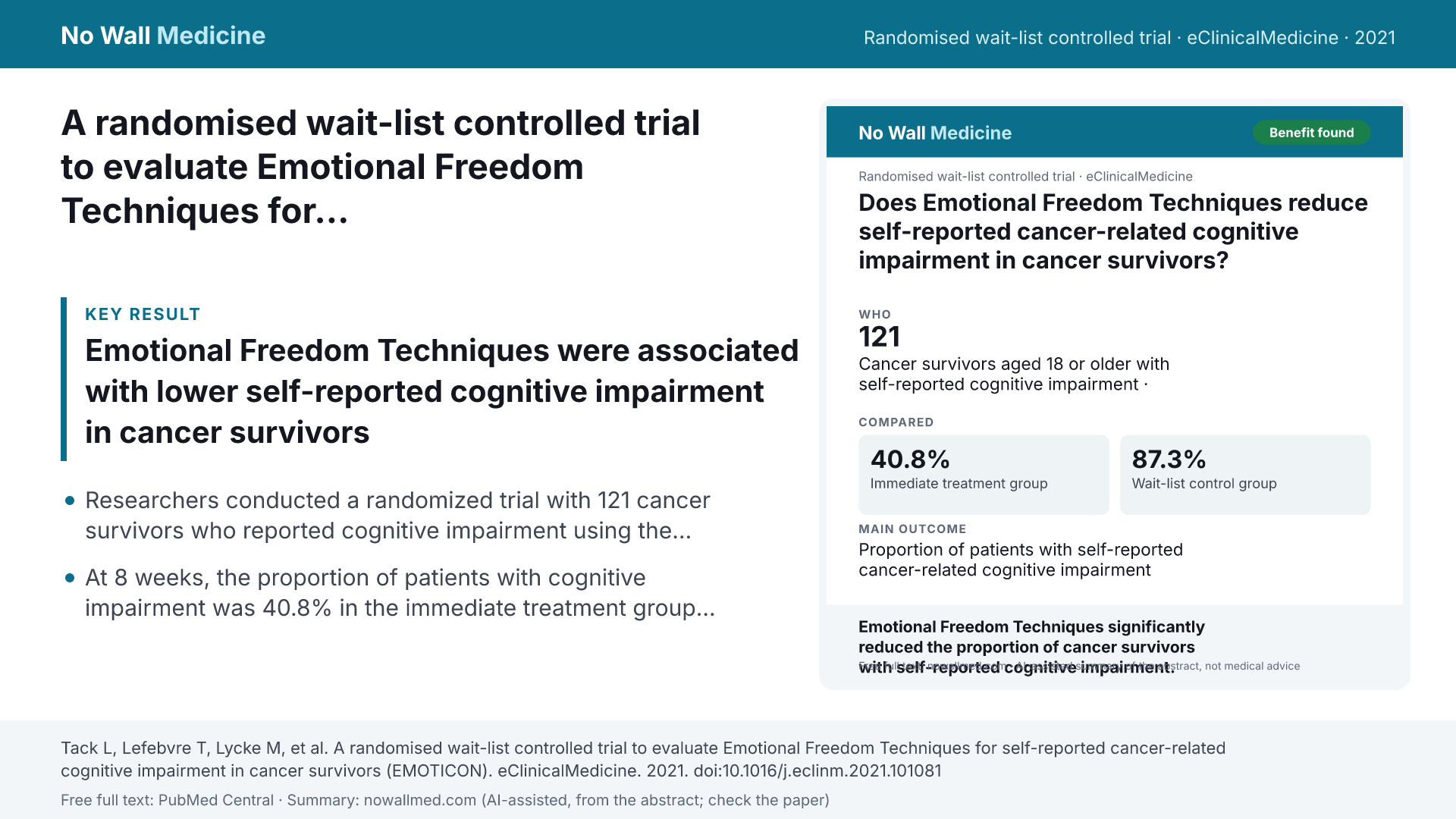
Headline, design, result, key points, caveat and citation as plain text.
Cite this article
Tack L, Lefebvre T, Lycke M, et al. A randomised wait-list controlled trial to evaluate Emotional Freedom Techniques for self-reported cancer-related cognitive impairment in cancer survivors (EMOTICON). eClinicalMedicine. 2021. doi:10.1016/j.eclinm.2021.101081
Spotted a mistake? Suggest a correction