A randomised wait-list controlled trial to evaluate Emotional Freedom Techniques for self-reported cancer-related cognitive impairment in cancer survivors (EMOTICON)
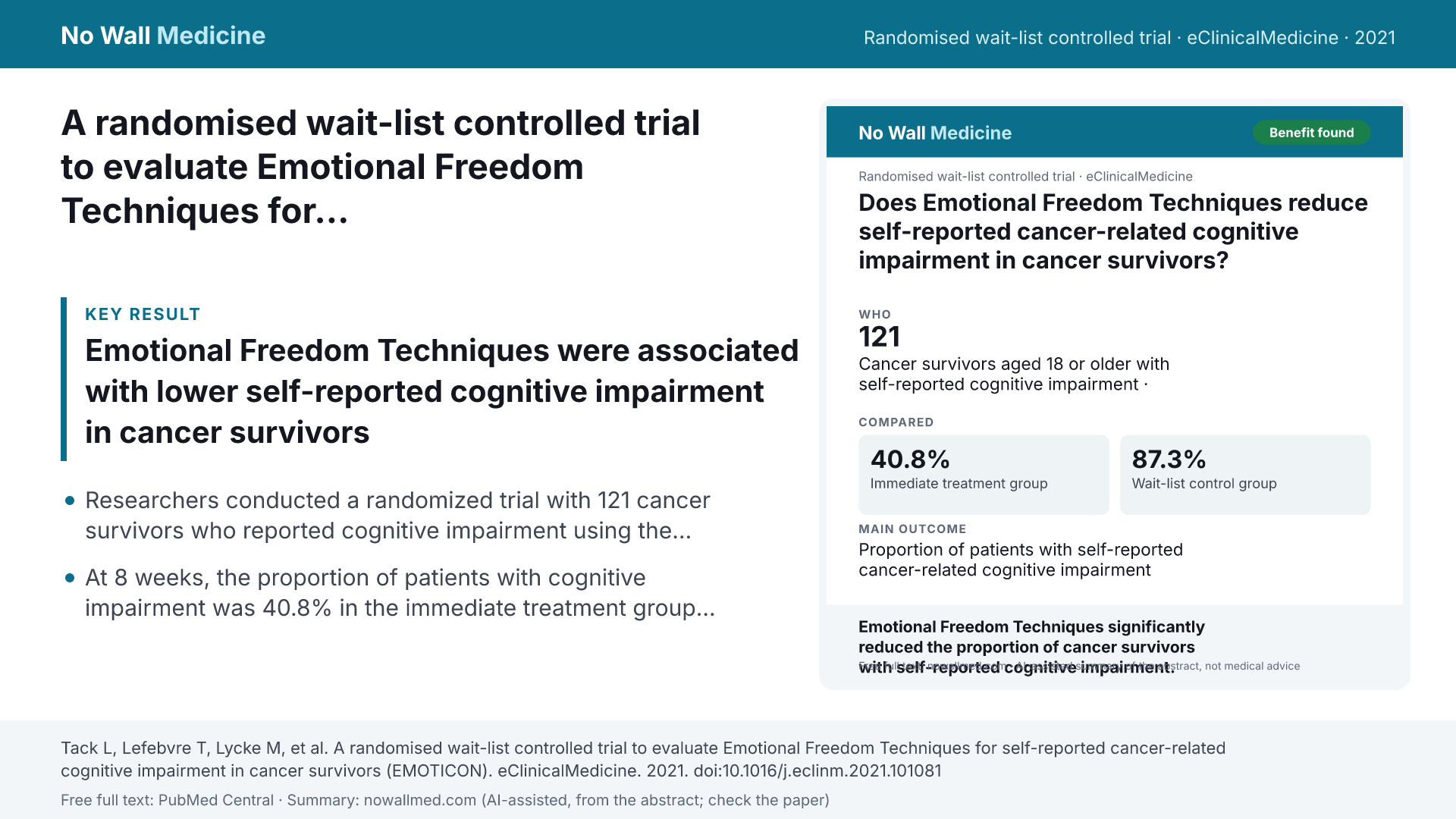
Key result: Emotional Freedom Techniques were associated with lower self-reported cognitive impairment in cancer survivors
Key points
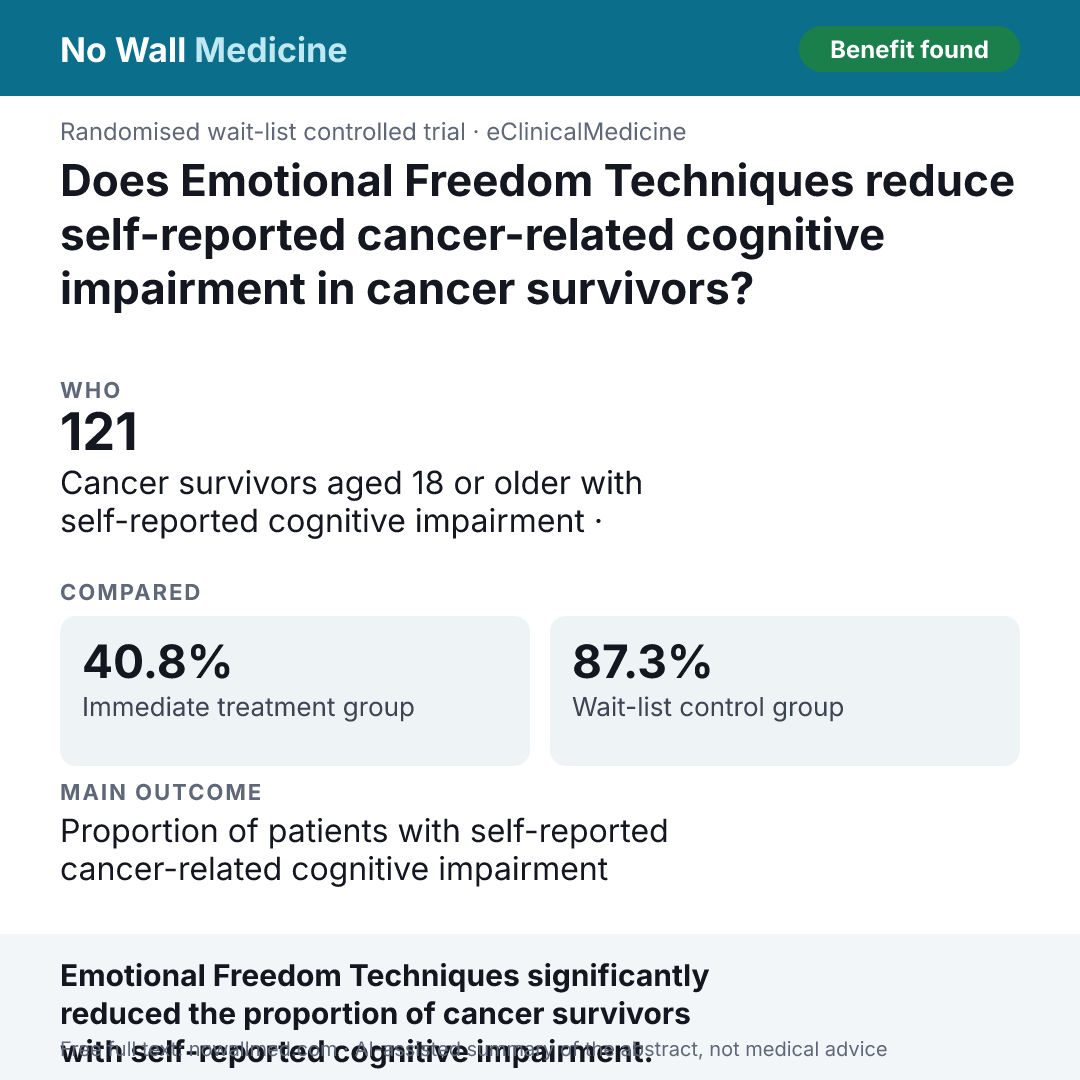
- Researchers conducted a randomized trial with 121 cancer survivors who reported cognitive impairment using the Cognitive Failures Questionnaire.
- At 8 weeks, the proportion of patients with cognitive impairment was 40.8% in the immediate treatment group compared to 87.3% in the wait-list group.
- The treatment was also associated with reductions in distress, depressive symptoms, and fatigue, as well as improved quality of life.
In absolute numbers: Immediate treatment group 40.8% vs Wait-list control group 87.3%, a difference of 46.5 percentage points (about 3 people treated for one more to benefit).
Discussion prompts
- Would these patients look like yours? Who was left out?
- Is the main outcome one that matters to patients?
- Is the difference large enough to change what you do?
Cite: Tack L, Lefebvre T, Lycke M, et al. A randomised wait-list controlled trial to evaluate Emotional Freedom Techniques for self-reported cancer-related cognitive impairment in cancer survivors (EMOTICON). eClinicalMedicine. 2021. doi:10.1016/j.eclinm.2021.101081
Free full text: PubMed Central · Summary and visual abstract: nowallmed.com/a/a-randomised-wait-list-controlled-trial-to-evaluate-emotional-freedom-zdd2e1/ (AI-assisted from the abstract; check the paper before relying on it).