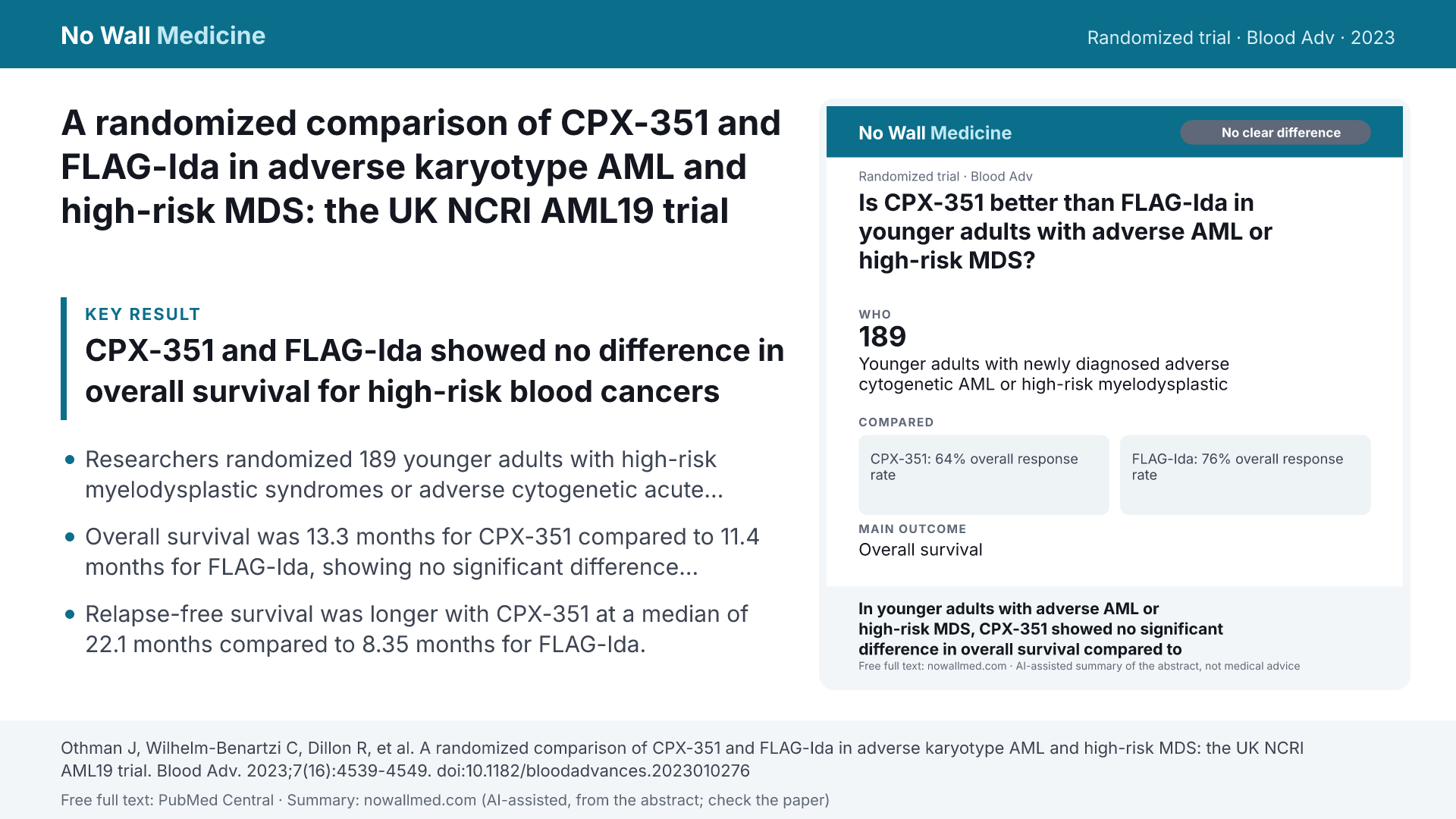
CPX-351 and FLAG-Ida showed no difference in overall survival for high-risk blood cancers
A randomized comparison of CPX-351 and FLAG-Ida in adverse karyotype AML and high-risk MDS: the UK NCRI AML19 trial
Randomized trialNo clear difference
Is CPX-351 better than FLAG-Ida in younger adults with adverse AML or high-risk MDS?
Who
189
Younger adults with newly diagnosed adverse cytogenetic AML or high-risk myelodysplastic syndromes
Compared
CPX-351: 64% overall response rate
FLAG-Ida: 76% overall response rate
Main outcome
Overall survival
Result: 13.3 months vs 11.4 months
Bottom line: In younger adults with adverse AML or high-risk MDS, CPX-351 showed no significant difference in overall survival compared to FLAG-Ida.
Blood Adv · 2023-05-12Download image
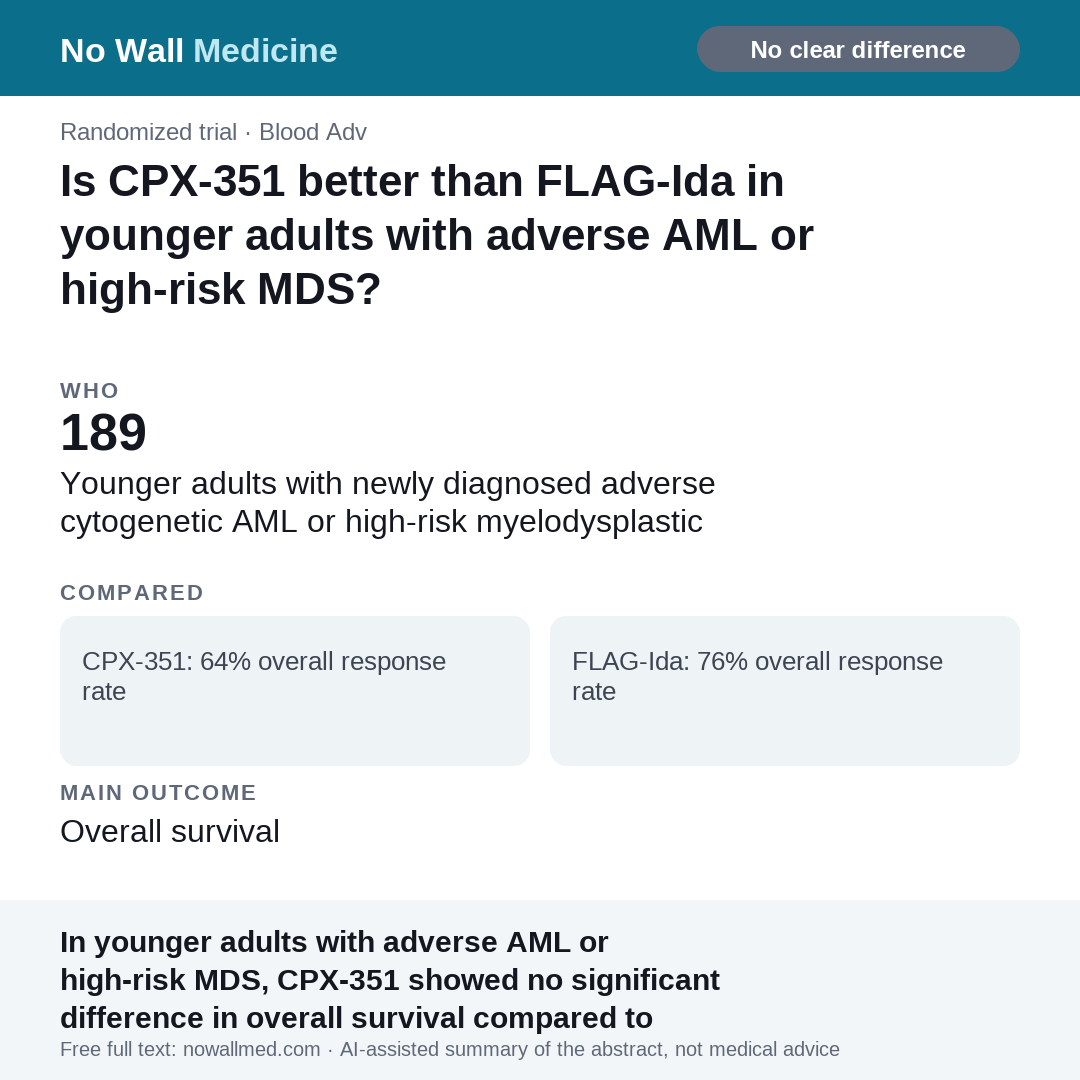
Clinical question: Is CPX-351 better than FLAG-Ida in younger adults with adverse AML or high-risk MDS?
Why it matters: It was unknown if CPX-351 provides better survival outcomes than FLAG-Ida chemotherapy for younger patients with high-risk myelodysplastic syndromes or adverse cytogenetic acute myeloid leukemia.
Key points
- Researchers randomized 189 younger adults with high-risk myelodysplastic syndromes or adverse cytogenetic acute myeloid leukemia to receive either CPX-351 or FLAG-Ida chemotherapy.
- Overall survival was 13.3 months for CPX-351 compared to 11.4 months for FLAG-Ida, showing no significant difference between the two treatments.
- Relapse-free survival was longer with CPX-351 at a median of 22.1 months compared to 8.35 months for FLAG-Ida.
Headline and key points written with AI from the paper’s abstract, with every number checked against it. Read the paper before relying on them.
Was this summary helpful?
Abstract
Liposomal daunorubicin and cytarabine (CPX-351) improved overall survival (OS) compared with 7+3 chemotherapy in older patients with secondary acute myeloid leukemia (AML); to date, there have been no randomized studies in younger patients. The high-risk cohort of the UK NCRI AML19 trial (ISRCTN78449203) compared CPX-351 with FLAG-Ida in younger adults with newly diagnosed adverse cytogenetic AML or high-risk myelodysplastic syndromes (MDS). A total of 189 patients were randomized (median age, 56 years). Per clinical criteria, 49% of patients had de novo AML, 20% had secondary AML, and 30% had high-risk MDS. MDS-related cytogenetics were present in 73% of the patients, with a complex karyotype in 49%. TP53 was the most common mutated gene, in 43%. Myelodysplasia-related gene mutations were present in 75 (44%) patients. The overall response rate (CR + CRi) after course 2 was 64% and 76% for CPX-351 and FLAG-Ida, respectively. There was no difference in OS (13.3 months vs 11.4 months) or event-free survival in multivariable analysis. However, relapse-free survival was significantly longer with CPX-351 (median 22.1 vs 8.35 months). There was no difference between the treatment arms in patients with clinically defined secondary AML or those with MDS-related cytogenetic abnormalities; however, an exploratory subgroup of patients with MDS-related gene mutations had significantly longer OS with CPX-351 (median 38.4 vs 16.3 months). In conclusion, the OS of younger patients with adverse risk AML/MDS was not significantly different between CPX-351 and FLAG-Ida.
Abstract reproduced under the article’s CC BY NC ND licence.
Subject terms
Cite this article
Othman J, Wilhelm-Benartzi C, Dillon R, Knapper S, Freeman SD, Batten LM. A randomized comparison of CPX-351 and FLAG-Ida in adverse karyotype AML and high-risk MDS: the UK NCRI AML19 trial. Blood Adv. 2023. doi:10.1182/bloodadvances.2023010276
Spotted a mistake? Suggest a correction