CPX-351 improves survival in patients with myelodysplasia-related acute myeloid leukemia but not others
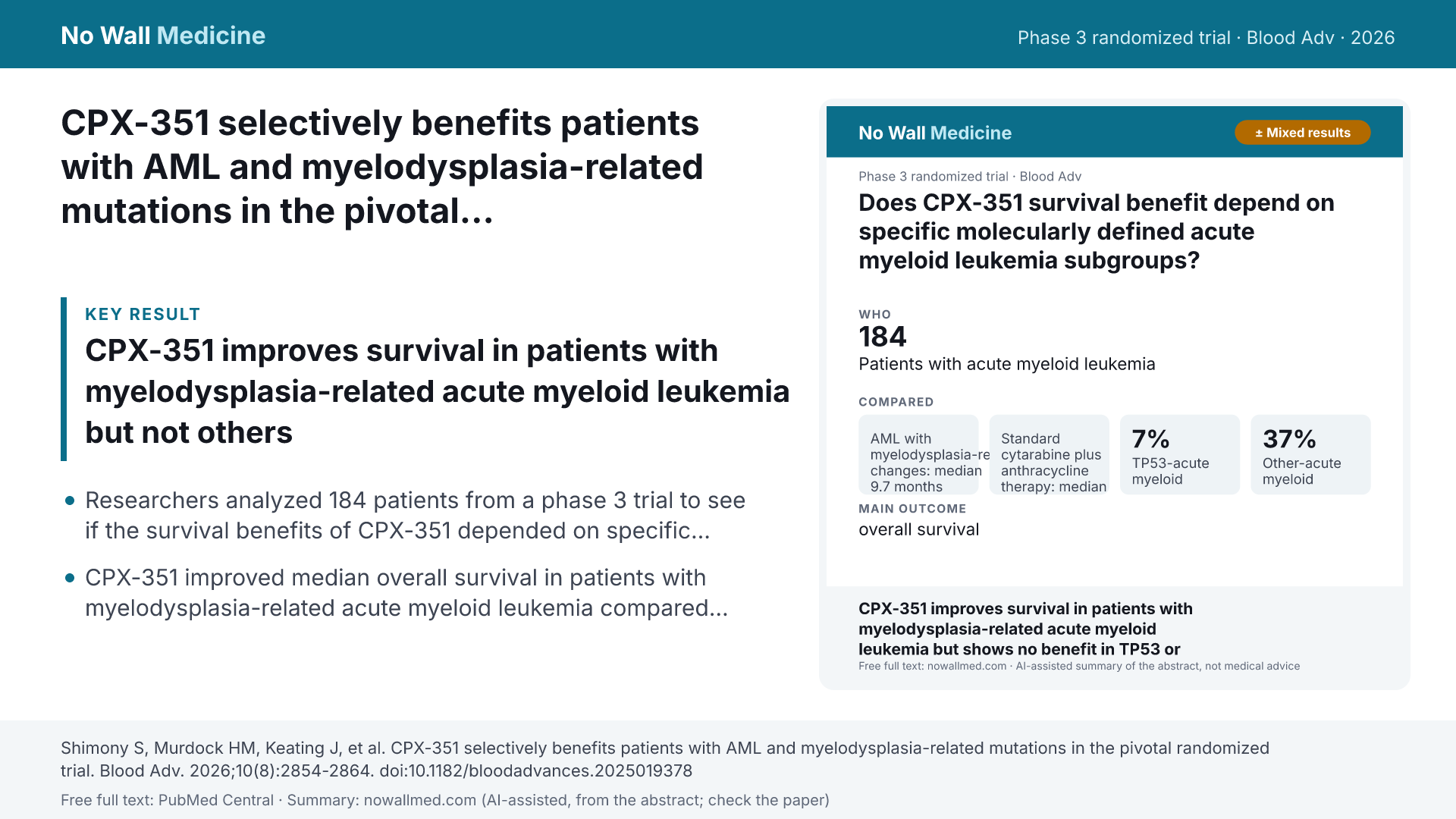
CPX-351 selectively benefits patients with AML and myelodysplasia-related mutations in the pivotal randomized trial
Phase 3 randomized trialMixed results
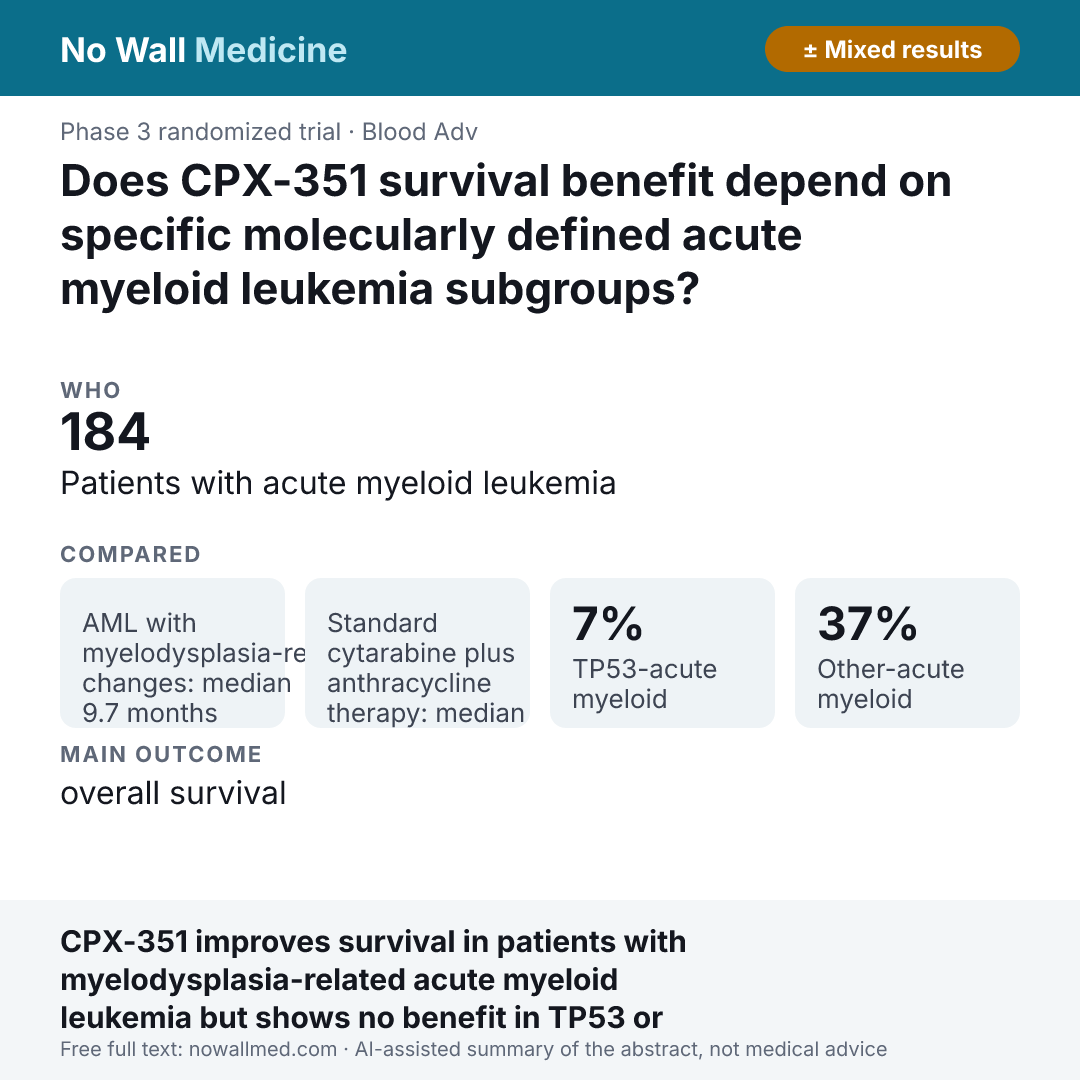
Does CPX-351 survival benefit depend on specific molecularly defined acute myeloid leukemia subgroups?
Who
184
Patients with acute myeloid leukemia
Compared
AML with myelodysplasia-related changes: median 9.7 months
Standard cytarabine plus anthracycline therapy: median 6.8 months
7%TP53-acute myeloid leukemia
37%Other-acute myeloid leukemia
Main outcome
overall survival
Bottom line: CPX-351 improves survival in patients with myelodysplasia-related acute myeloid leukemia but shows no benefit in TP53 or other subgroups.
Blood Adv · 2026-02-02 · Save PNG
Same trial (NCT01696084)
Papers we list that report this registered trial, oldest first. Read a secondary analysis alongside the main results.
- Secondary analysis Benefit found
CPX-351 improved survival in older adults with high-risk AML in remission Blood Adv 2021-03 - Secondary analysis Benefit found
CPX-351 provided higher quality-adjusted survival compared to standard chemotherapy in older adults with high-risk leukemia J Hematol Oncol 2021-07 - Secondary analysis Benefit found
CPX-351 showed higher remission and survival rates than standard chemotherapy in high-risk AML subgroups J Hematol Oncol 2022-10 - Main results Mixed results
This paper Blood Adv 2026-02
Clinical question: Does CPX-351 survival benefit depend on specific molecularly defined acute myeloid leukemia subgroups?
Key points
- Researchers analyzed 184 patients from a phase 3 trial to see if the survival benefits of CPX-351 depended on specific gene mutations.
- CPX-351 improved median overall survival in patients with myelodysplasia-related acute myeloid leukemia compared to standard chemotherapy, with 9.7 months versus 6.8 months.
- The treatment showed no survival benefit for patients with TP53-mutated acute myeloid leukemia or the other-acute myeloid leukemia subgroup.
Headline and key points written with AI from the paper’s abstract, with every number checked against it. Read the paper before relying on them.
Was this summary helpful?
Abstract
CPX-351 was approved for the treatment of acute myeloid leukemia (AML) using now-outdated definitions of AML with myelodysplasia-related changes (AML-MRC) and therapy-related AML. We evaluated whether the overall survival (OS) benefit of CPX-351 over standard cytarabine plus anthracycline (7+3) therapy is confined to molecularly defined AML subgroups by performing DNA sequencing in 184 patients enrolled in the pivotal phase 3 randomized trial. Patients were categorized hierarchically based on gene mutations: (1) TP53-AML, (2) DDX41-AML, (3) myelodysplasia-related AML (AML-MR) defined by the World Health Organization fifth edition criteria, or (4) other-AML. TP53-AML was subclassified as single (TP53single) or multihit (TP53multi) based on the number of alleles altered via mutation, deletion, or copy neutral loss of heterozygosity. Two-year OS differed significantly across molecular subgroups: TP53-AML (7%), AML-MR (19%), other-AML (37%), and DDX41-AML (70%) (P< .001). CPX-351 improved survival in patients with AML-MR compared with 7+3 (median, 9.7 vs 6.8 months; P = .037), with no benefit in TP53-AML or other-AML. For patients undergoing transplantation, CPX-351 improved 2-year survival (76% vs 27%; P< .01), an effect primarily observed in AML-MR. Multivariable analysis confirmed the independent association with survival of both CPX-351 and hematopoietic cell transplantation in AML-MR. TP53multi demonstrated significantly worse survival than TP53single (median, 3.8 vs 7.0 months; P = .004). The OS benefit of CPX-351 observed in the trial was driven by AML-MR with no benefit of CPX-351 in TP53-AML, in which the primary prognostic factor was allelic state. This trial was registered at www.clinicaltrials.gov as #NCT01696084.
Abstract reproduced under the article’s CC BY NC ND licence.
Subject terms
Headline, design, result, key points, caveat and citation as plain text.
Cite this article
Shimony S, Murdock HM, Keating J, et al. CPX-351 selectively benefits patients with AML and myelodysplasia-related mutations in the pivotal randomized trial. Blood Adv. 2026;10(8):2854-2864. doi:10.1182/bloodadvances.2025019378
Spotted a mistake? Suggest a correction