A Randomized Controlled Trial Comparing a Patella-Stabilizing, Motion-Restricting Knee Brace Versus a Neoprene Nonhinged Knee Brace After a First-Time Traumatic Patellar Dislocation
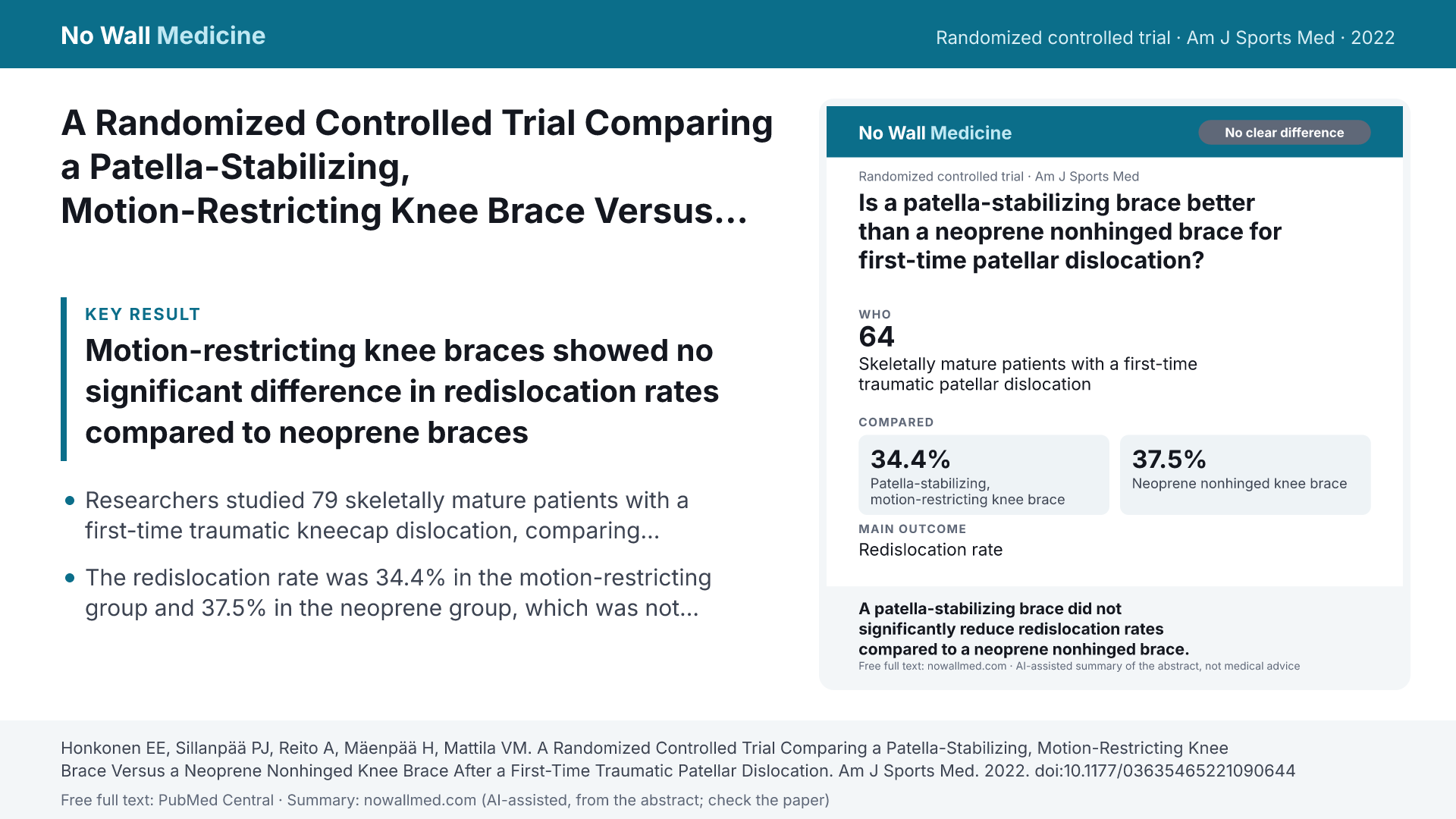
Key result: Motion-restricting knee braces showed no significant difference in redislocation rates compared to neoprene braces
Key points
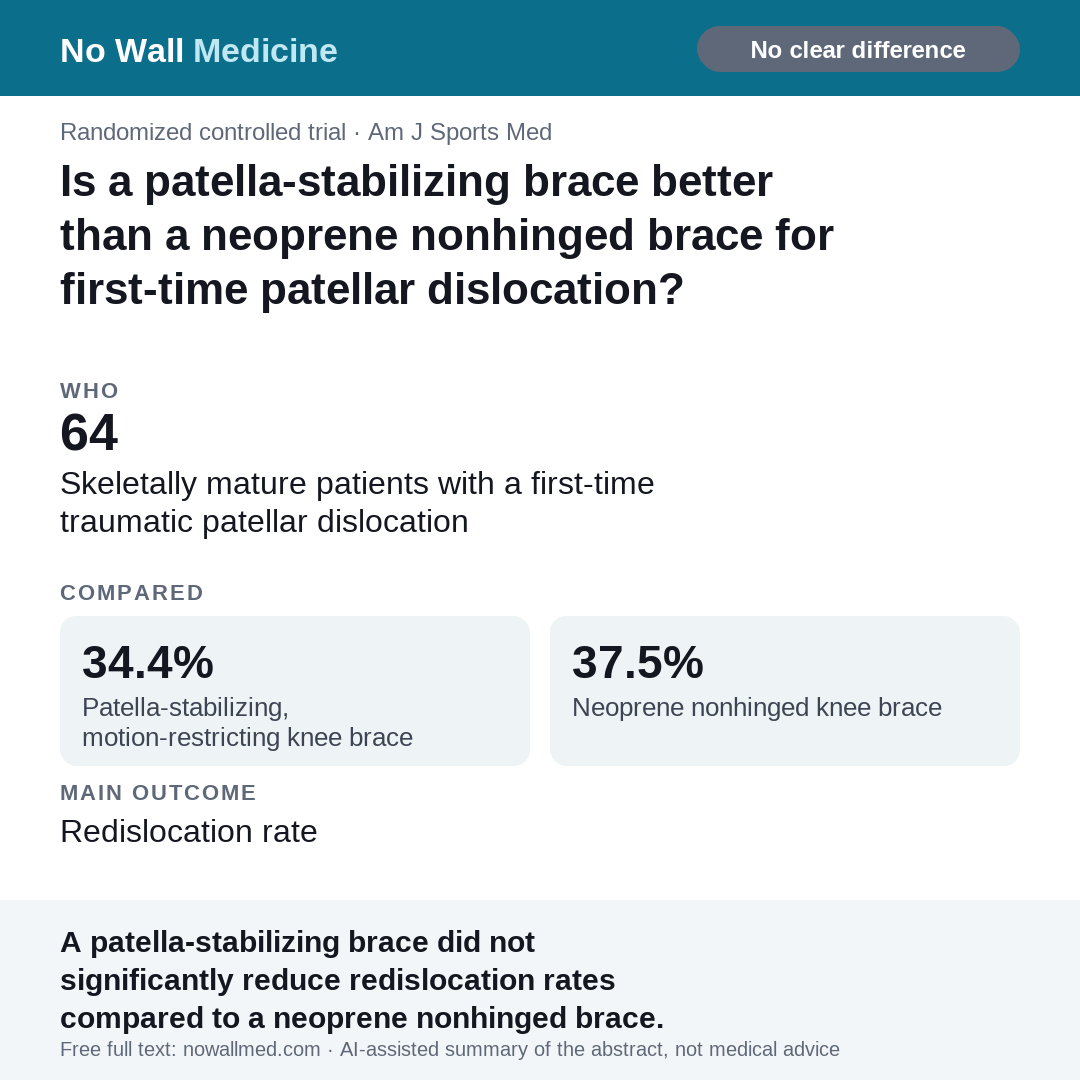
- Researchers studied 79 skeletally mature patients with a first-time traumatic kneecap dislocation, comparing a motion-restricting brace to a neoprene nonhinged brace.
- The redislocation rate was 34.4% in the motion-restricting group and 37.5% in the neoprene group, which was not a statistically significant difference.
- Patients using the motion-restricting brace had less knee range of motion and more quadriceps muscle wasting at 4 weeks and 3 months.
Why it matters: It is unknown which type of knee brace is most effective for nonoperative treatment after a first-time traumatic patellar dislocation.
Discussion prompts
- Would these patients look like yours? Who was left out?
- Is the main outcome one that matters to patients?
- Is the difference large enough to change what you do?
Cite: Honkonen EE, Sillanpää PJ, Reito A, Mäenpää H, Mattila VM. A Randomized Controlled Trial Comparing a Patella-Stabilizing, Motion-Restricting Knee Brace Versus a Neoprene Nonhinged Knee Brace After a First-Time Traumatic Patellar Dislocation. Am J Sports Med. 2022. doi:10.1177/03635465221090644
Free full text: PubMed Central · Summary and visual abstract: nowallmed.com/a/a-randomized-controlled-trial-comparing-a-patella-stabilizing-motion-1y5a05h/ (AI-assisted from the abstract; check the paper before relying on it).