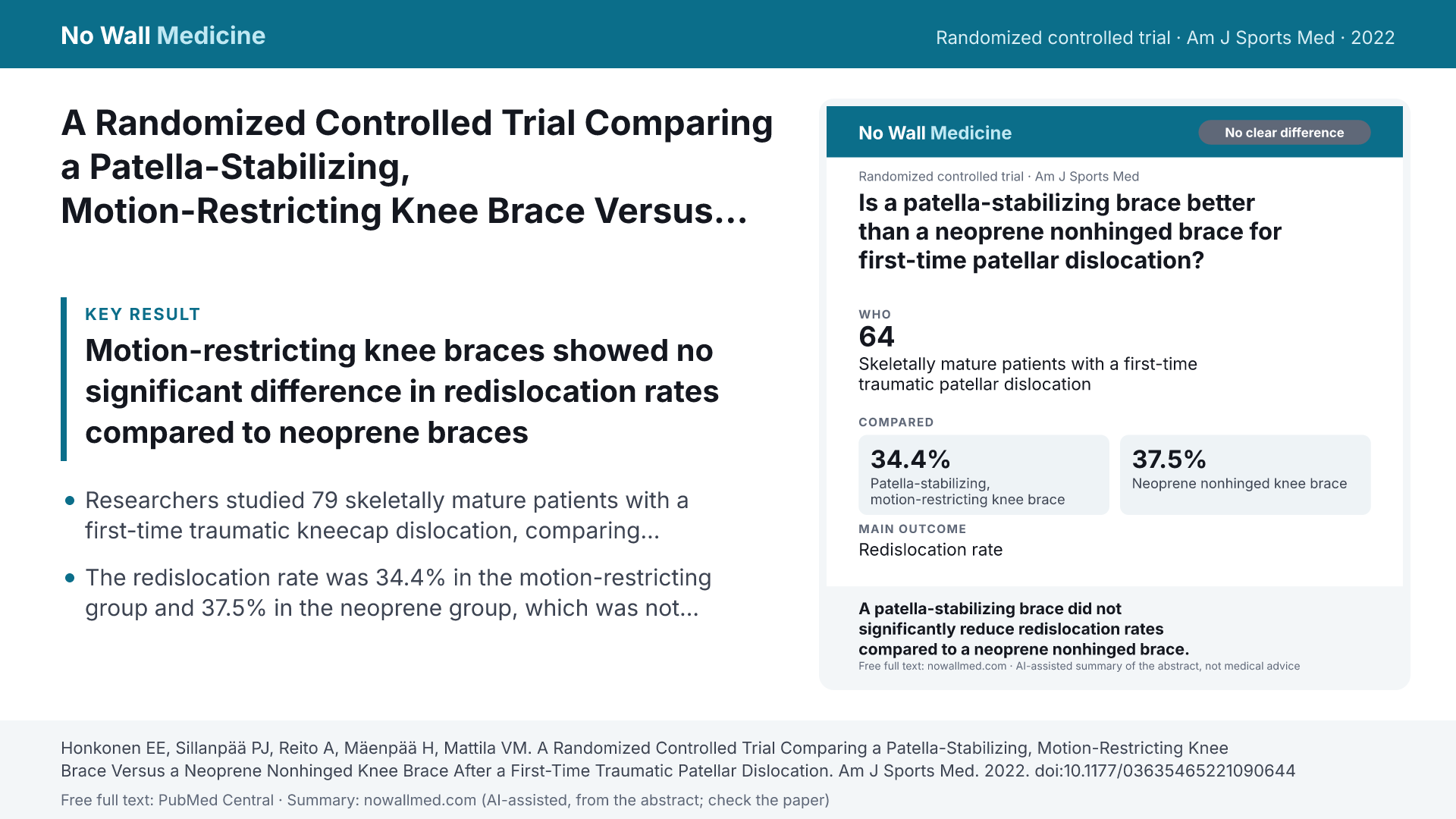
Motion-restricting knee braces showed no significant difference in redislocation rates compared to neoprene braces
A Randomized Controlled Trial Comparing a Patella-Stabilizing, Motion-Restricting Knee Brace Versus a Neoprene Nonhinged Knee Brace After a First-Time Traumatic Patellar Dislocation
Randomized controlled trialNo clear difference
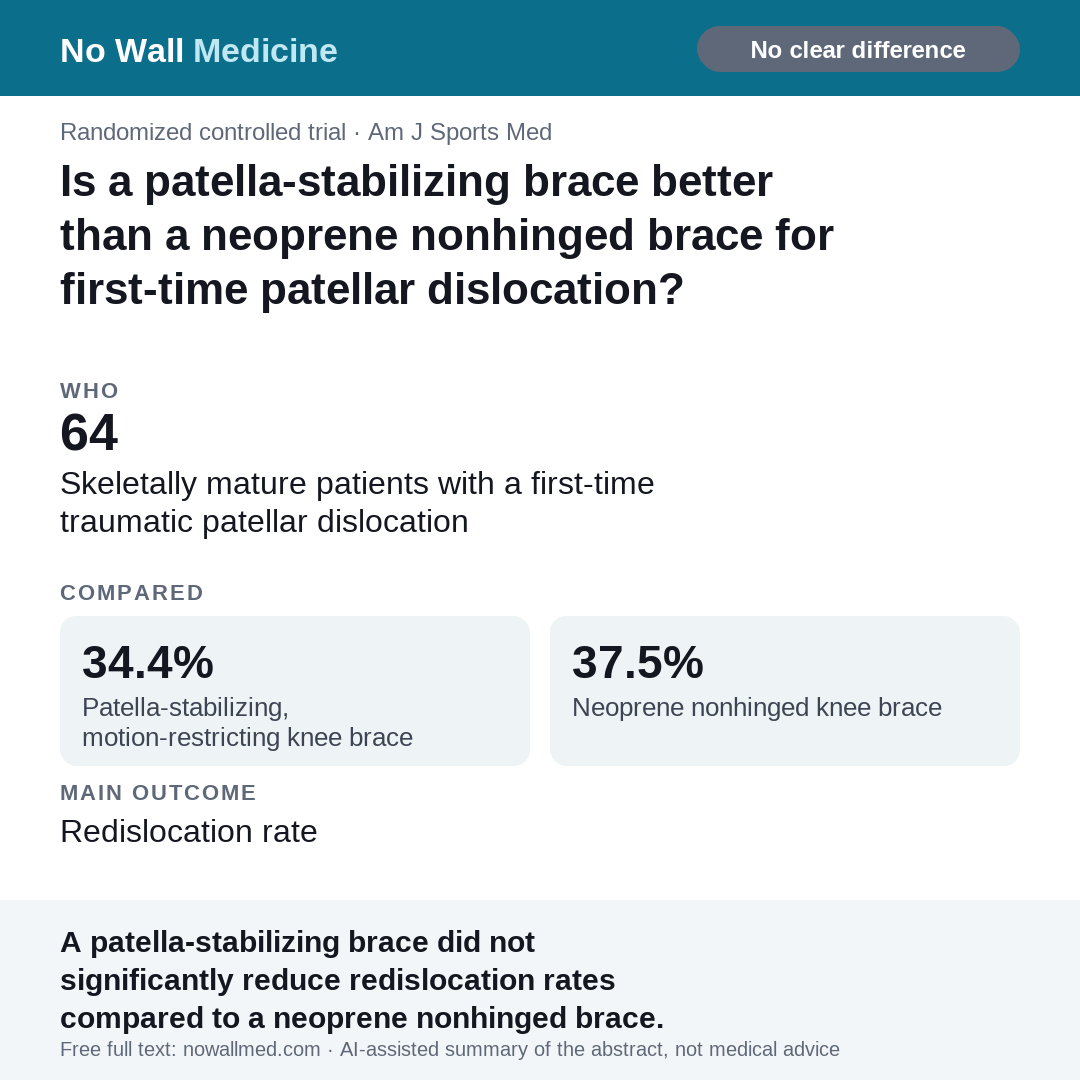
Is a patella-stabilizing brace better than a neoprene nonhinged brace for first-time patellar dislocation?
Who
64
Skeletally mature patients with a first-time traumatic patellar dislocation
Compared
34.4%Patella-stabilizing, motion-restricting knee brace (11/32)
37.5%Neoprene nonhinged knee brace (12/32)
Main outcome
Redislocation rate
Result: risk difference, -3.1% (95% CI, -26.6% to 20.3%)
Bottom line: A patella-stabilizing brace did not significantly reduce redislocation rates compared to a neoprene nonhinged brace.
Am J Sports Med · 2022-04-19Download image
Clinical question: Is a patella-stabilizing brace better than a neoprene nonhinged brace for first-time patellar dislocation?
Why it matters: It is unknown which type of knee brace is most effective for nonoperative treatment after a first-time traumatic patellar dislocation.
Key points
- Researchers studied 79 skeletally mature patients with a first-time traumatic kneecap dislocation, comparing a motion-restricting brace to a neoprene nonhinged brace.
- The redislocation rate was 34.4% in the motion-restricting group and 37.5% in the neoprene group, which was not a statistically significant difference.
- Patients using the motion-restricting brace had less knee range of motion and more quadriceps muscle wasting at 4 weeks and 3 months.
Headline and key points written with AI from the paper’s abstract, with every number checked against it. Read the paper before relying on them.
Was this summary helpful?
Subject terms
Cite this article
Honkonen EE, Sillanpää PJ, Reito A, Mäenpää H, Mattila VM. A Randomized Controlled Trial Comparing a Patella-Stabilizing, Motion-Restricting Knee Brace Versus a Neoprene Nonhinged Knee Brace After a First-Time Traumatic Patellar Dislocation. Am J Sports Med. 2022. doi:10.1177/03635465221090644
Spotted a mistake? Suggest a correction